Welcome to my blog. I live, knit, crochet, spin and craft near the Northumbrian Coast (but not too near – the waves won't be splashing my yarn!).There's a story in every stitch, every grain of sand, every blade of grass. I thought I'd blog about it…
A few weeks ago, we headed up to Spittal, which is at the mouth of the River Tweed, on the south side of the river (South of Berwick-on-Tweed). We had gone there in search of Bottle-Nosed Dolphins as they had been been seen there on most days during the early summer. There were no dolphins to be seen, but I ended up watching three people doing an extreme sport I’d never come across before.
I’ve since discovered on the internet that these are kite buggies, vehicles, usually with 3 wheels, propelled by the wind using a power kite and steered with the feet.. It looks rather like a cross between sand yachting and kite surfing. I’ve seen the kite surfers at Bamburgh many times and that looks pretty spectacular, but this was something new for round here.
The big beach at Spittal was pretty quiet (even though the car park was busy), so they had plenty of space. I’m not sure how easy it is to control speed and direction!
There was a bit of a breeze, so they were zipping along pretty quickly. I suppose one of the advantages is that you don’t need to have quite such a good sense of balance as you would with kite surfing.
Last month Alnwick Garden invited bloggers to attend one of two days as part of their “Bloggers Week”. It was scaled down somewhat from the original event, but COVID – 19 had put paid to that. I was pleased that it had been rescheduled and it was nice to get a treat, so I booked my free ticket. I’ve been many times previously and used to have a members pass. I stopped that after they started a special offer which gave you entry for the year on a single admission ticket and haven’t been since, until this recent visit. It was also one of my first trips out to a public place since lockdown – it was going to be interesting to see what measures had been put in place and also how I felt about being in a busy location.
If you decide to visit, I strongly advise you to check the Alnwick Gardens website beforehand to check if advance booking is required and if there are any restrictions on opening hours or the facilities available. Everywhere is subject to quite rapidly changing guidelines in these difficult times.
As a disabled visitor I was able to show my blue badge use the designated forward parking area by the entrance. I had brought my own disability scooter, because the gardens own scooters and wheelchairs were not available for visitor use. A one- way system was in use to facilitate social distancing. which included a couple of small kerb bumps that in other circumstances I would have tried to avoid with the scooter, but they were not too bad and I got over them ok. As we approached the pavilion area it did seem more crowded, which did make me feel uneasy – Social distancing was just about manageable but I was still reaching for my mask! I think that this was mainly because the cafe was not open at the time, so more people were milling about – a couple of stalls were serving refreshments along the walkway to the left of the pavilion which seemed to add to the congestion. There were plenty of hand sanitiser points around.
The first sight of the cascade as you come through the pavilion courtyard remains as spectacular as ever. At regular intervals an additional sequence of fountains plays out, which is lovely to watch. Part of this is accompanied by the delighted shrieks of children trying to dodge the jets of water that shoot over the walkway in the centre of the cascade
The central cascade is flanked by hornbeam tunnels which have matured beautifully.
The one way system in the garden itself was not so easy to follow, especially when I’m used to following the easiest paths for the scooter . Most parts of the garden are reachable by scooter, with fairly gentle ramped paths throughout. Because of this we somehow bypassed the area of the garden which has a series of water features hidden from the rest of the garden by hedges.
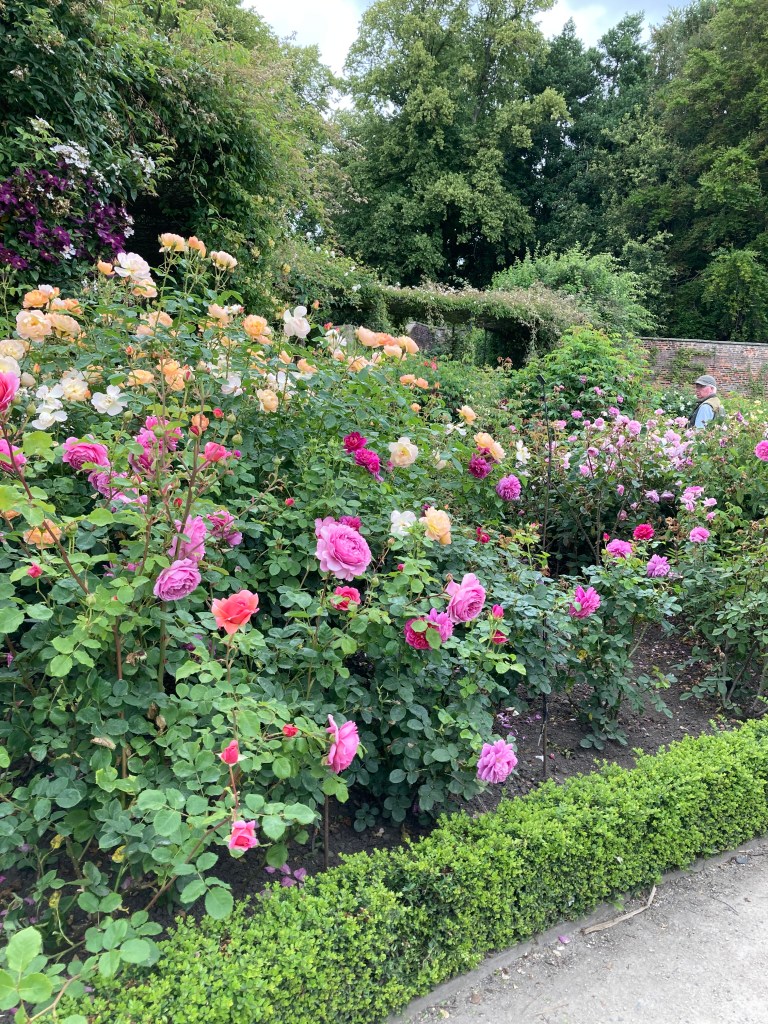
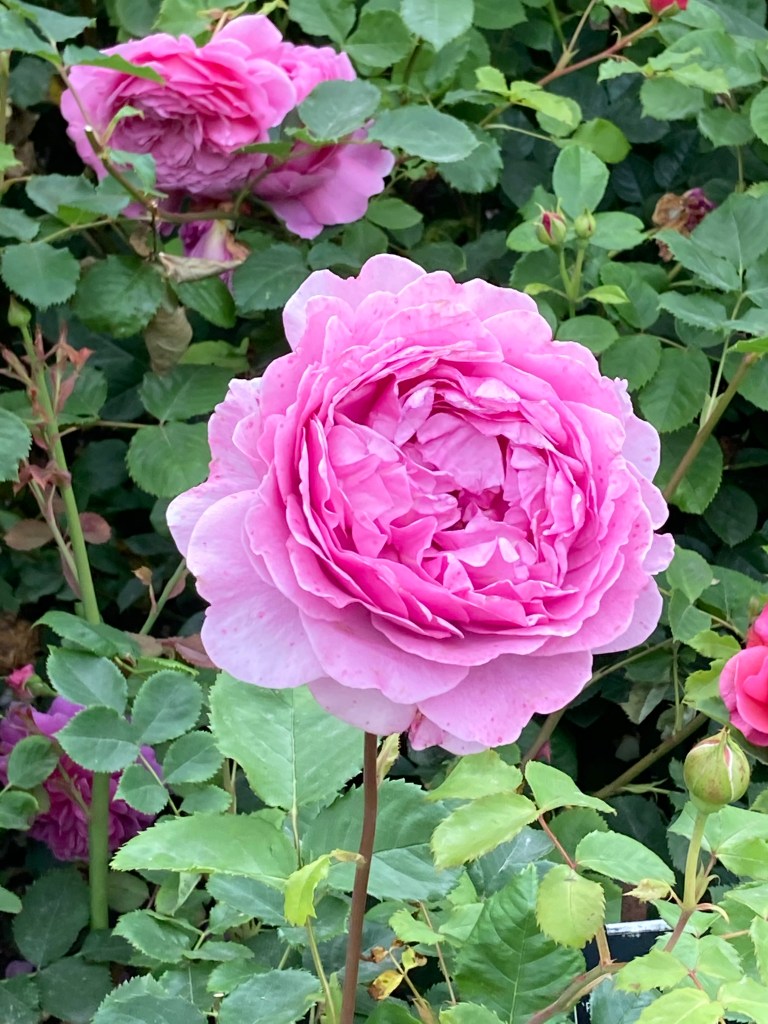
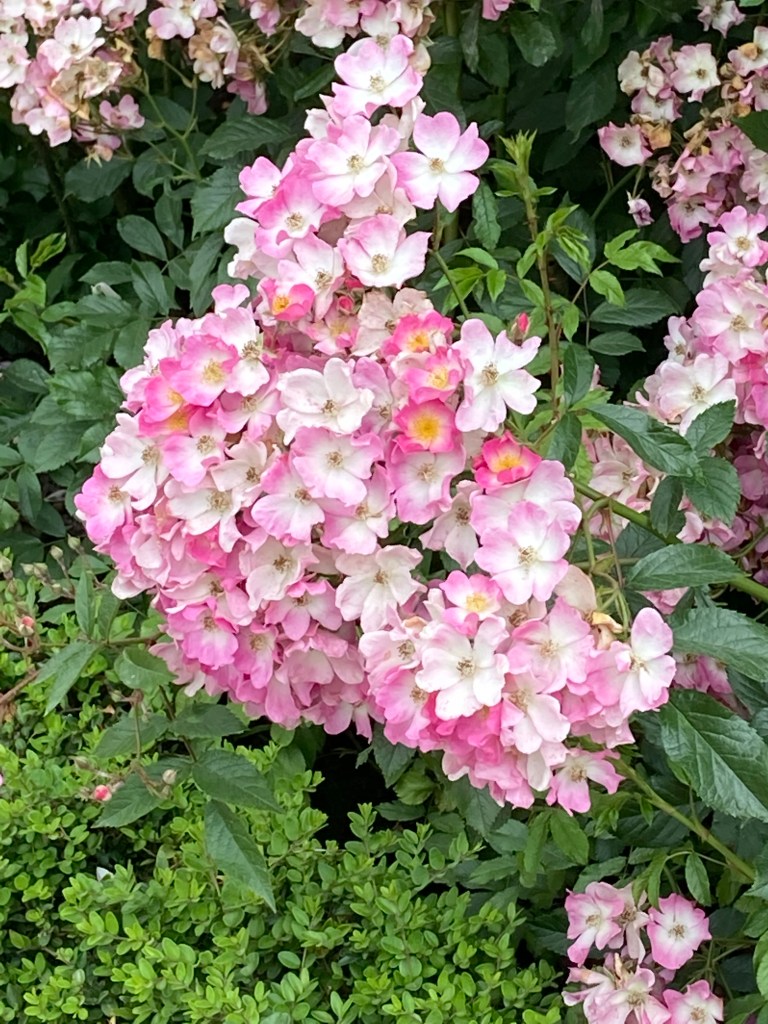
July is my favourite time to visit when the Rose Garden is at its best. The scent is intoxicating. Out of interest I checked if I could still smell the roses with one my homemade masks on – I could not, so that’s an interesting test of their efficiency!. Until you visit a place like this it’s hard to imagine what variation in fragrance there is between different roses. Some are quite spicy, others have citrus notes. There are a stunning variety of different colours and forms too, from massive many-petalled blooms to sprays of tiny single flowers.
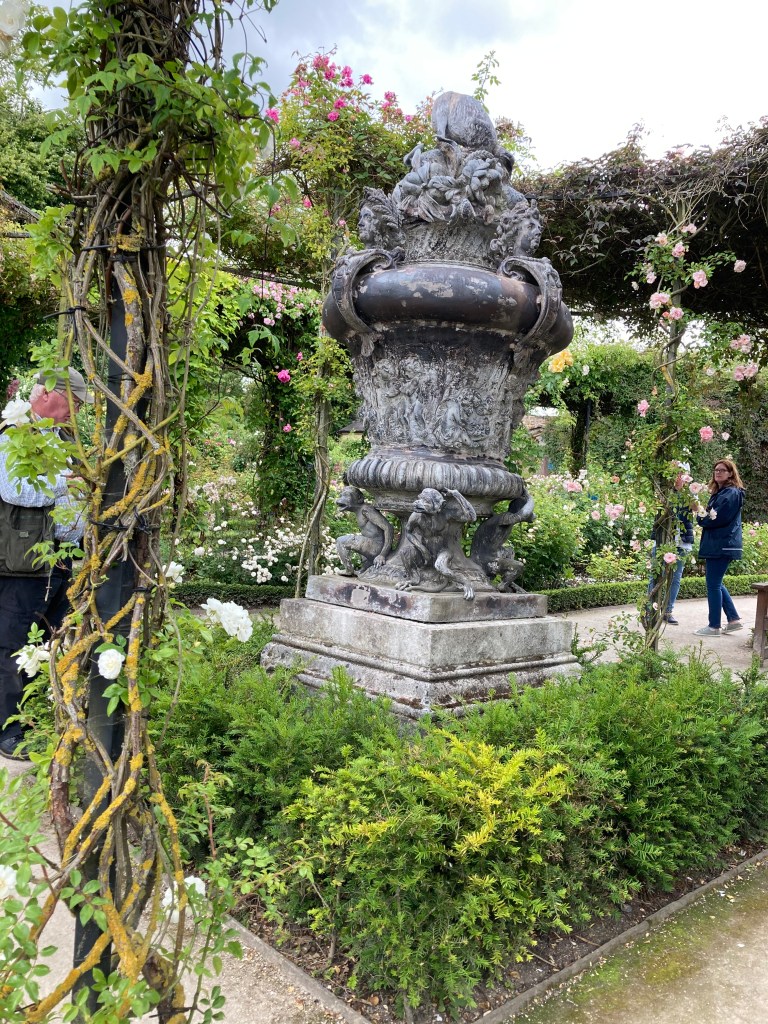
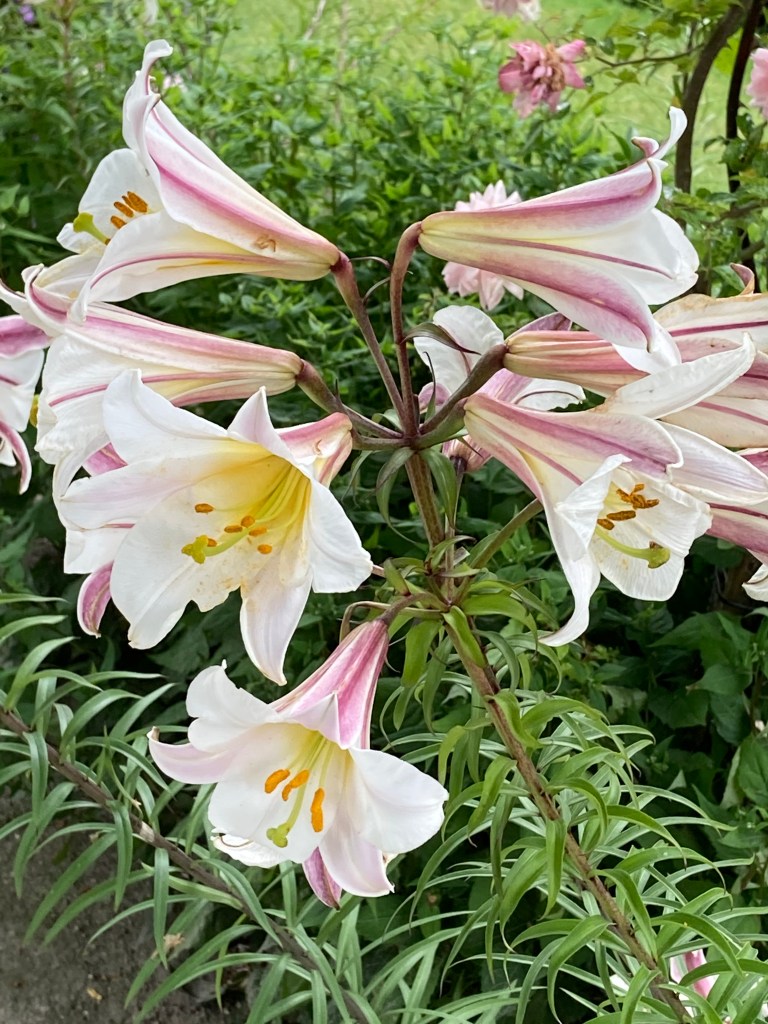
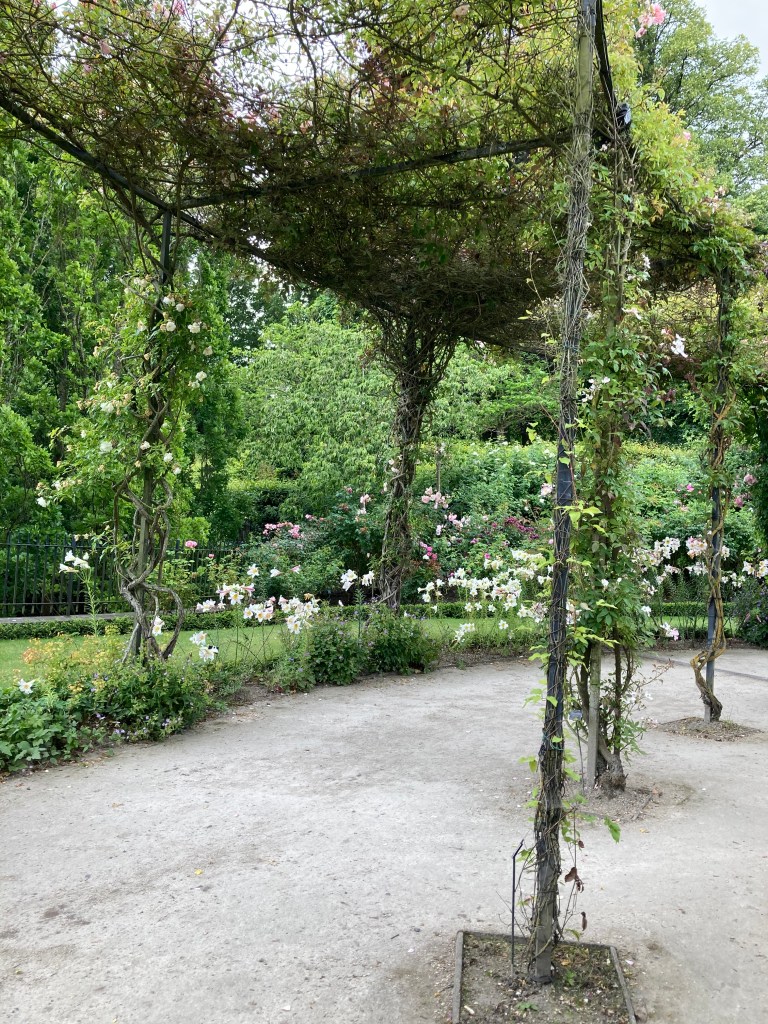
At the centre of the rose garden is a pergola covered in climbing roses and clematis, with an ornate urn. There are lilies here too.
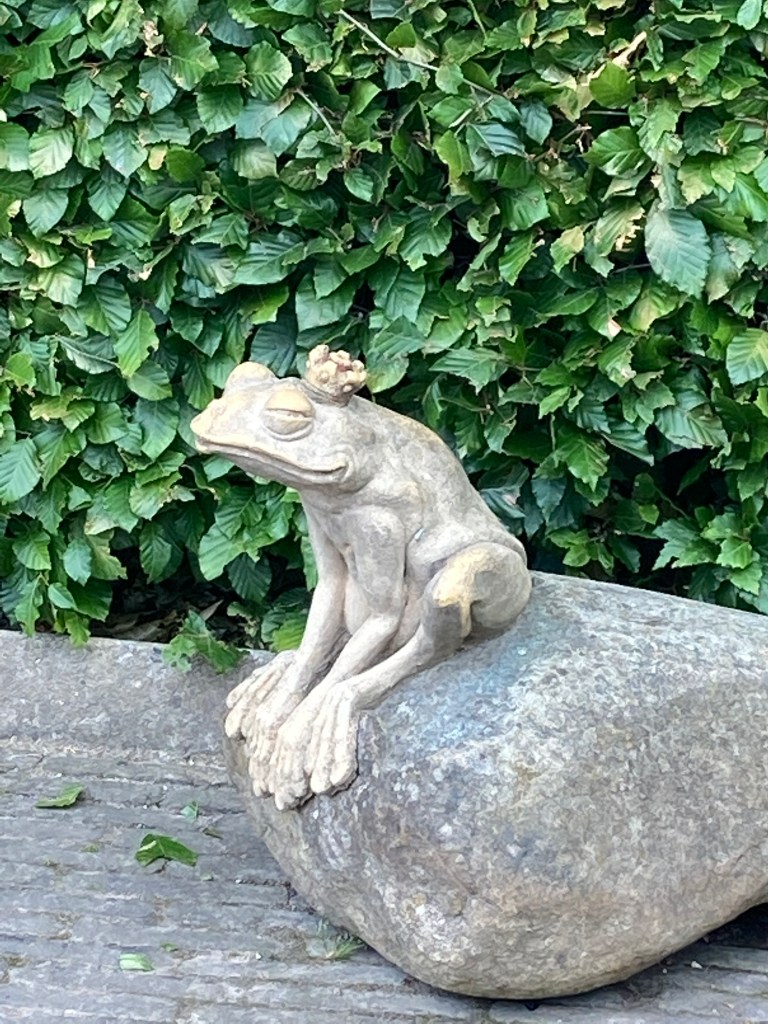
in addition to the amazing planting and water features there are a few unexpected ornamental items, like this little frog statue, which I love.
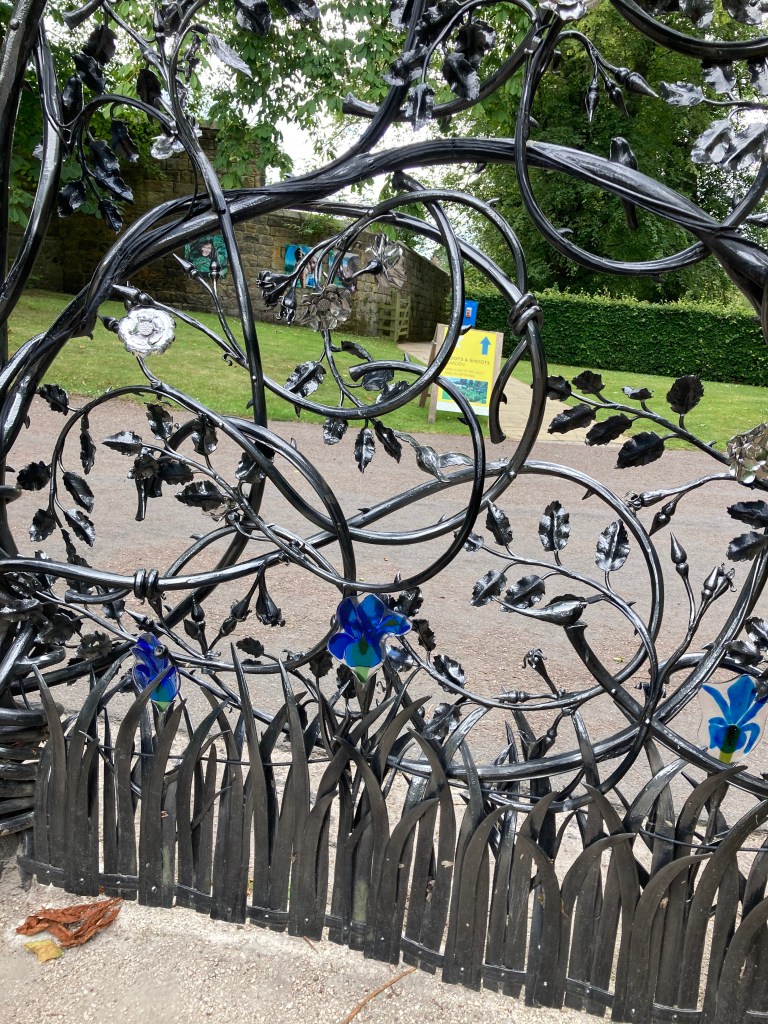
Even the wrought iron gates are works of art
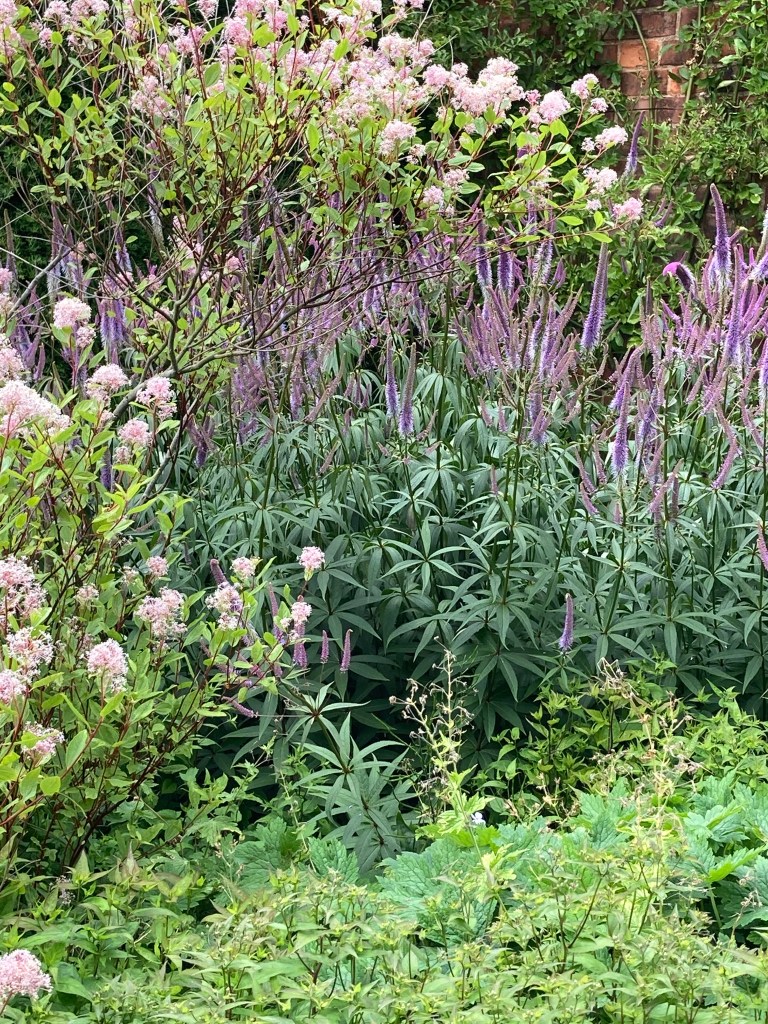
The path slopes upwards through the trees at one side of the cascade to the walled garden at the top. This is another feast for gardeners with stunning herbaceous borders that thrive in the shelter of the tall old brick walls. Earlier in the summer the delphiniums near the walled garden entrance are one of my favourite elements of this part of the garden, though the planting has highlights at all times of the year. They are past their best now but there are many other plants to enjoy, including a stunning bed of alstroemerias, in shades of red, orange and pink.
The centre of the walled garden has a formal layout with beds and paths bordered by clipped hedges, some low to show off the flowers inside, some high, like the ones surrounding this little secret garden with its central fountain
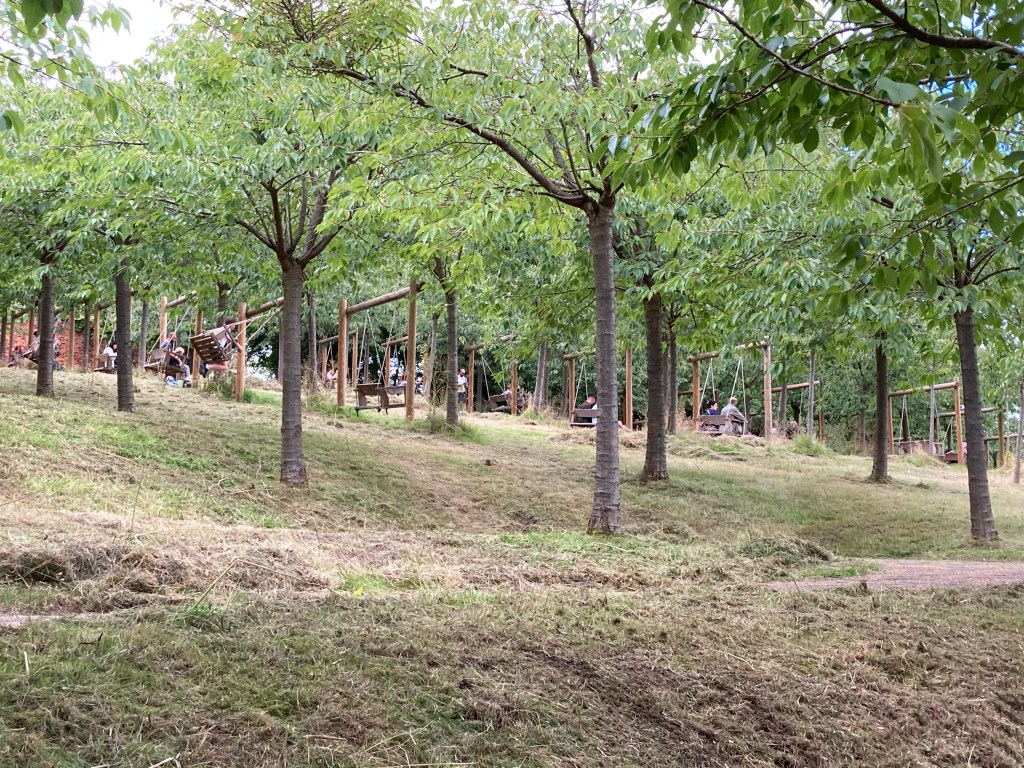
Following the path from here to the other side of the cascade we arrived at the cherry orchard, which is a vision of blossom in the spring. The path zig zags down through the trees (the corners are a little bit steep and the path is not a smooth as elsewhere in the garden but I managed (there is a steeper path with steps straight down the bank for those able to use it). In amongst the the trees are some swing seats for those whose want to stop for a breather here.
The path leads along past a large duckpond towards the poison garden, which has a fascinating collection of poisonous and medicinal plants. Visitors here are escorted by guides that begin their tours at regular intervals.
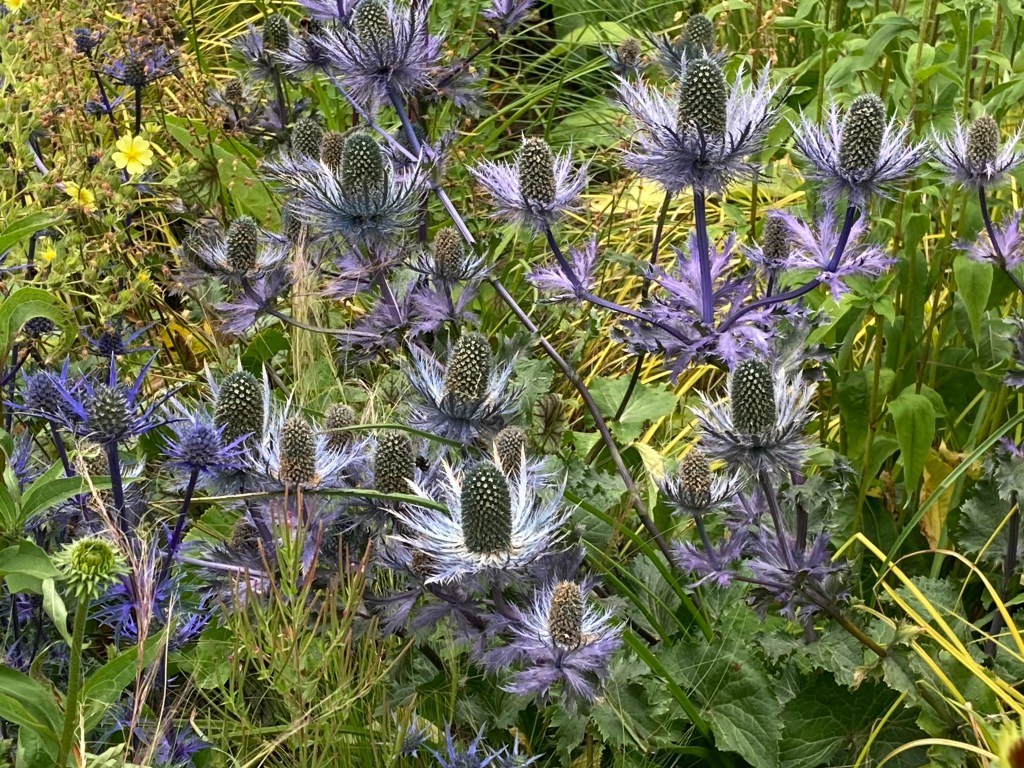
Between here and the pavilion there is another lovely border, planted in shades of blue and yellow. We grabbed a coffee from the stall here and sat watching the bumblebees visiting these electric blue and silver eryngiums.
The one-way system exited through the gift shop. I have to say this was the most stressful part of the visit. Even though my visit took place before masks became mandatory in shops, I felt safer wearing mine. Despite signage, few of those using the gift shop seemed to be observing social distancing and the route meandered through the shop displays and the shoppers, rather than directly to the exit door. The gift shop used to be in a separate building and visiting it was optional. It seemed ironic that we were corralled in this way at a time when social distancing is needed – rearrangement of shop fixtures would help.
With that exception, I enjoyed my visit. The gardens are as lovely as ever and there was plenty of space on the lawn for families to picnic and enjoy the space.
Just before we left we caught the climax of another fountain display. It ended with the large fountain in the lower pool getting higher and higher.
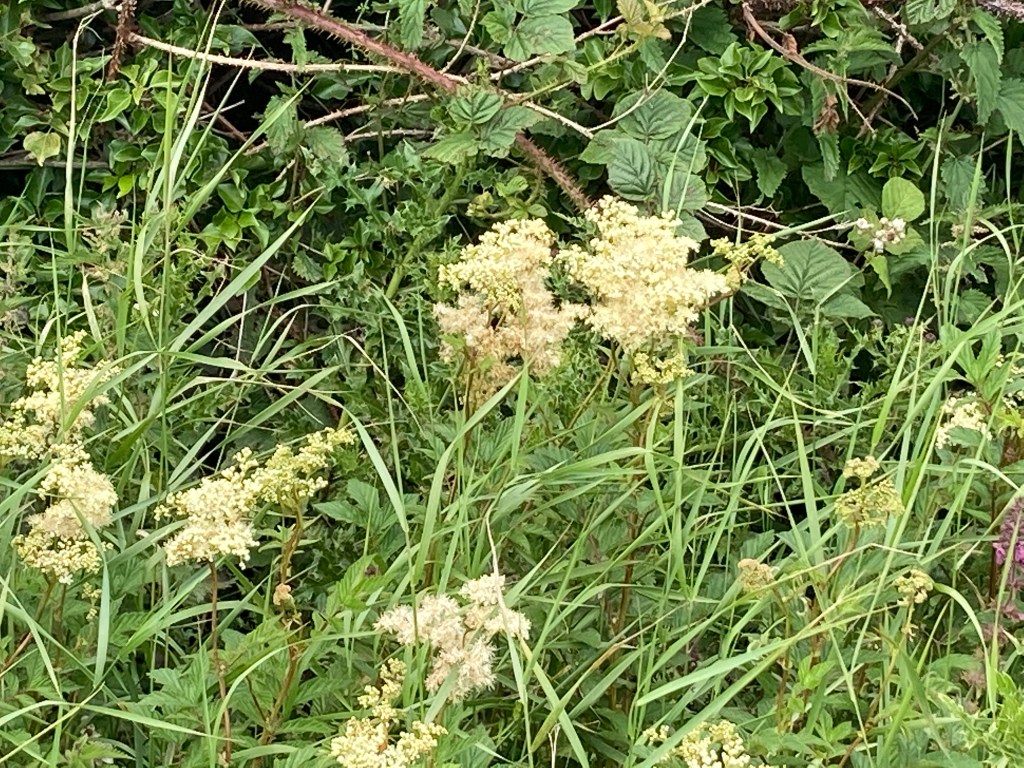
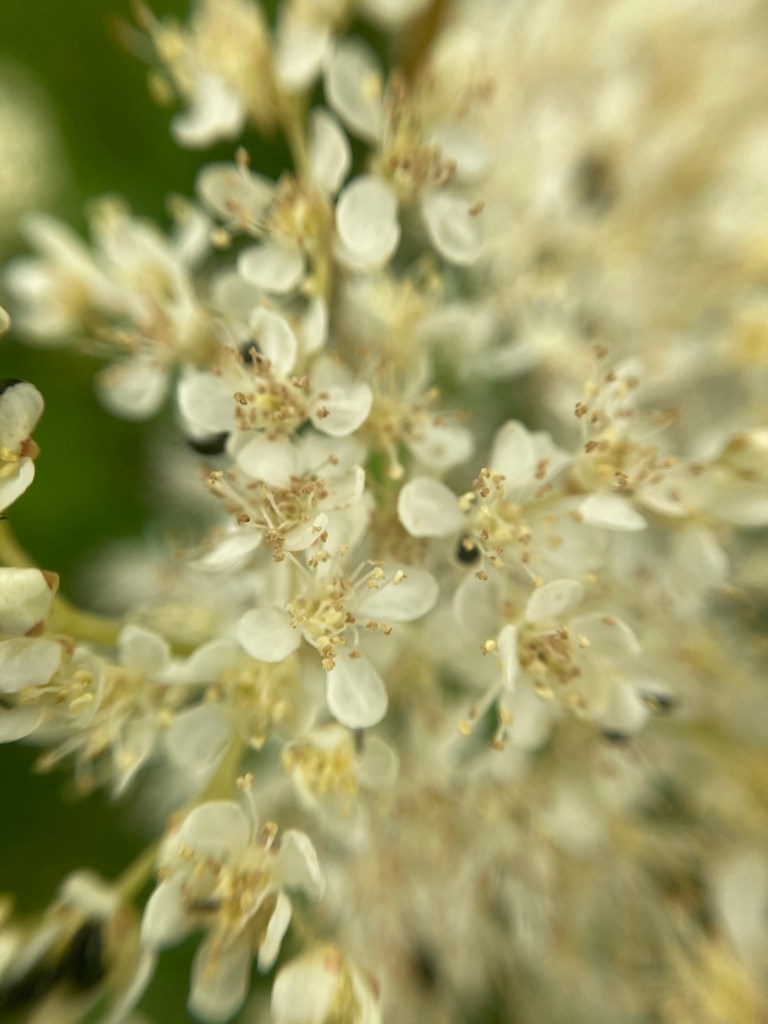
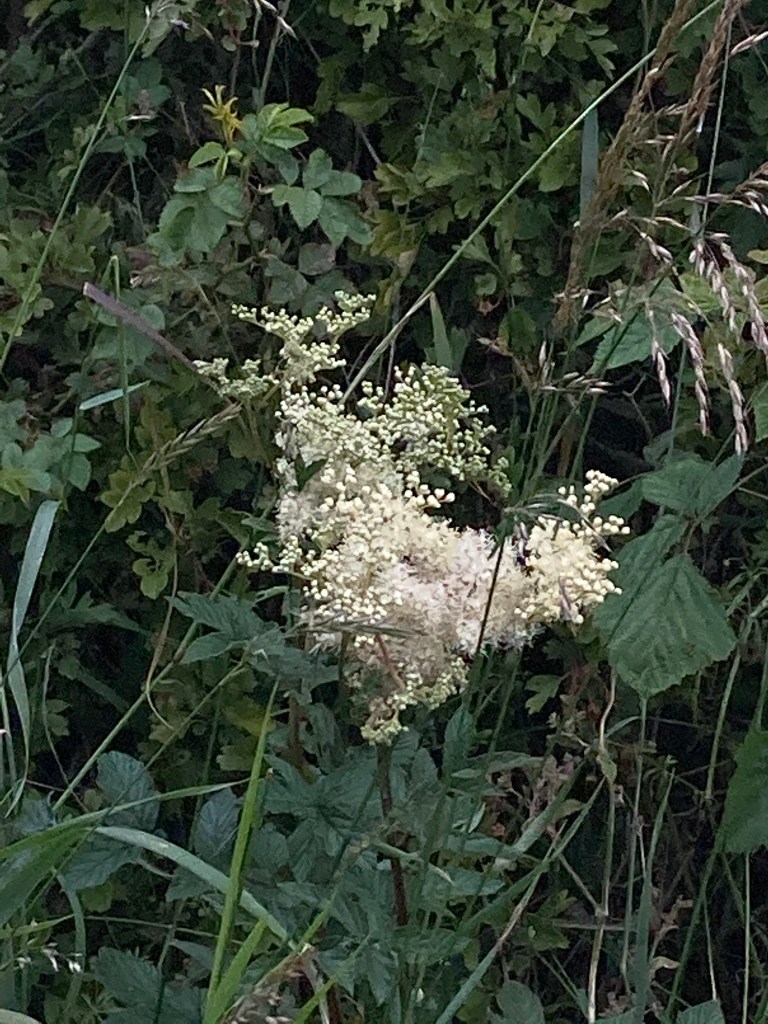
At it’s peak now, Meadowsweet (Filipendula ulmaria) flowers from June to September, and is common in damp meadows, ditches and road verges, by rivers and streams, growing to about 1.5m on reddish stems. . It is actually a member of the rose family, though the frothy clusters of cream-coloured flowers give no clue to this. Each tiny flower has 5-6 petals and male or female flowers are on separate plants. the flowers smell faintly of almonds and are an important pollen source for insects.
Found from Europe to the Middle East, the plant was introduced to America, where it has become naturalised.
The dark green leaves however are, more like those of the rose, set in pairs along a leaf stem, toothed and more heavily veined, with a silvery underside. When crushed they can have an antiseptic smell on top of the same almond notes of the flowers.
The plant has many names, some of which indicate it’s many uses through the ages. It was used as a strewing herb, thrown on the floor to cover the mud, provide insulation and a pleasant scent when trodden underfoot. The flowers were used to decorate banquets and for bridal garlands, giving rise to the name bridewort. The herbalist Gerard said that the scent “make the heart merrie, delighting the senses without headache or putting off meat”. Meadowsweet was said to have been a favourite of Elizabeth I.
Although the name Queen of the Meadow or Pride of the Meadow, would suggest that the plant is named for its habitat, the alternative of meadwort is thought to derive from the use of the flowers to flavour mead. It has been used to add flavour to port, claret and beer, gin, sloe gin, jam and various desserts – some sources recommend using it in the same way as elderflower to make cordials, liqueurs and “champagne”.The flowers and leaves retain a scent and flavour even when dried, enabling use all year round. The roots yield a black dye.
Herbalists have also found many uses for this plant. Culpeper used it for fevers, wounds and eye irritations. It has also been used for colds, bronchitis, upset stomachs, joint problems and for bladder infections. Modern science has found one of the reasons for its useful medicinal properties: it contains salicylic acid, also known as aspirin.
This really is a versatile plant with a fascinating history.Wildflower
During this crazy year, when time has either been standing still or passing us by, it’s quite reassuring to go for a walk and see the passing of the seasons. Whatever else happens, the wild plants still come into flower around the right time and the swallows migrate here. The farm year continues too and we see fields change as crops grow and reach harvest and spring lambs grow bigger.
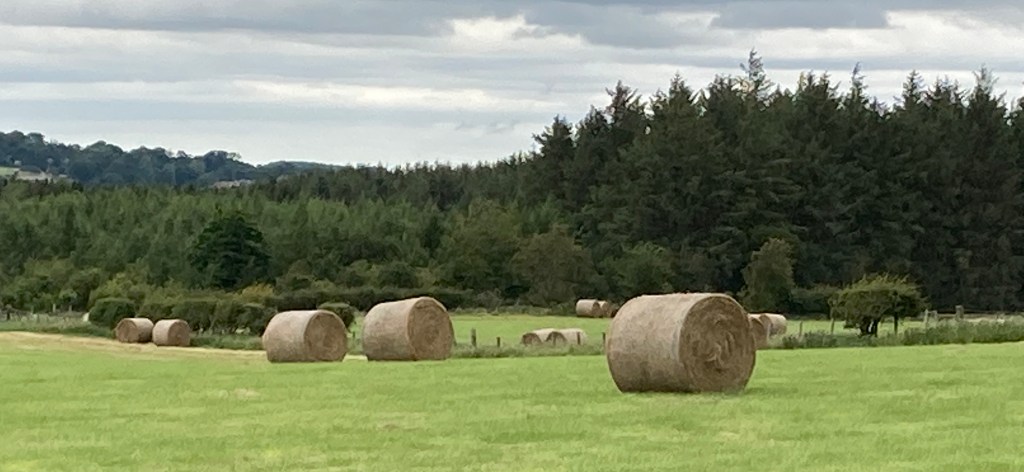
Today I took my usual walk near the village and the first thing I spotted was that some of the meadows have been cut – the warm wet weather has really encouraged grass growth and hay and silage making.
The oilseed rape crop is ripening. The acid yellow flowers of spring have now been replaced by brown stems and seed pods.
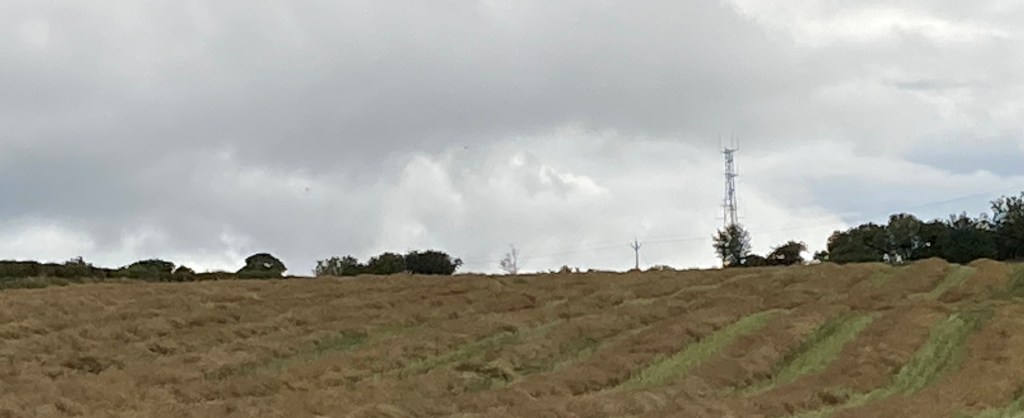
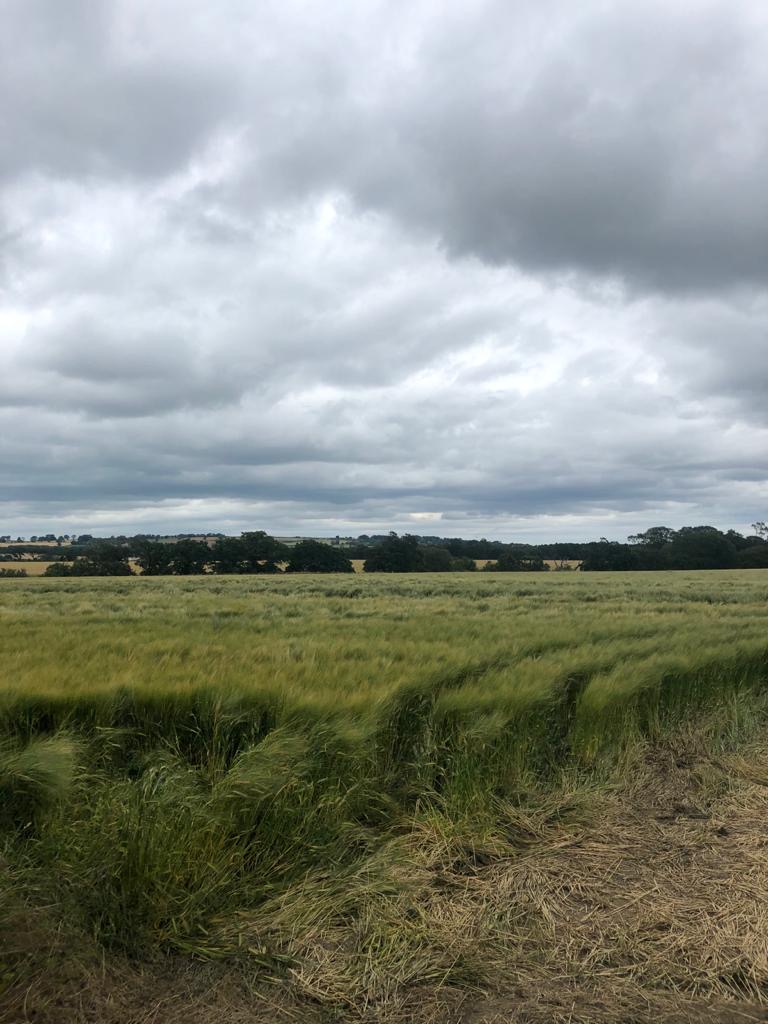
The grain crops are ripening fast and combining has already begun in some places. This barley still has a greenish tinge. I love to watch it swirl about and ripple in the breeze.
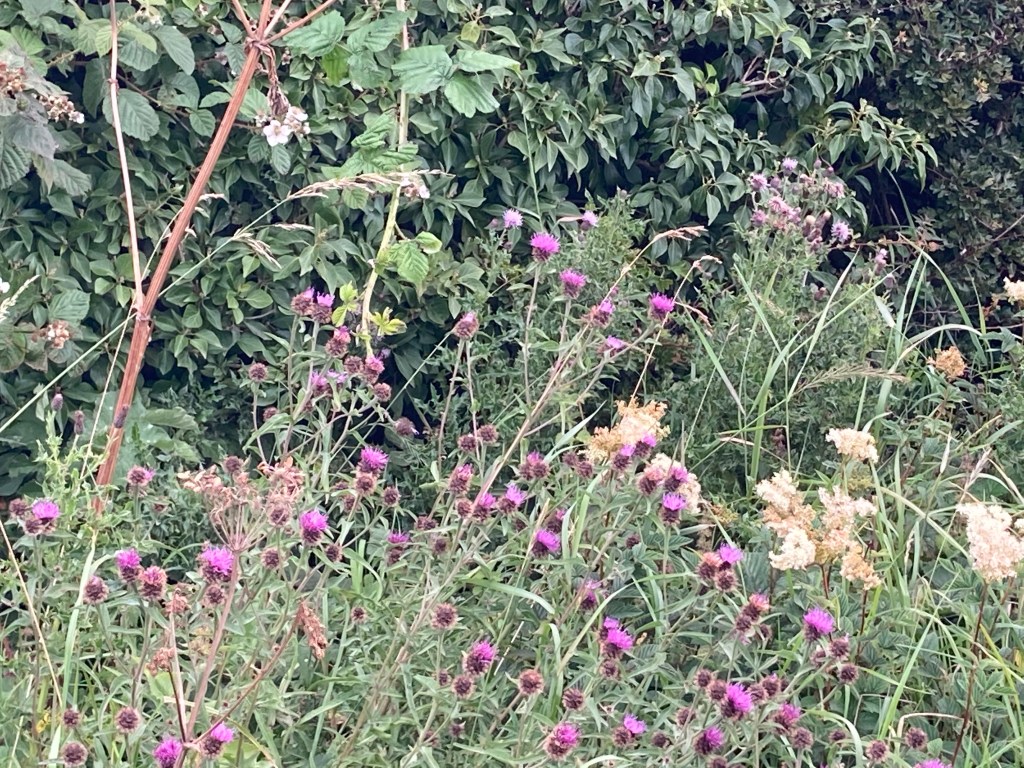
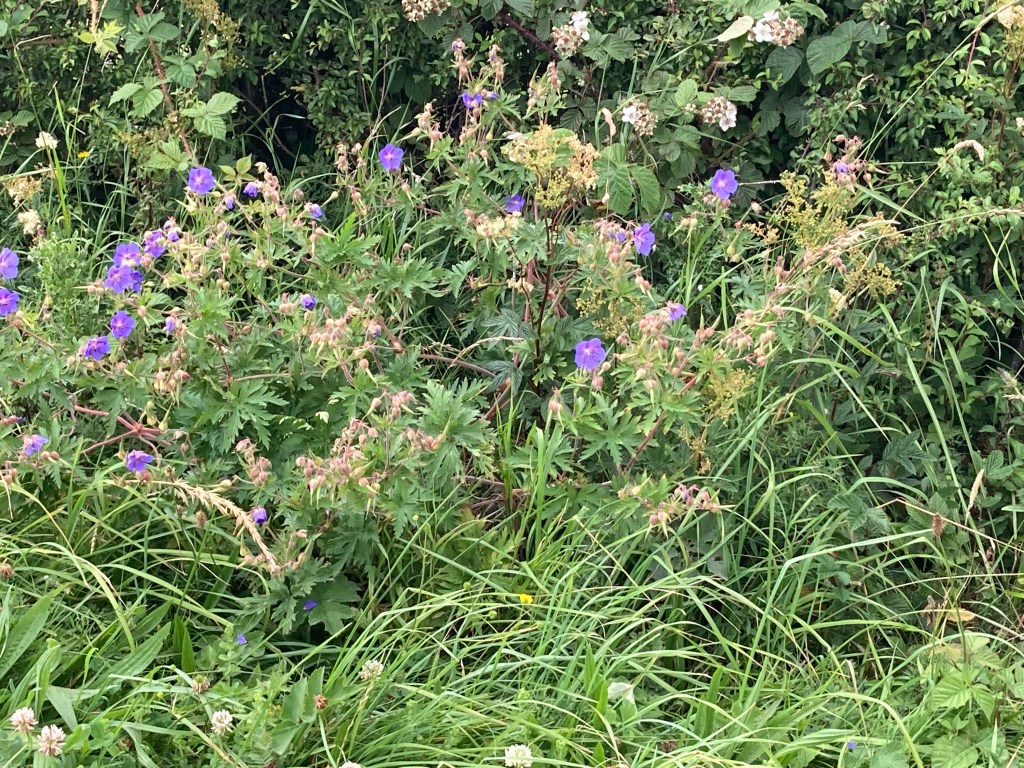
The verges and hedgerows are now a dustier, darker green, with the creamy grass seed heads, thistledown and meadowsweet flowers and accents of purple from thistles, knapweed, meadow cranesbill and woundwort.
Purple Knapweed and Milk Thistle (top right) with creamy Meadowsweet (bottom right)The brilliant blue-purple flowers of Meadow Cranesbill
The most dominant birdsong I heard today was that of the yellowhammer: a rising sequence of notes followed by a single, lower, longer one. They seemed to follow me and every so often I’d catch a glimpse of one on top of a hedge.
There were lots of butterflies today, mainly whites, including green-veined whites and also small tortoiseshells and red admirals. I also saw this beautiful pale moth – so far I can’t identify it.
As we turned, a roebuck crossed by the bridge. They are very common round here, but mostly keep themselves well hidden in woodland, especially during summer, so it was lovely to see one.
What aspects of nature characterise this time of year where you live?
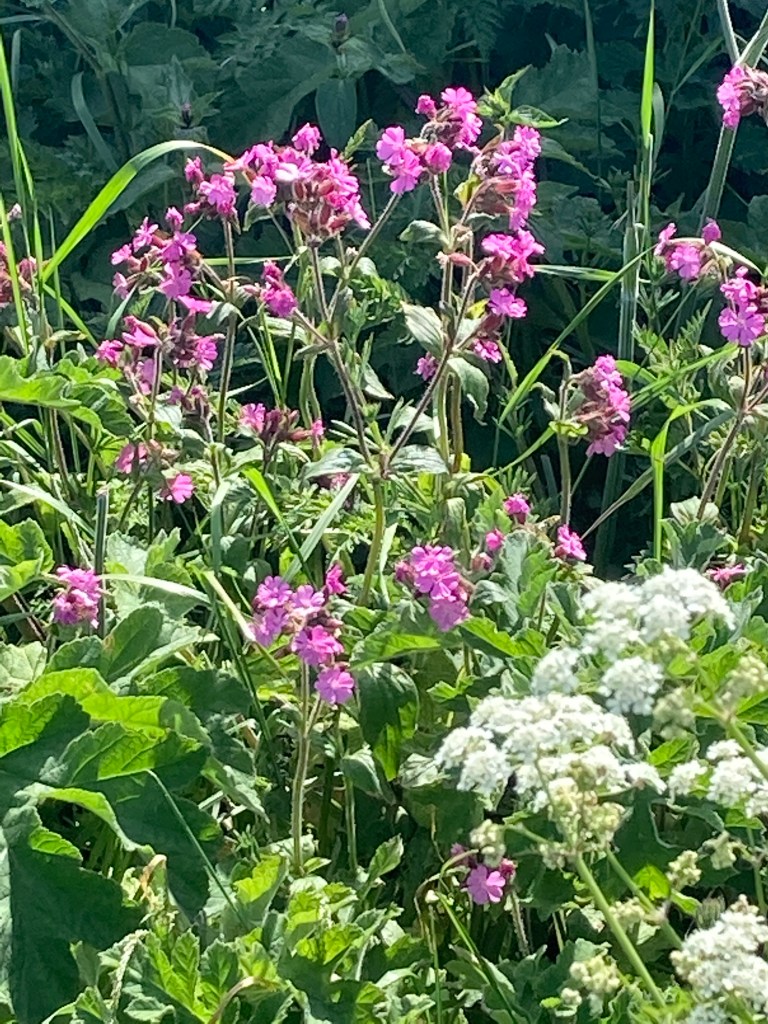
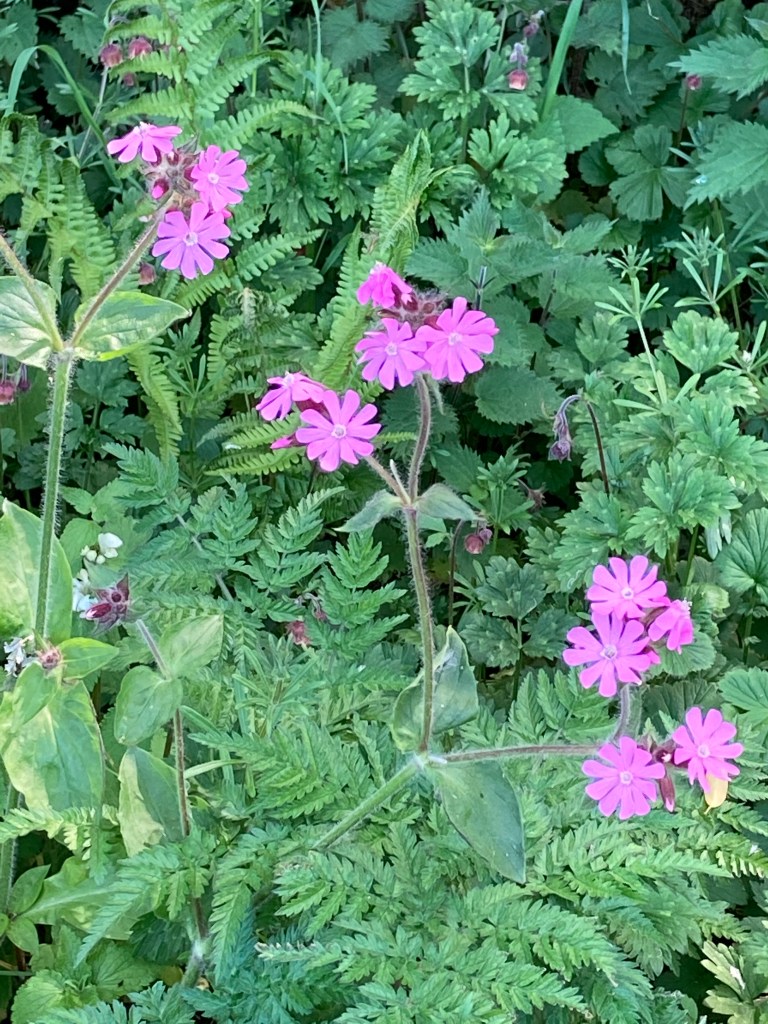
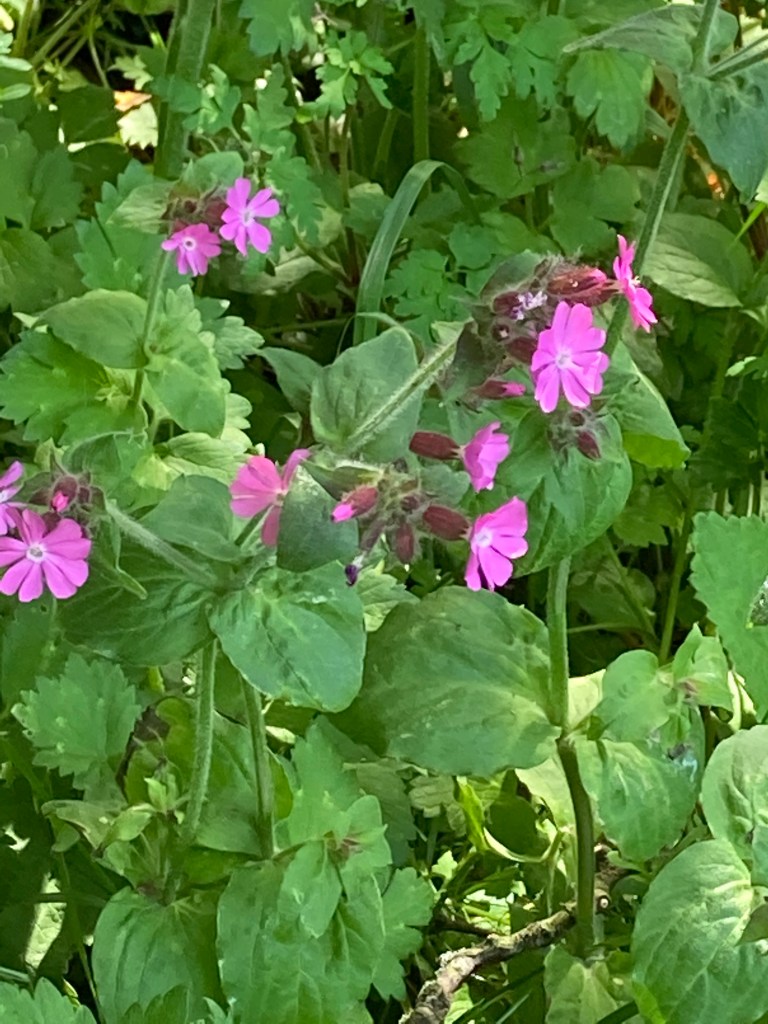
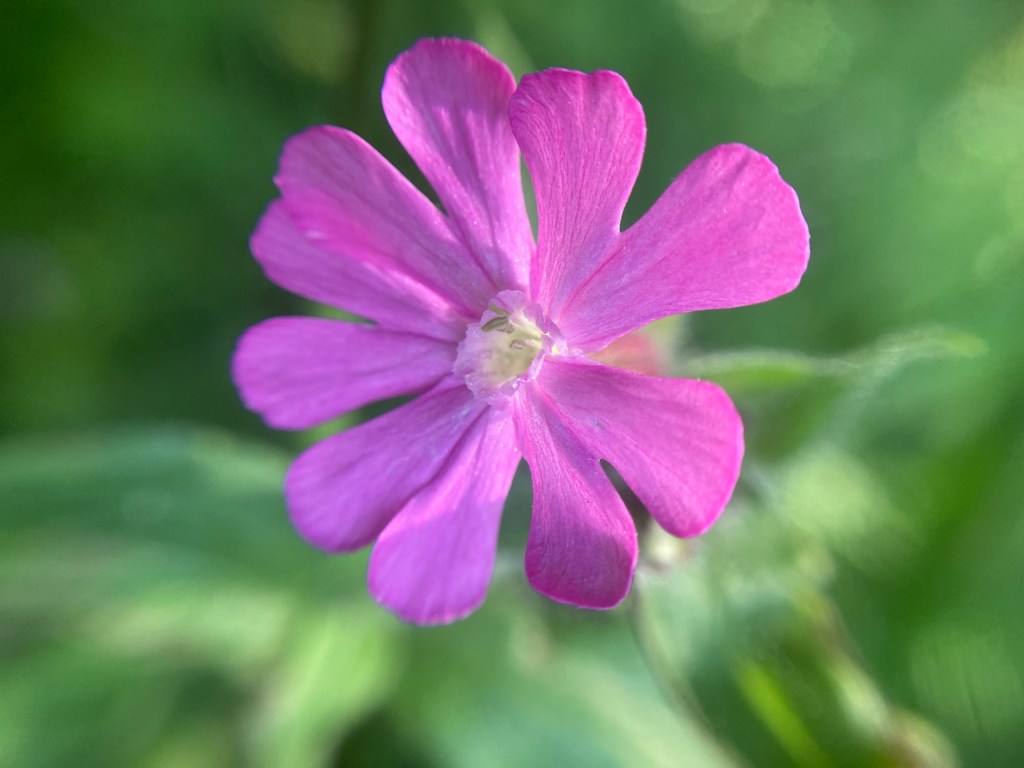
It’s impossible to miss the tall clumps of pink-red flowers of red campion that are growing in profusion in hedgerows and woods at the moment and will continue to do so until August and well into Autumn and Winter if the weather is mild. This relative of the carnation is a short-lived perennial that produces copious seed that enables it to spread rapidly , especially in fertile soils.
The plant grows up to a metre tall, though usually 30-60cm high. with leaves and stems covered in softly downy hairs. The leaves are pointed oval in shape, carried in pairs on the stems.
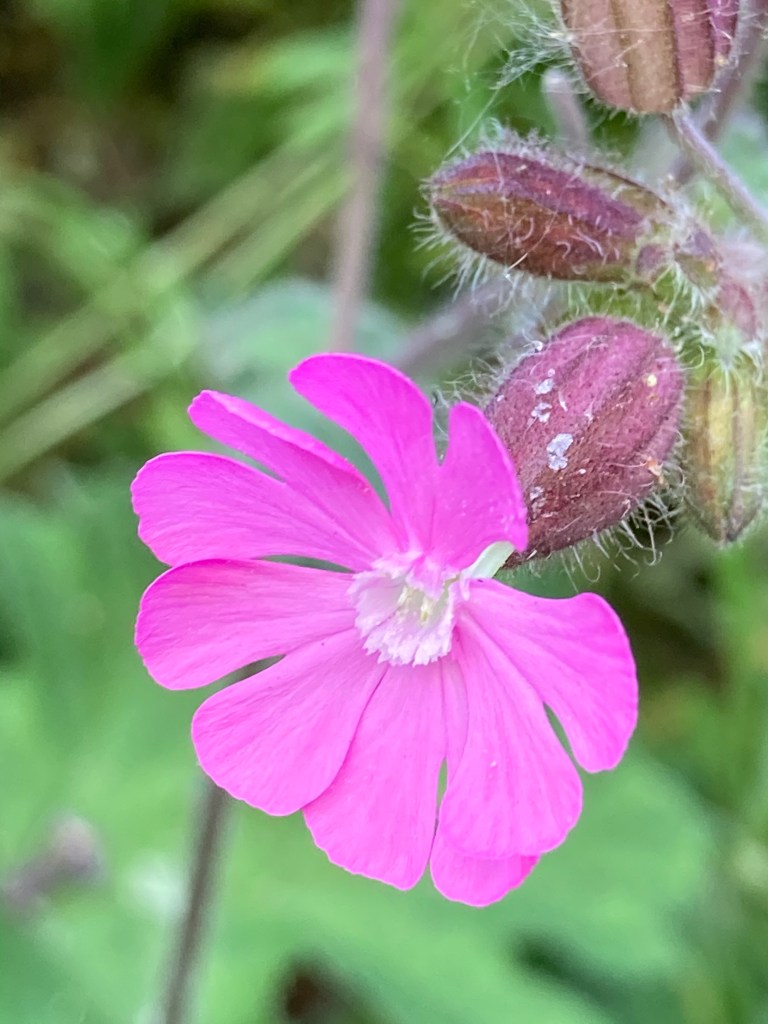
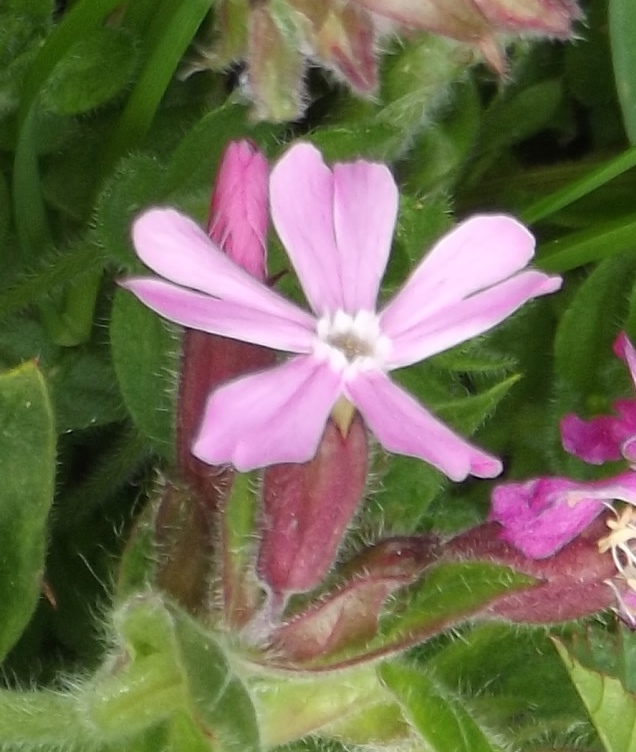
The flowers carried in small groups at the end of the stems. Each has five petals and each petal has a central cleft. the calyx immediately behind the flower is dark red/brown and hairy. The plant is dioecious, that is a single plant carries flowers with either female or male parts, not both as in most flower species. On the female plants the calyx develops into a vase-shaped seed capsule full of tiny black seeds. The female flower produces a sticky substance that causes pollen from visiting insects to stick. The Latin name for the campion family, Silene, may come from the woodland god Silenus or from the word for saliva.
The red campion hybridises freely with the closely related white campion with resulting flowers in a wide range of shades of pink. Though I’ve never noticed this, you may come across flowers with a darker centre. This is caused by a fungal disease known as anther smut, producing dark spores on the reproductive parts of the plant
The plant is sometimes called the Adder Flower from it’s use in folk medicine to treat snakebites (though personally if I was in this situation I would prefer to seek professional medical advice immediately rather than take my chances with the plant!) The roots of plants in the campion family can be used to prepare a soap substitute, though the red campion is less known for this than it’s close relative, soapwort. The 16th Century herbalist, John Gerard said that the hairy stems could be used to make candle wicks. A century later, Nicholas Culpepper described a number of medical uses including the treatment of kidney stones and internal bleeding as well as to “helpeth those that are stung by scorpions or other venomous beasts”.
Another country name is Batchelor’s Buttons as unmarried young men would wear the flower in a buttonhole..
Red campion certainly provides a welcome splash of colour in late spring and throughout the summer.
As always, please remember these guidelines.
Don’t touch or pick any plant unless you are ABSOLUTELY CERTAIN that it is safe to use, and not poisonous.
Don’t pick anything unless it is abundant
Only pick small amounts and no more than you need
Don’t pick if there is a risk of pesticide/weedkiller or other contamination, including from traffic or other forms of pollution.
Always get permission from the landowner.
Avoid areas which may be soiled by animals (wild or farm animals or pets)
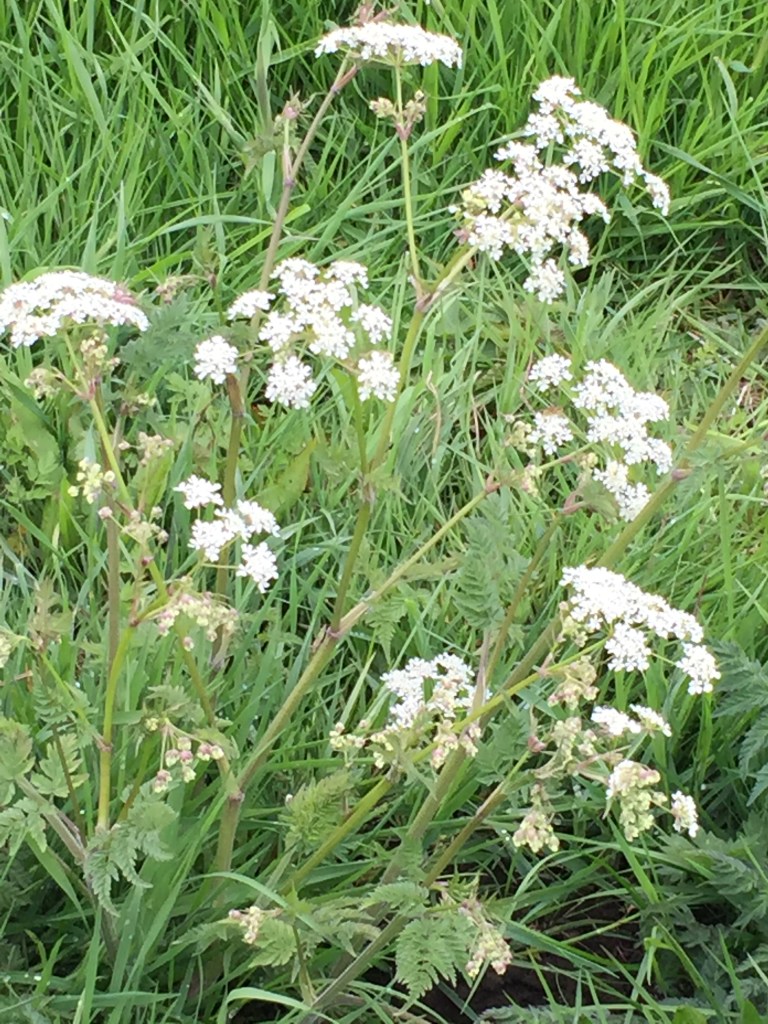
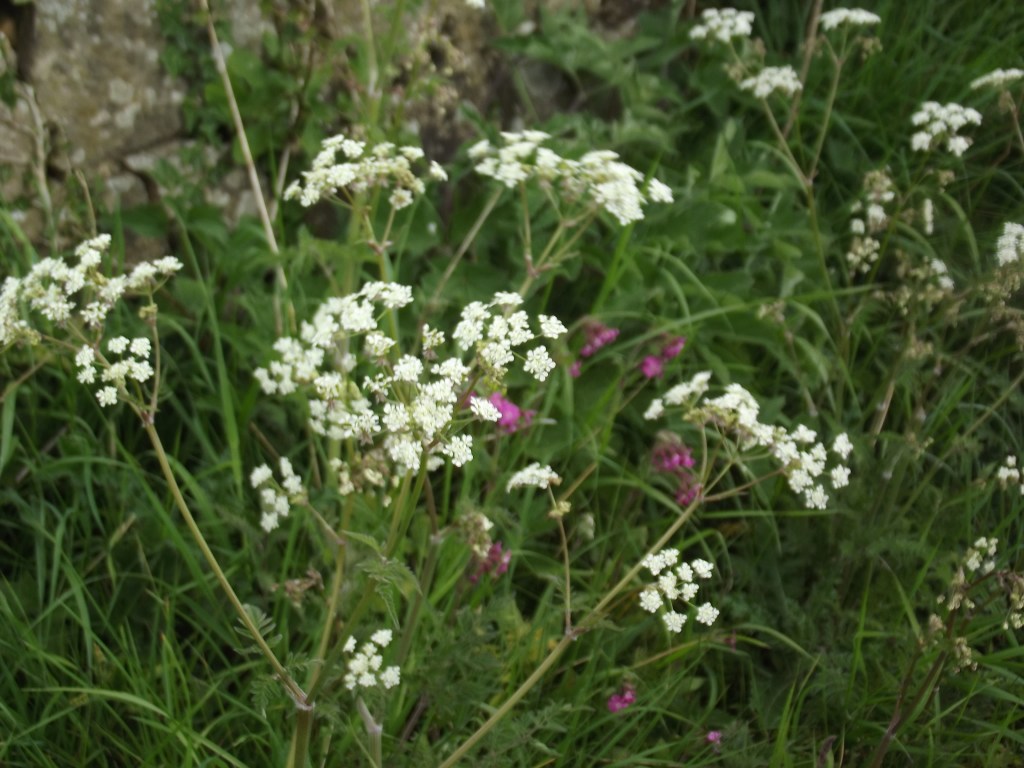
From April to June our hedgerows, road verges and meadows are filled with the frothy white flowers of cow parsley. It is the earliest to flower and one of the most common of a large plant family, the umbellifers, which all have similar shaped flower clusters or umbels, made up of tiny individual flowers on stems radiating from a single point in a sort of umbrella shape. The family includes several food plants and culinary herbs, including carrot, celery and and parsley, but also some extremely poisonous species such as hemlock and fools parsley and also hogweed which has a highly irritant sap that can cause quite severe burns.
The flowers are carried on metre high hollow stems. As they appear quite early in the year, they are are a great food source of both pollen and nectar for insects.
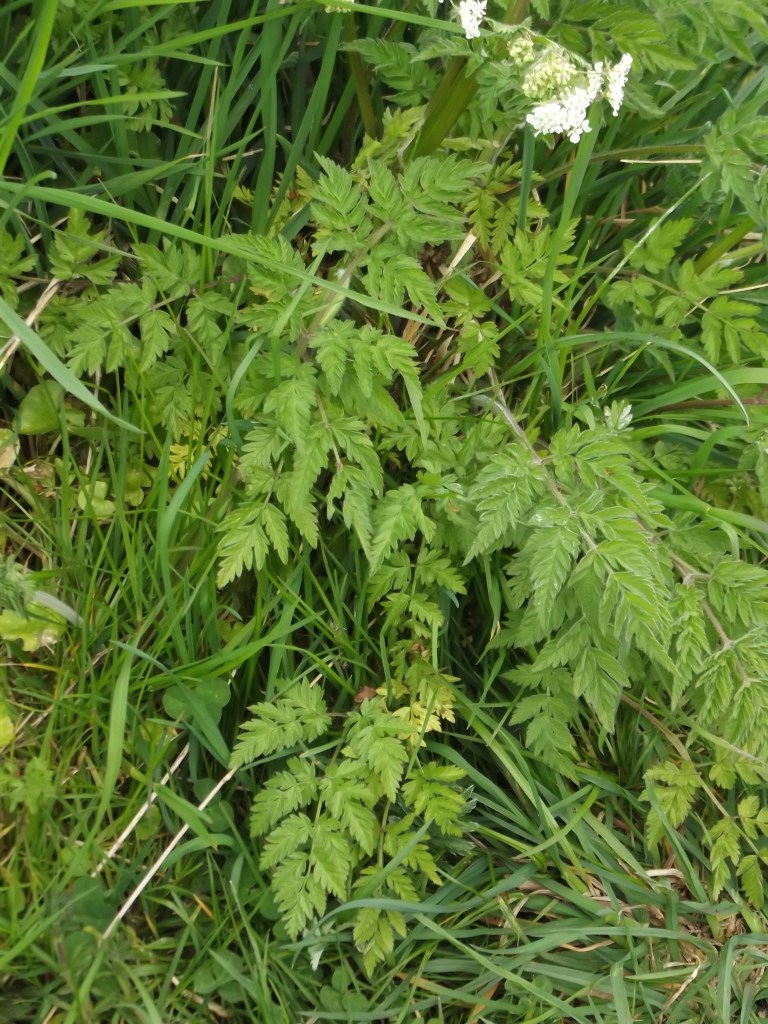
The leaves are arranged alternately along the stems and are fern-like: triangular and finally divided. When crushed they smell of aniseed.
Cow parsley spreads rapidly, producing large quantities of seed and also though spreading rhizomes. It is on the increase in the UK. Like the nettle, it enjoys fertile soil and increased agricultural fertiliser use has benefited it. This may be to the detriment of smaller plants that become smothered out by the taller cow parsley. It is considered an invasive species in parts of the US.
The plant has a variety of old names. including hedge parsley, wild chervil, keck, lady’s lace and Queen Anne’s lace. In some parts of the UK it has the rather gruesome name of mother die or mummy die. Children would be told they would lose their mothers if they brought it in the house – to deter them from picking it and the highly poisonous hemlock that it resembles.
Though cow parsley is edible, eating it or using it medicinally is not to be encouraged in case it is mistaken for its deadly relative. It has also been used as a mosquito repellent.
The lacy flowers certainly make very pretty addition to our hedgerows in late spring and early summer.
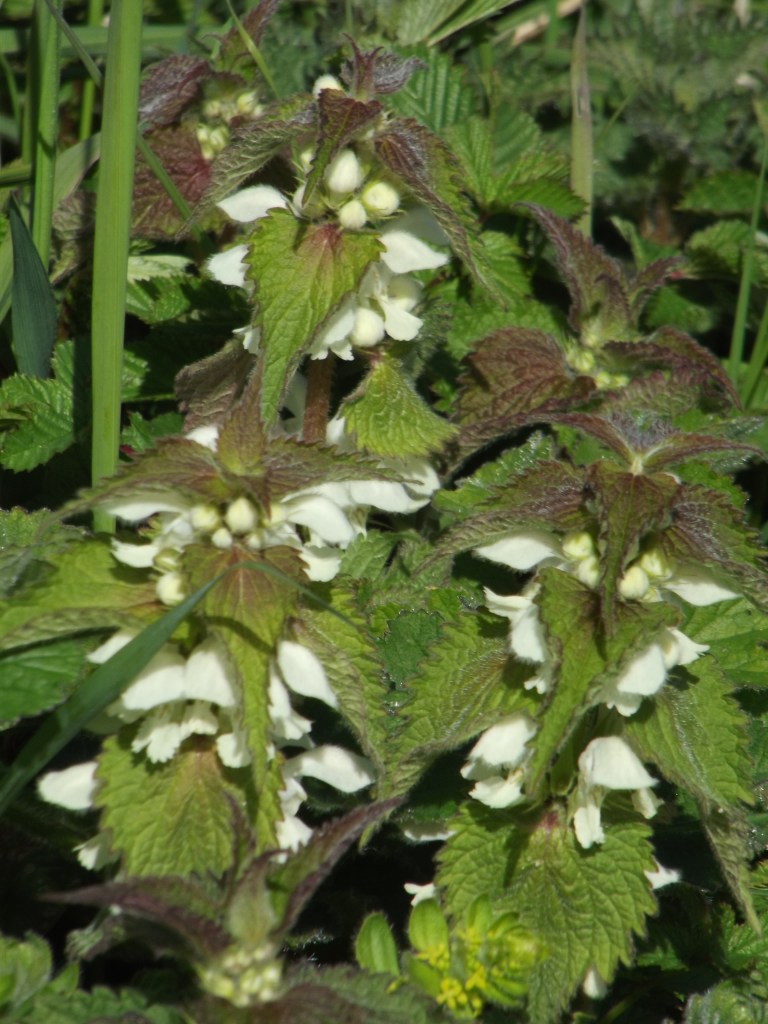
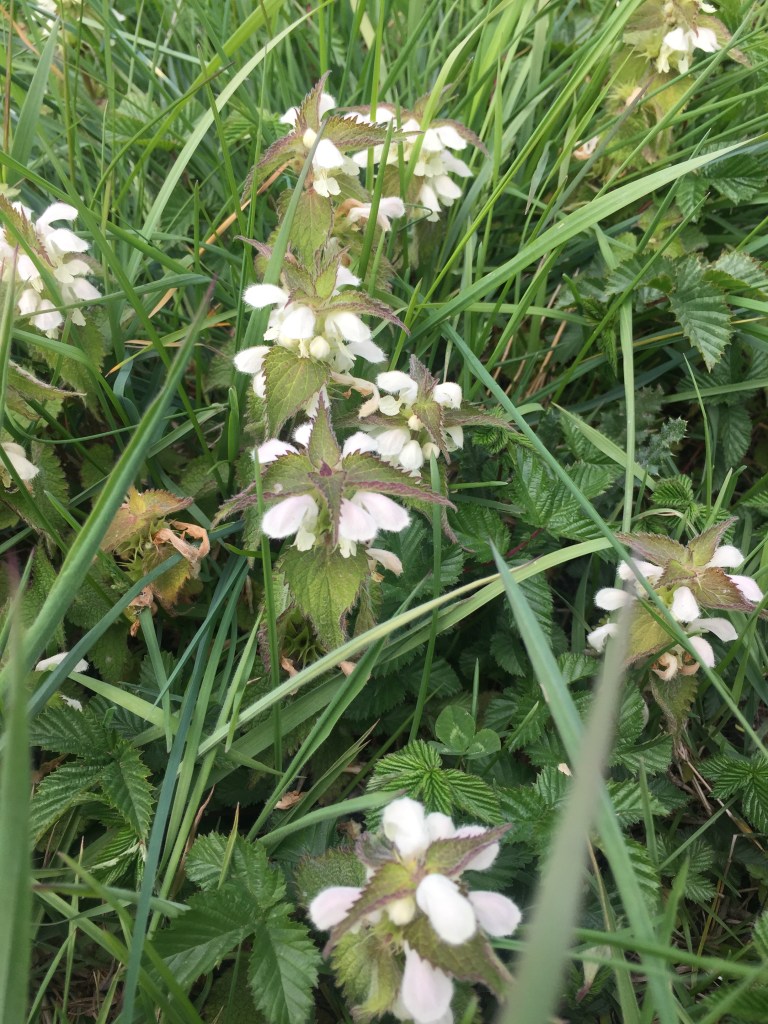
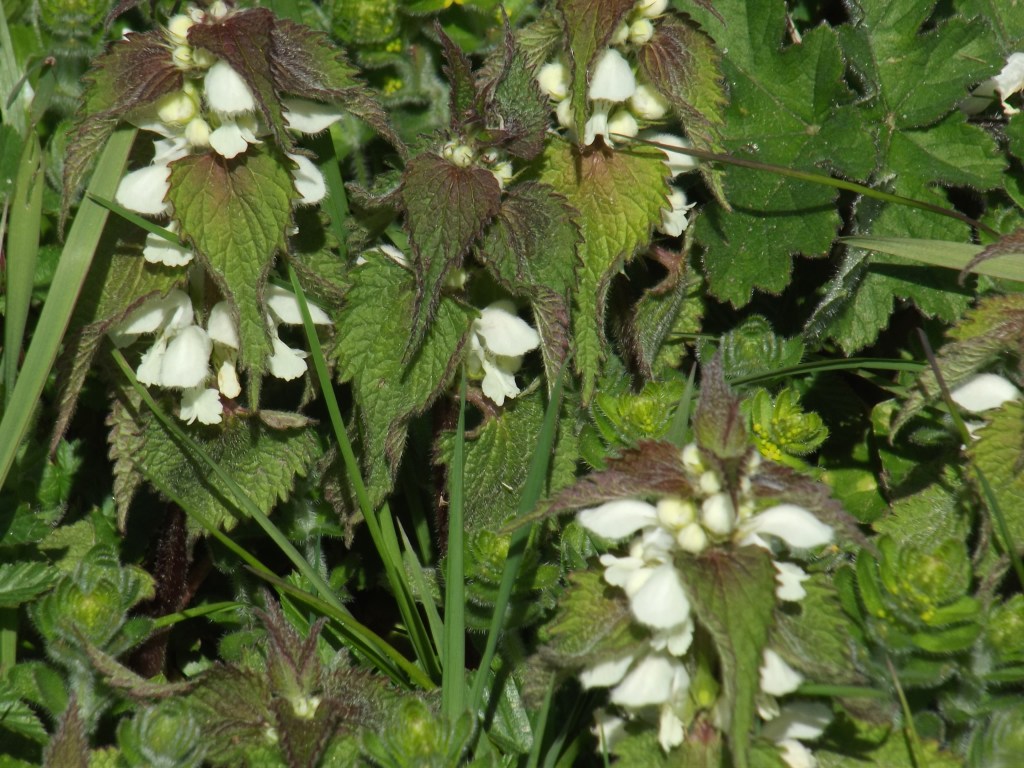
Commonly seen on road verges and on disturbed land, the white dead-nettle resembles the stinging nettle, but, as its name suggests, has no sting. It is a short to medium height perennial. The leaves (closely resembling those of its stinging relative) are heavily veined, toothed, slightly hairy and heart-shaped, arranged in pairs on square, often reddish stems.
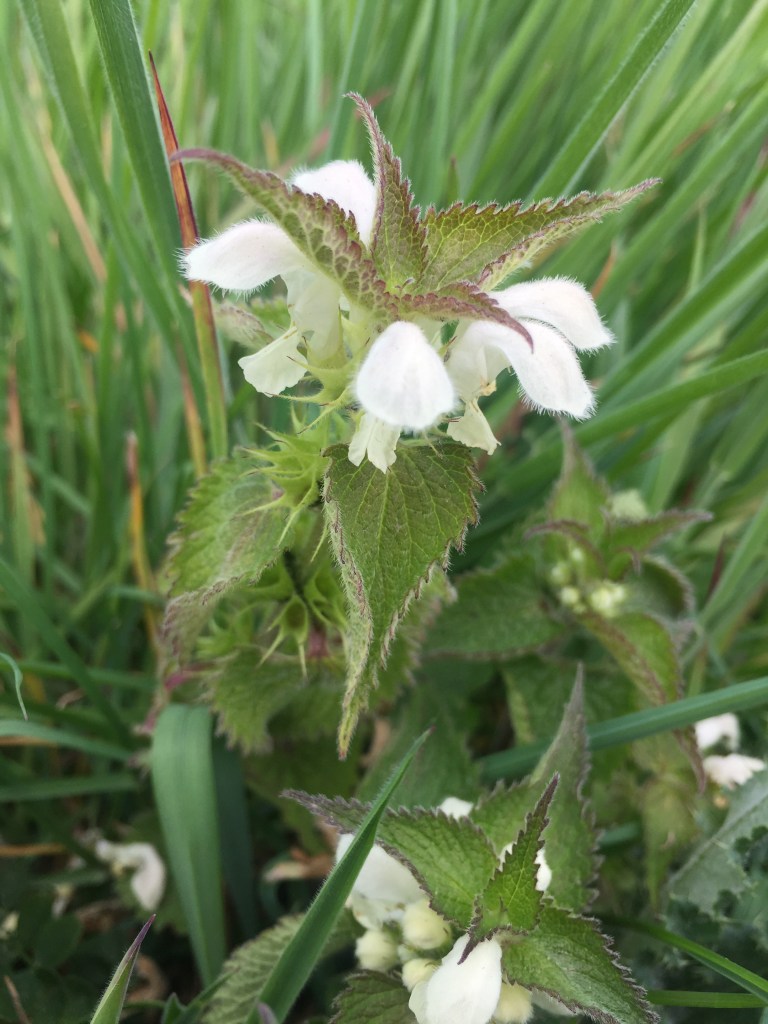
The flowers form in whorls round the stems immediately above each pair of leaves. They are lipped and white, slightly tinged with green. A rich source of nectar, the flowers are popular with insects, especially bumblebees. The blooms have evolved to be pollinated by the larger bees – only they have a long enough proboscis to reach the base of the flower where the nectar is and they are the perfect size for their backs to brush against the stamens and stigma of the flower, depositing and collecting pollen as they feed. The nectar is protected by a ring of hairs that stop smaller insects crawling inside, though some reach the nectar by cheating: they bite a hole in the base of the flower!
As the flowers die the calyx of each remains, forming a spiky cup that holds the developing seed.
White dead-nettle’s popularity with bees gave it one of its old names, the bee nettle. It is also known as white archangel as it was said to come into flower around the feast day of Michael the Archangel. From a certain angle the stamens resemble two human figures and this gave rise to the name Adam-and-Eve-in-the-bower.
The flowers and young shoots can be used in salads or the leaves cooked as a vegetable. Traditional medicinal uses for the plant were for staunching wounds, curing haemorrhage, reducing excessive menstrual bleeding, and also as a tonic to lift the spirits.
White dead-nettle has been in bloom since March and will continue until Autumn
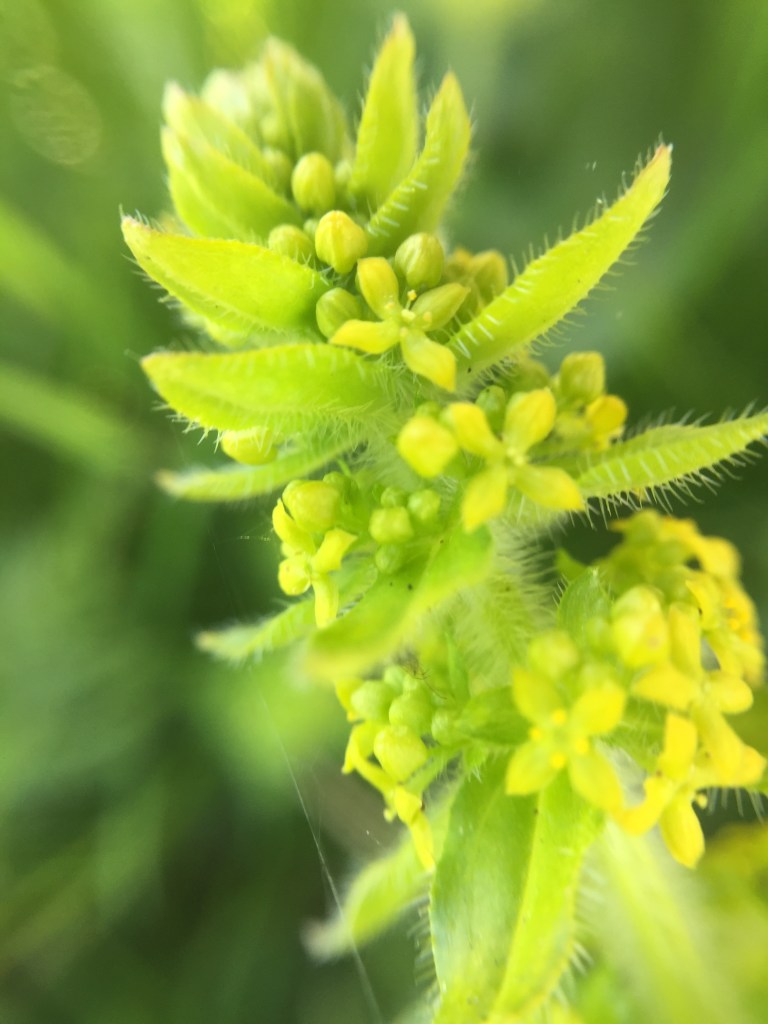
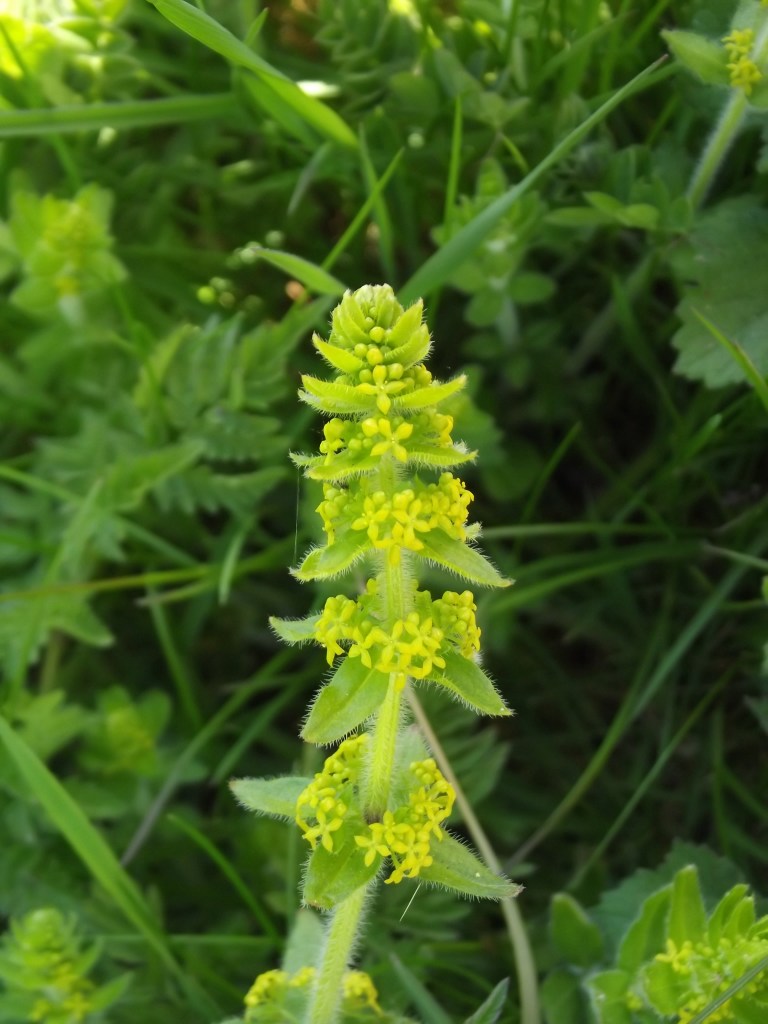
Crosswort is one of those wildflowers that seems insignificant at first, but once you spot it, it seems to be growing profusely everywhere. There is a good show at the moment along the grass verges, but as the grass and larger plant grow rapidly they obscure it.
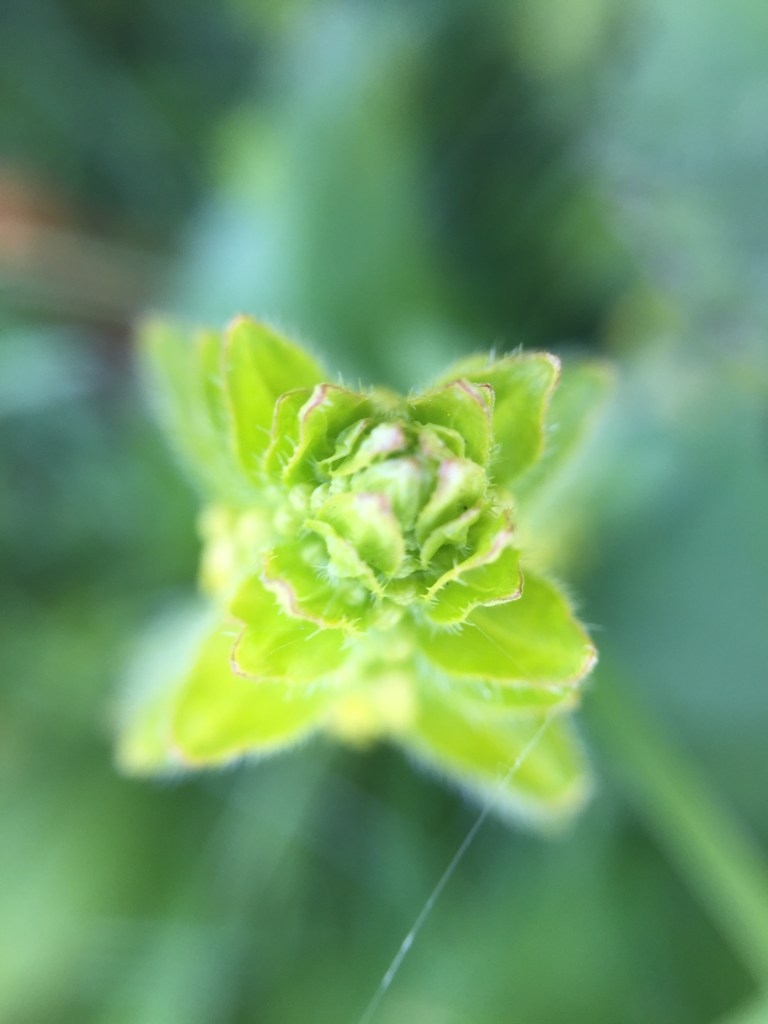
Crosswort is a low growing perennial, that forms rhizomes, underground stems from which the shoots sprout around 4-8 inches high in Spring. The stems are square and unbranched, bearing triangular leaves, both stems and leaves are covered in tiny hairs.
The leaves are arranged in groups of four in a cross-shape, which can be easily seen when viewed from above. This gives rise to the name. It is also known as smooth bedstraw, maywort and maiden’s hair.
The tiny four-petalled yellow flowers also follow a cross shape and smell faintly of honey. They are arranged in clusters around the stem above each group of leaves.
Crosswort isn’t used as a modern culinary or medicinal herb but in the past it was used to treat dropsy, rheumatism and rupture. It was also used to promote would healing and cure headaches. A red dye was extracted from the roots.
Crosswort is found throughout Europe and Asia. In the UK it is less common in Northern Scotland and the far west. It thrives on chalky soils in grassland and roadside verges.
We’ve missed our monthly trips to Acklington Park Farm since lockdown. That’s where the Brewery Tap for the Rigg and Furrow Breweryis based. The bar pops up every month in part of one of the barns that has been converted for this purpose. In summer the customers spill out onto the grass where there are benches and blankets to sit on and enjoy the sunshine. It’s child friendly and dog friendly and there’s also delicious street food available from visiting caterers. You can read about a previous visit here.
Earlier this week we found out that they were starting a click and collect service. K was delighted – Rigg and Furrow’s Run Hop Run is his favourite beer. So he ordered and paid for a mini-keg and received his instructions for collection. He’s been like a child waiting for Christmas ever since.
Today was collection day – the farm opened its gates for just an hour this morning and with all the anticipation (and the possibility of a trip out and a few minutes freedom) I had to go too. It’s only a few minutes drive away, but it’s a lovely trip through some pretty countryside. It was so nice to have a change of scene for a little while.
Rigg and Furrow had obviously given a lot of thought to their collection process. They operated a one-way system up the farm lane and a queueing system for vehicles, but when we arrived there was only one other car in front – we had been instructed to stay in the car until it was our turn. We then had call our our order number and our beer was brought to a table set up outside the barn- the staff member took a few paces back, then K went to retrieve it – all conducted very safely, contactless and strictly observing social distancing. He stowed the beer in the car and off we went, out the other gate – it was all very well organised.
He’s over the moon with his beer – it’s the little things that make us happy! That should last him a while but as the brewery hope to continue to run this service during the lockdown, so all is well for when he runs out. Well done Rigg and Furrow! It’s goodto be able to support a local business – especially when the beer is this good!
Have any of your favourite local businesses managed to find new ways of working during the Pandemic?
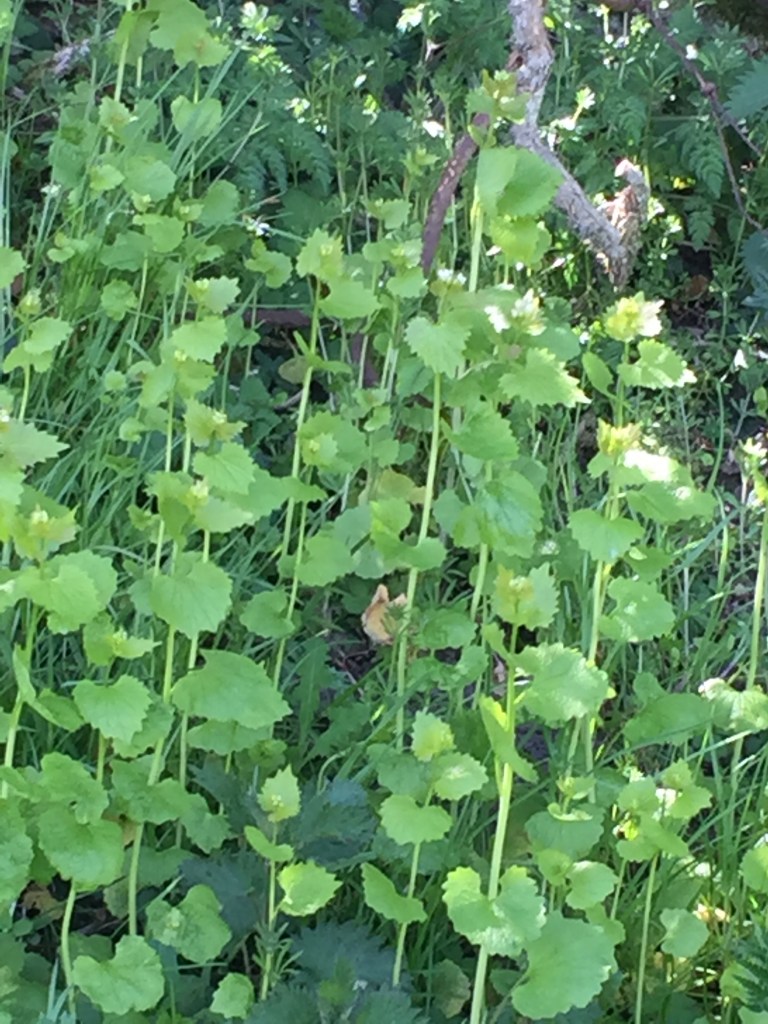
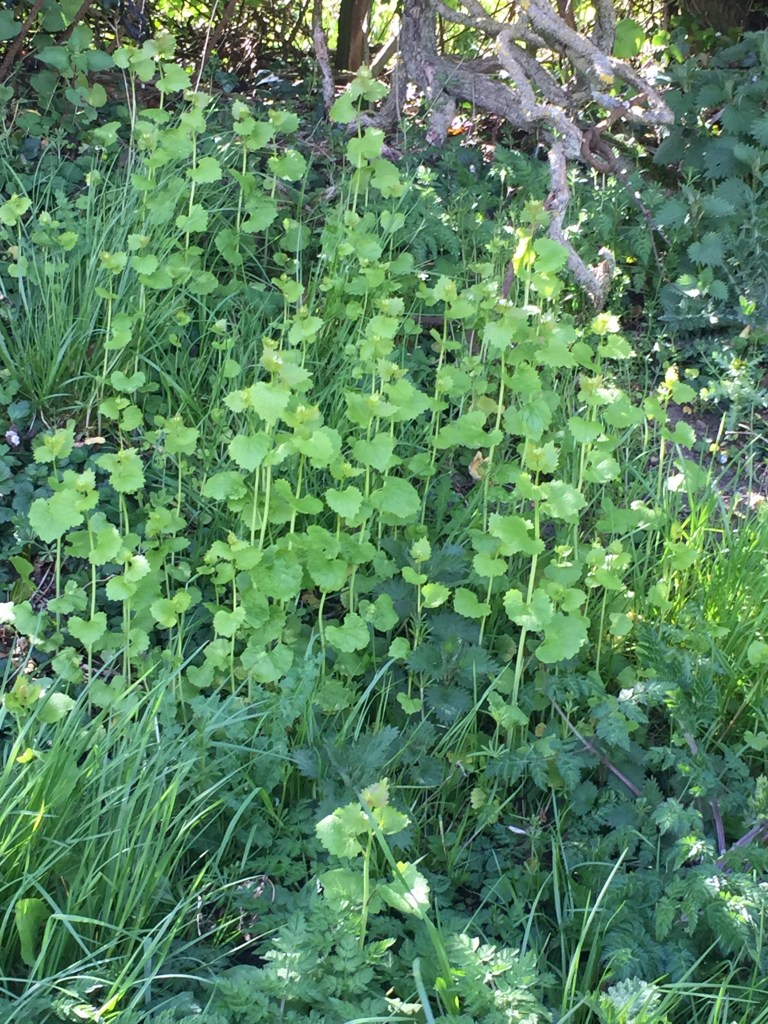
In Spring, tall upright stems with neatly spaced leaves, topped with small clusters of white flowers, appear in the shade of hedgerows, giving this plant its other common names: hedge mustard or jack-by-the-hedge.
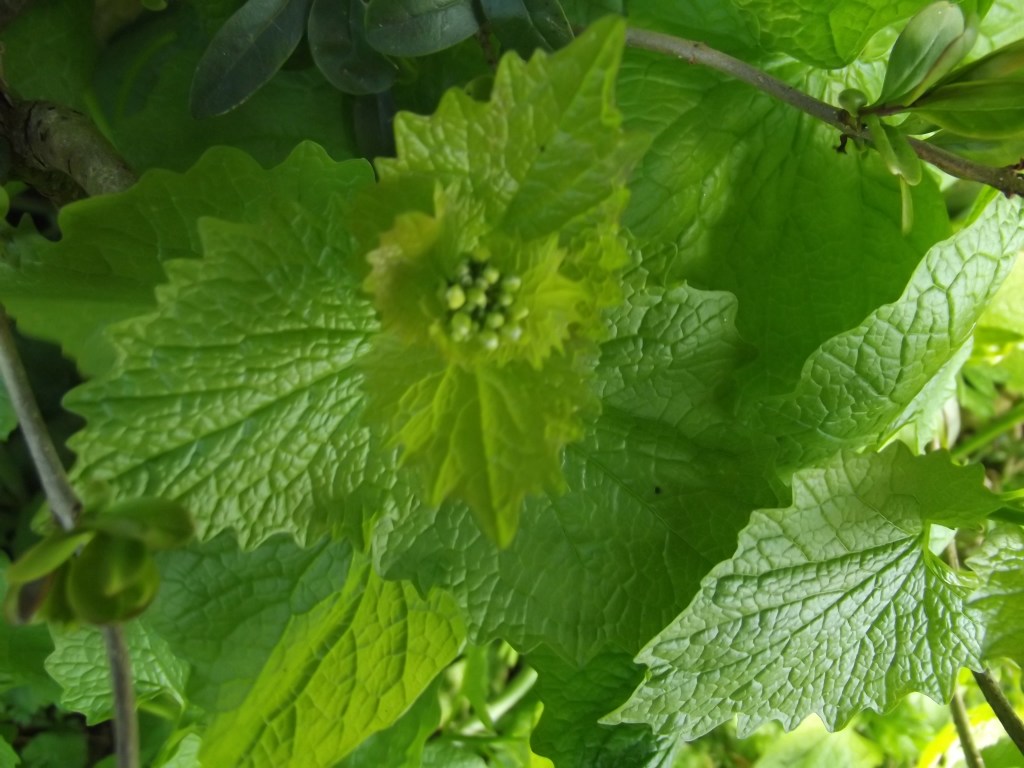
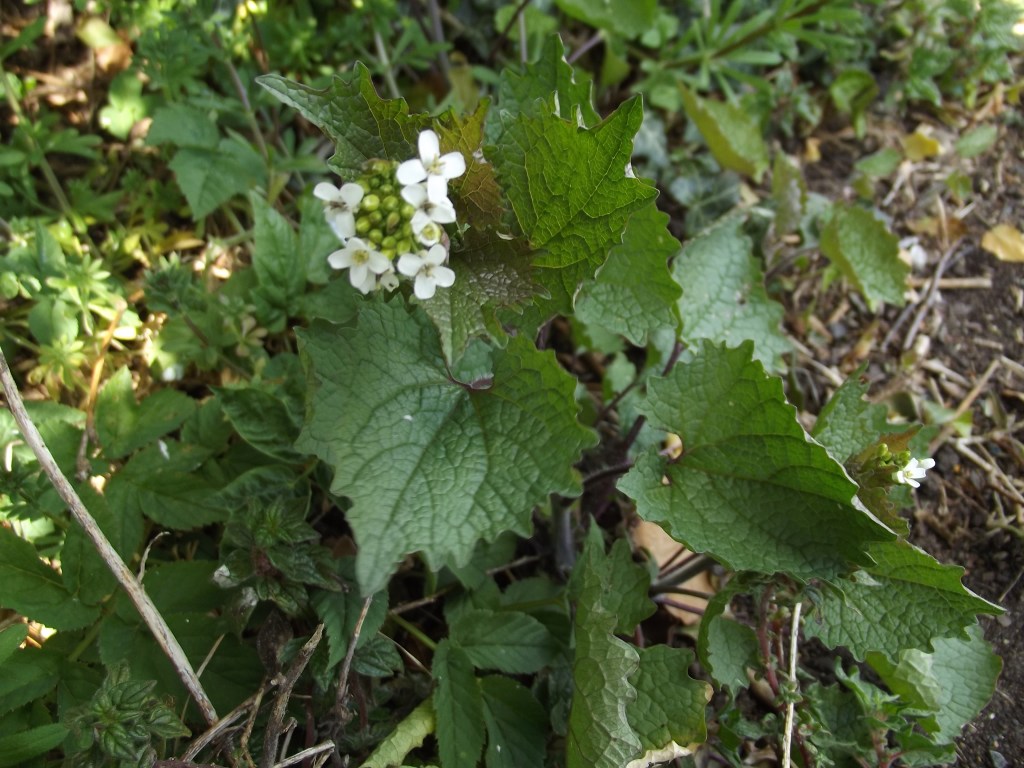
The plant is a biennial, taking two years to complete its life cycle. In its first, non-flowering year the plant forms a low growing cluster of heart-shaped, leaves, heavily veined with serrated edges. In the following year a single upright stem grows up to about 3 feet tall from this base. The leaves become more pointed and almost triangular in shape and are spaced alternately on the unbranched stem. They are a bright, almost lime-green colour, which really makes them show up a in shady areas (where they are growing in sunnier spots the leaves turn a darker green).
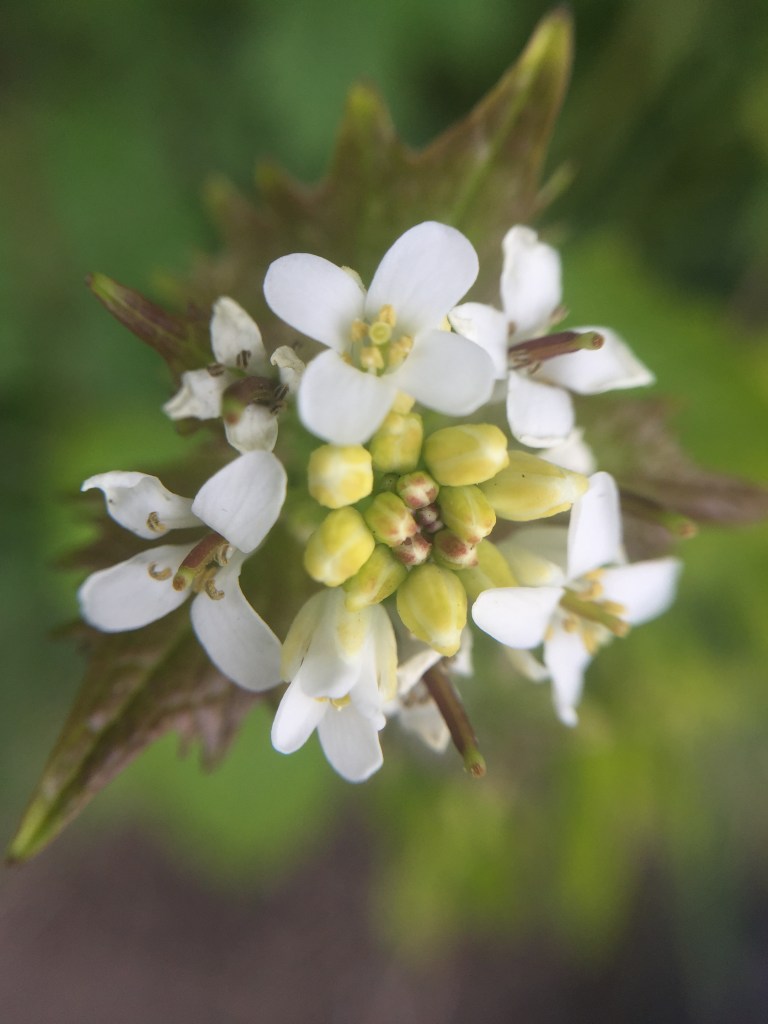
The flowers are tiny, each one with four white petals, arranged in a cross shape. The flower clusters form at the top of the stems and are followed by long seedpods.
Garlic mustard is native to Europe, Asia and parts of North Africa. Here in the UK it is an important food plant for both the orange tip and green-veined white butterflies, which lay their eggs on the plants and the caterpillars feed on the leaves. Introduced to the USA long ago, probably by early settlers for food the plant has become a serious invasive weed in some areas, with no natural predators to keep it in check.
Garlic mustard totally unrelated to garlic (it is a member of the cabbage family. The leaves do smell faintly of garlic when crushed and have a mild garlic flavour. Interestingly, Some people report an unpleasant bitter aftertaste, completely undetected by others. For those who do like the flavour, the young leaves can be chopped and added to salads and used instead of mint to make an alternative sauce to serve with lamb. Historically it was used to make a sauce to accompany sea fish – this gives another old name: sauce-alone. The seeds are mildly peppery and can be used as a mild alternative to commercial mustard.
Herbal and folk medicine has employed garlic mustard to treat asthma and other lung complaints and as an antiseptic. As with all foraged wild plants, it is important to follow some common sense safety guidelines
Don’t touch or pick any plant unless you are ABSOLUTELY CERTAIN that it is safe to use, and not poisonous.
Don’t pick anything unless it is abundant
Only pick small amounts and no more than you need
Don’t pick if there is a risk of pesticide/weedkiller or other contamination, including from traffic or other forms of pollution.
Always get permission from the landowner.
Avoid areas which may be soiled by animals (wild or farm animals or pets)
Wash plants thoroughly
One of my favourite sights on a sunny Spring day is to see the shoots of garlic mustard standing to attention in front of a hedge or on a woodland edge, with a pair of orange-tip butterflies fluttering overhead.























 Stitches by the Sea