Posted in Uncategorized

Saying Goodbye to Mum (3)

A Silver Lining

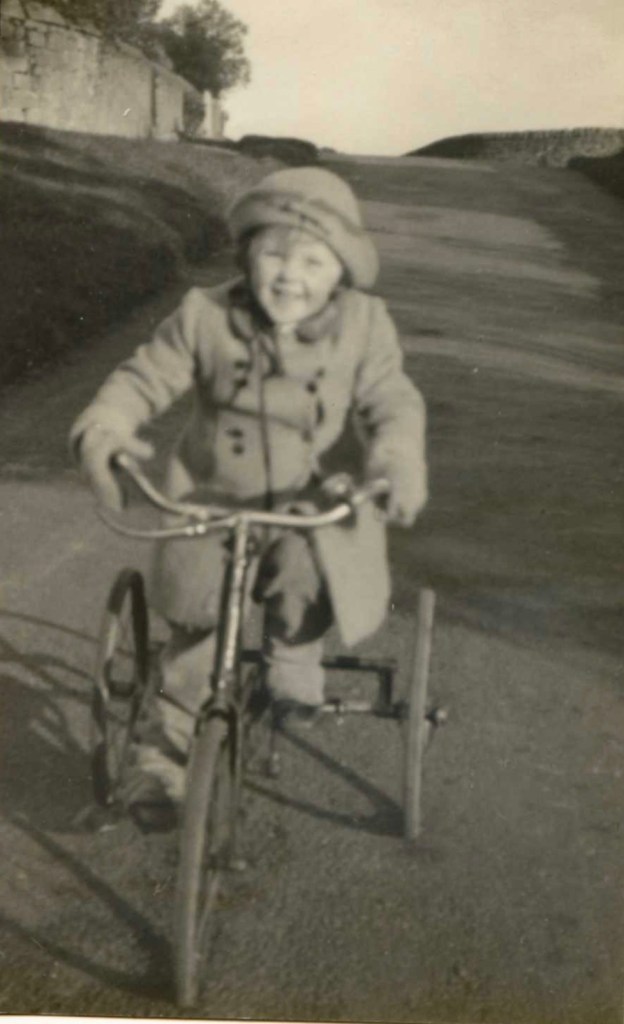
Mum on road by Glen View Cottage

It’s been a horrible few weeks, but something that has been really positive about the whole experience has been reaching out to my extended family. Both my grandparents came from large families so there are a lot of us. Initially this was to let people know that Mum had passed away, then we shared memories of her.

I knew that my Mum, along with her mother, brothers and some of the cousins had been evacuated to the village of Ingoe during World War II, to escape the bombing in Newcastle. Shipyards, engineering works and factories making tanks and guns had made the city into a target.

One of Mum’s cousins, Pat, a lovely lady who I have not seen in years, has been exchanging emails with me. She and her brother, Michael were in Ingoe during the war with Mum. One of her grandchildren had done a school project about wartime evacuation and she’d written about it for him. She sent me this account along with some photographs and has very kindly allowed me to publish them here.
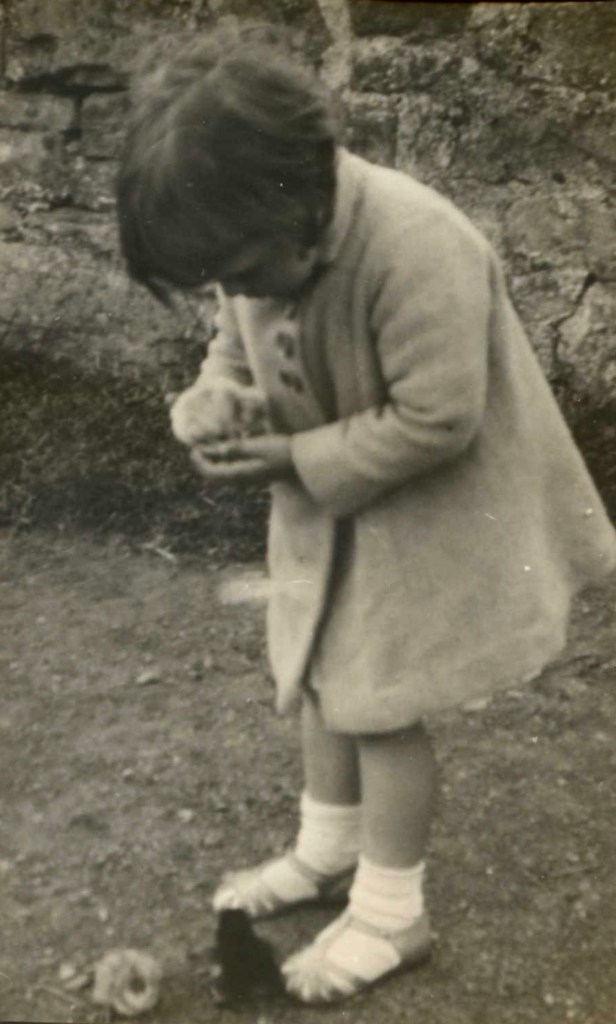
Pat

Evacuation in 1939

I was seven years old when the Second World War began and I lived with my parents and younger brother in Newcastle upon Tyne.  My school had infant, junior and senior departments.  Our parents were given the option to allow us to be evacuated from Newcastle which was thought to be a prime target for German bombers as it had a large shipbuilding industry as well as engineering works and associated factories making armaments.  Railway links with Newcastle running north, south, and west were important and there was a large goods depot where food supplies and necessities were stored and where trains were maintained and repaired.  Throughout England more than 3,000,000 children and adults were evacuated, from cities and towns, to areas which were deemed to be ‘safer’ in a scheme known as Pied Piper.

My mother volunteered to go as a helper with children from the school and my brother came too.  Michael was three years old.  I am sure that there must have been meetings for parents, and certainly information and lists, so that they knew what the children had to take with them, when and where everyone had to assemble but we were not told where we would be taken.  On the morning of the evacuation we all went to school equipped with a case, or bag, containing underclothes, night clothes, slippers, socks, spare shoes, toothpaste and brush, soap, facecloth, towel and some warm clothes and with the all-important gas mask in a box attached to a long string which went around our necks.  I think that we were all wearing warm coats to which a label was pinned giving our names and ages and the name of the school from which we had been sent.  We also carried something to eat on the journey.  

In a very long crocodile we left the school fairly early in the morning and walked to the nearest railway station which was not far away (on Jesmond Road) accompanied by teachers and many helpers.  My mother was not only responsible for Michael and me but she also had several other children to look after during the journey and I do remember that we all managed to fit into one railway compartment.  Many parents accompanied us to the station but could not board the train so stood on the platform watching their children on the train.  I think that there were lots of tears but generally we children were quite excited to be on a train.

The train left Jesmond Station, Newcastle when it was full and took us through Newcastle then, very quickly out west into the countryside.  We must have travelled to Carlisle then south to the Lake District.  It was quite a long journey but most children had a sandwich or piece of bread and cheese.  There was a lot of unemployment on Tyneside and many very poor families so the sandwiches may have contained egg or cheese but there were many children on the trains who had just a piece of bread or a jam sandwich.  Apples came out of many pockets and some had the luxury of a Kit Kat biscuit or another type of biscuit.  We were given water to drink several times during the day and mother had brought some extra food and sweets to share with the children in our carriage.  I think that we fell asleep for a while and in the afternoon we were aware that the countryside was different, we could see high hills and mountains.  The train eventually reached Windermere and, I think that we were then taken, in buses, to Bowness on Windermere which was our destination and we walked to a school where lots of people were waiting for us.  Because Michael and I were accompanied by a parent we were almost last to be allocated a place to stay and by that time we were all very tired. I am sorry that I did not ask my mother, when I was an adult, how she felt about the situation, how she related to the lady with whom we were living and how she felt about being away from her own home.  She was kept very busy because two other children were with us and I know that she did a lot of the cooking and washing.

We were billeted with the head teacher of the primary school who lived in a large house opposite an open piece of land on which brambles grew and where blackberries were ripening in large quantities so that blackberry pies, crumbles and cakes were everyday items on the menu.  We went to school each day but only for half a day as the school could not accommodate the resident population of children plus all the evacuees.  The weather was lovely that September and we would walk down to the lake, paddle in the shallow water for a while, play in the sand and throw pebbles into the lake before walking back to the house for lunch or tea.  There was no bombing during the first few weeks and months of the war and mother decided to take us back to Newcastle for a while.  

I think that Uncle Ken [my grandfather] came to collect us because we made the journey by car and, at that time, my father could not drive because of a badly damaged ankle.  Uncle Ken’s parents had a cottage twenty miles outside Newcastle where our Aunty Wyn [my grandmother] and Gillian [my mum], were already staying and within a few weeks Michael and I went to stay with them.  Mother stayed at home with Dad but mother’s youngest sister (Jean) came with us to help look after us all.  Aunty Jean was still quite young then and living with our Grandmother in Newcastle until she was old enough to join the WRAAF.  The village in which the cottage stood was on a high outcrop of rock with views towards Newcastle and the coast so that on a fine day we could see a silver line on the horizon which was the North Sea. 
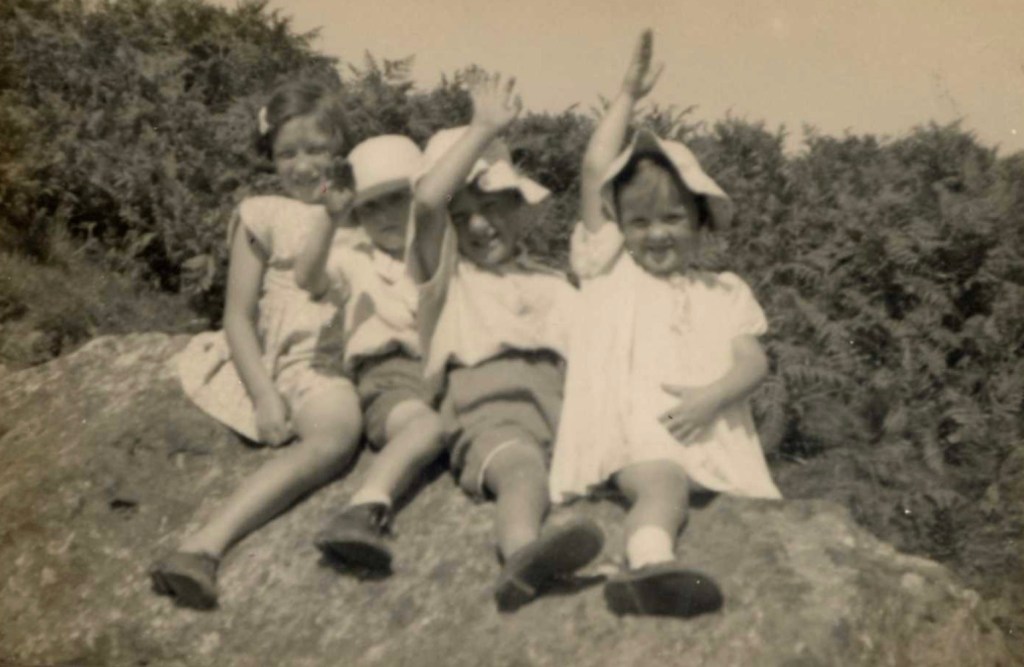
South Crag.L-R: Pat, Michael (Pat’s brother), ?, Mum

There were only about thirty cottages and half a dozen farms in the area plus a Methodist Chapel.  There were no shops but a travelling shop called three times each week and I can still recall the very special smell that came from the back of the van when the driver opened the doors – the mingled smell of bread, meats, apples, vegetables, and paraffin for the lamps was very distinctive and I can still remember it today!  On Thursdays a bus came at 9.30 and took people to Hexham to do their main shopping and brought them back at 3.30., we children never went on the bus. Another smell which reminds me of Ingoe is that of Phlox  because there were clumps of pink Phlox in front of the house, there was also a Beech hedge and when I hear the breeze through the Beech hedge here in Cheltenham I am reminded of Ingoe.  Smells!  Pleasant and not so pleasant!

Outside cottage. Had Tinted? Mum and her cousin Michael with Auntie Jean behind the garden wall

There was a school which took in children from the age of five to fourteen, which was the school leaving age then; the head teacher was Miss Robson and there was an assistant evacuee teacher whose name I cannot remember.  There was only one large classroom for all the children and on the longest wall there was an enormous fire range which kept the room warm and provided us with hot water and sometimes, in the winter, soup for the children who could not go home for lunch.  Many of the children had a long walk to and from school each day; they came from outlying farms and cottages.  The toilets were outside and were very basic, smelly, draughty and cold and they had a distinctive smell too!

The village had no running water into the cottages and farms although some of the farms had wells.  People in the village had to carry every drop of water that was needed from a tapped spring which lay at the bottom of a steep hill (I think that it was called The Pant!) and each child who was capable of doing so had to help to carry at least a little water.  When evening came we lit Tilley (paraffin) lamps and candles so it was always early to bed even for the adults.  
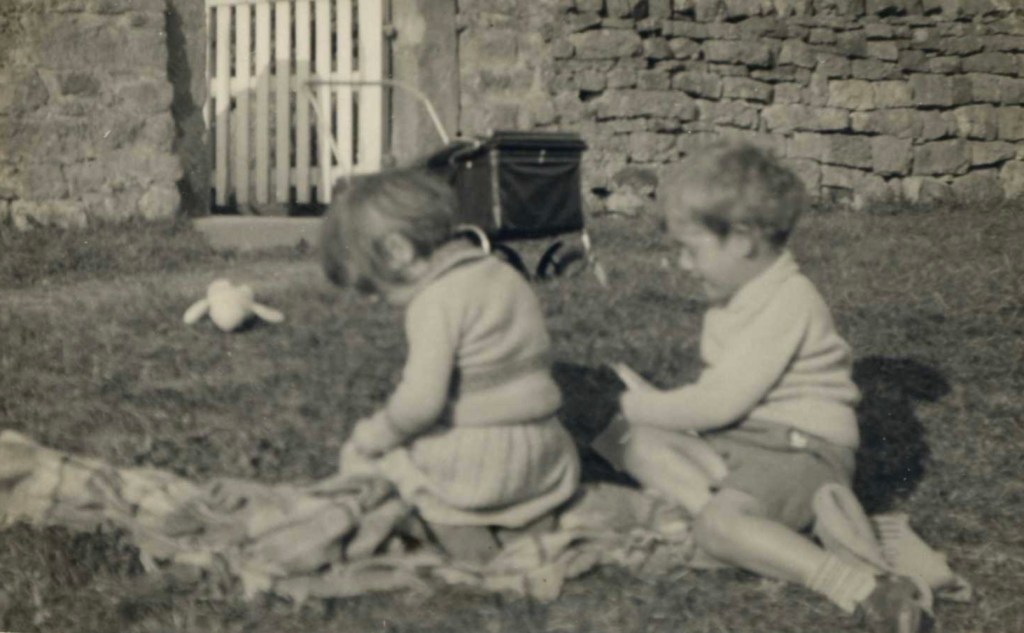
Outside cottage. Mum and Cousin Michael

War seemed a long way away although we did sometimes see air battles in the distance and when there had been a night raid on Newcastle we could see the glow of large fires even though it was so far away.  The night on which the goods station at Manors Railway Station was bombed the blaze was spectacular and could still be seen during the day.  At school we were trained to run to a ditch or hedge and lie down with our hands over our heads and ears when we heard an aeroplane.  Usually the planes were friendly as there was a small air field nearby where new pilots were trained but occasionally there were German planes in the vicinity.

Life must have been very difficult for Aunty Wyn but I don’t remember her being cross with us.  Every house had one or two rainwater butts to collect water from the roofs for washing people and clothes but every drop of drinking water had to be carried in buckets from ‘The Pant’ which was a piped spring at the bottom of the steep road which was the only road into the village.  An adult would carry two buckets and any child capable of carrying water was expected to help.  Neighbours were helpful and generally kind.  There were no indoor bathrooms/toilets; outside, at the back of the house there were two facing rows of cubicles each containing a wooden plank seat with a hole over a bucket!  It was smelly in the summer and bitterly cold in the winter and the holes did seem quite large!  Michael actually managed to lose his grip on the side of the hole and fell down into the bucket.  Poor Aunty!  Fortunately Aunt Florrie was staying at the time and she had to extricate him from the bucket then clean him up!!  She was not amused. There were chamber pots under the beds and we washed in a bowl in the tiny kitchen or had a bath in a tin bath into which hot water from the ‘range’ was poured – sometimes the tin was a bit hot I do remember that!   We had Tilley lamps and candles for lighting and a coal/wood burning range in the living room for heat and for cooking.  There was always a kettle of water on the hob and the oven was usually warm, or hot for cooking.  I don’t remember much about the food except that we had a lot of vegetable soups sometimes flavoured with chicken stock from boiled bones.  

My mother came at the weekends and always brought some ‘goodies’ for us all and clean clothes for three children.  Uncle Ken still had a car so was able to come most weekends and he was the one who had the unenviable task of emptying our toilet bucket!  When we knew that he would be coming we would be outside listening for his car which we could hear before we could see it.  I do remember the utter silence on most days although, of course, there were plenty of farms around the village so there were a few tractors.  Most of the farms still used horses with ploughs and the hay was often still cut by men with scythes although some was cut mechanically.  We bought our milk from Pasture House Farm where Mr and Mrs Temple lived and they became firm friends and were very kind to us.  Sometimes they would give us a couple of free eggs or a few rashers of bacon.  Another farm was Sandyway Heads which was farmed by the son of the largest nearby farm but I can’t remember the name of that farm or of the farmers.

I loved the country and the freedom that I had to roam fields and play in the bracken on the South Crag.  School was very relaxed!   We younger children were often looked after by the older girls who just ‘mothered’ us and read to us – if they could read themselves.  Michael and Gillian were too young to go to school so were looked after by Aunty Wyn.  I wish that I had talked to her too about those days!  I also wish that I had thanked her for her care during the time we were with her.
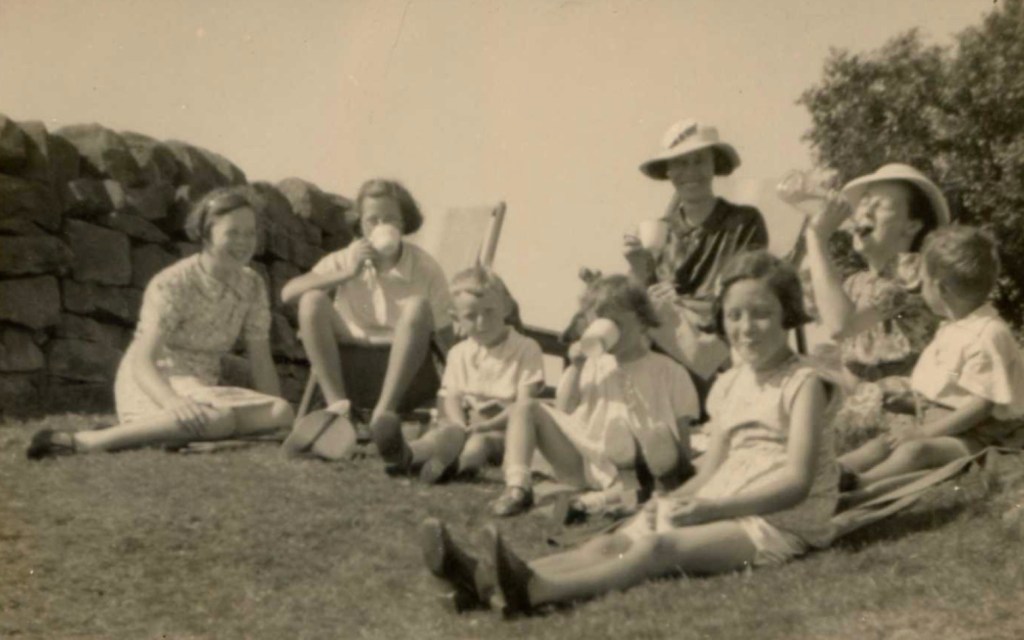
At South Crag. Far right: Michael, looking up at my grandmother (his Aunty Wyn). In front of them ar Pat (R) and Mum next to her drinking from cup

I’m so grateful to Pat for sending me this. She has an incredible memory! It has given me so much insight into what My mother experienced during this time – she was very young (just 2 years old when war broke out), so she could only just remember some of it. Pat has written such an amazing account, not only a fascinating social document, but a piece of my family’s history that I will cherish.

The photos Pat sent include this one of the cottage. It still stands and can be seen on Google Map Street View – little has changed
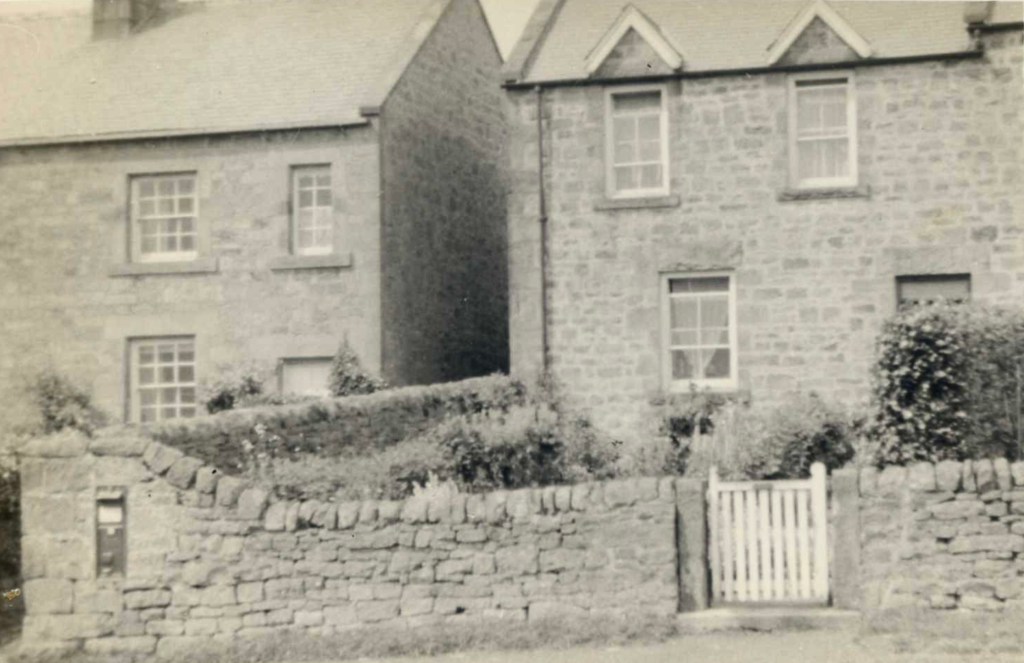
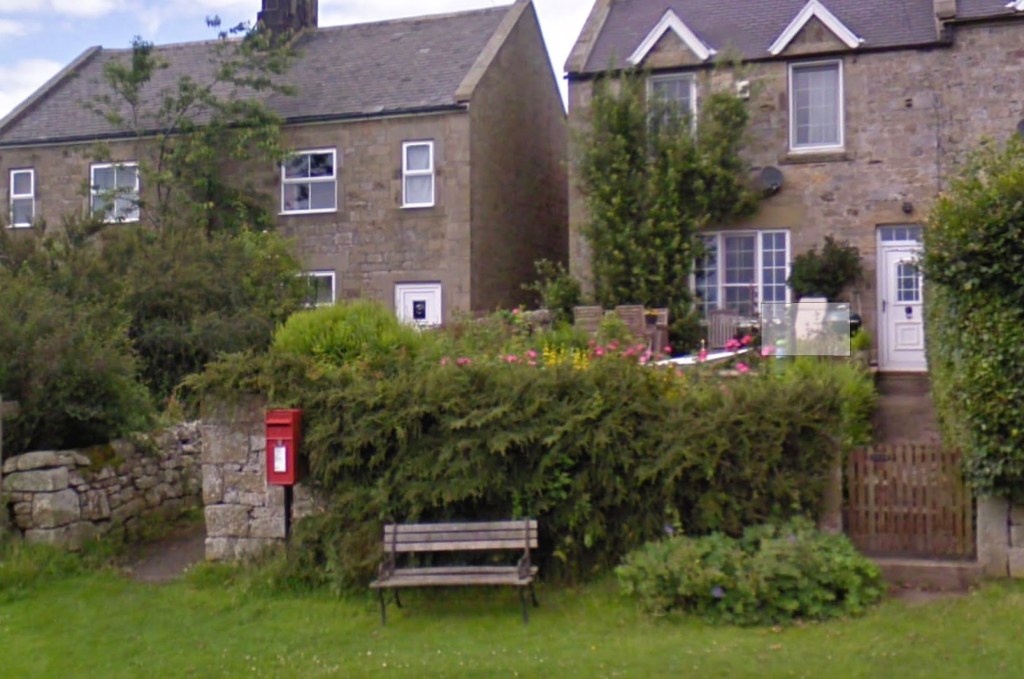
Glen View Cottage
Screenshot from Google Street View

Another unexpected connection that I discovered after the last two blog posts were published is that one of my blog subscribers is the mother-in-law of one of my cousins (Hello Cathy!). She is a keen genealogist and has traced my ancestors several generations back from back from my grandfather (Uncle Ken in Pat’s account). Cathy has offered to send me further details. How amazing is that?

All this is really helping me find something really positive at what has been a very sad time – I’m learning more of my family’s history and it’s so interesting.
Posted in Uncategorized

Saying Goodbye to Mum (2)

I’ve heard that writing can be used as a form of therapy and self-indulgent as it might be, since the planning of my Mum’s funeral has taken up most of my headspace over the last couple of weeks, I do feel the need to write about it now.

For most of us, planning a funeral is something that we may have to do only once or twice in our lives if we are lucky. We want to do what our loved one would have wanted, often second guessing them as few leave behind plans to be followed. It’s certainly made me think about what I want to happen when the time comes, and how to make my wishes known to my family.

In arranging Mum’s funeral, all we knew was that she wanted to be cremated and to have a Christian service, so we came up with something that was in line with her faith, but at the same time very personal.

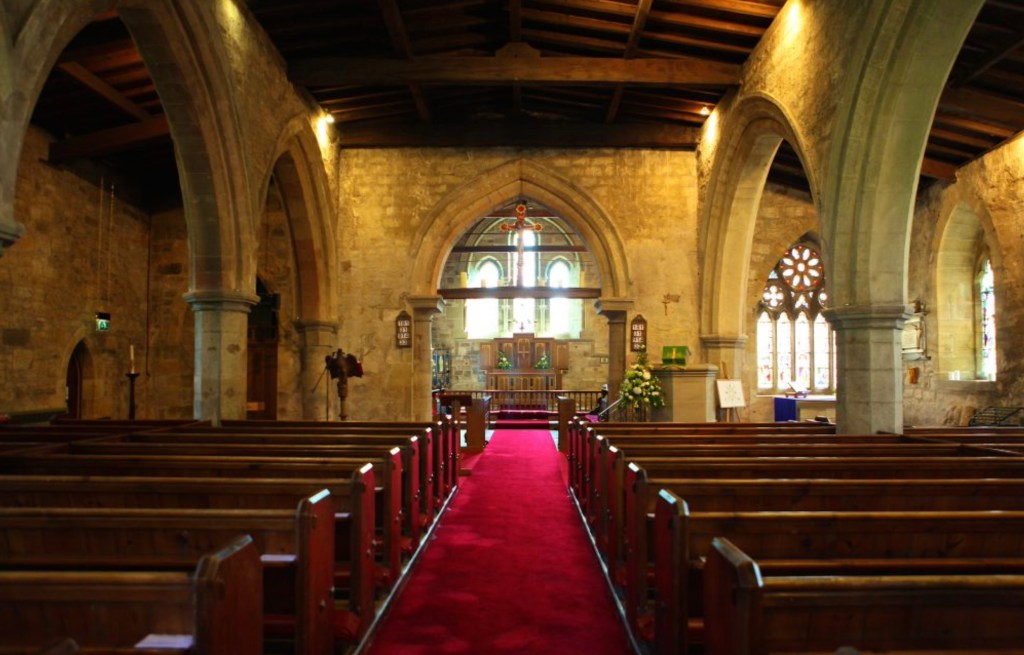
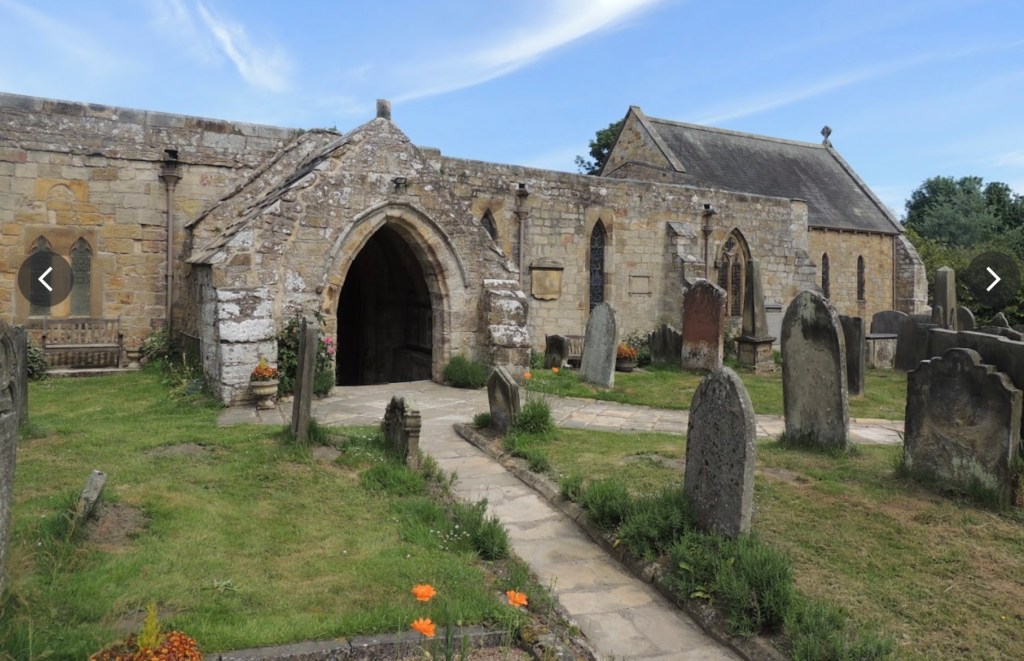
We agreed on a traditional funeral service at the church she attended for many years, St Michael and All Angels, Felton, followed by a short cremation service at the nearby Bockenfield Crematorium. Both the vicar, Rev Richard Townend and our funeral director, Kevin Foster gave us lots of help and support, which was greatly needed, having never done this before and not being either church goers or particularly religious. I asked my aunt about hymns (she used to attend church with my mum) and the vicar advised us on readings.

Screenshot

The church is a beautiful old building dating back to around 1200 (you can read more about its history here). My brother and I visited it a couple of weeks before the funeral as we hadn’t been for ages. One of the reasons we wanted to do this was to check out the access as ancient buildings are not always the easiest for disabled visitors. The main path up to the church has some steep and uneven sections, so we decided to borrow a wheelchair for my aunt and that I would use my mobility scooter. The funeral director was able to obtain the wheelchair and ensured that there was space in the back of the funeral car for a folding scooter. There is a portable ramp at the steps into the church.

The church has kept up with the times , despite its medievals origins, to make it a more flexible space. A glass wall was erected to divide off the back of the church and this has created a soundproof space with all sorts of functions: it is used by the Sunday School children and to serve refreshments after services, with a hatch into the kitchen. Other additions to the church are toilets, a sound system and large screen tv. All have been added very sensitively and don’t detract at all from the old stonework and stained glass windows.

Screenshot

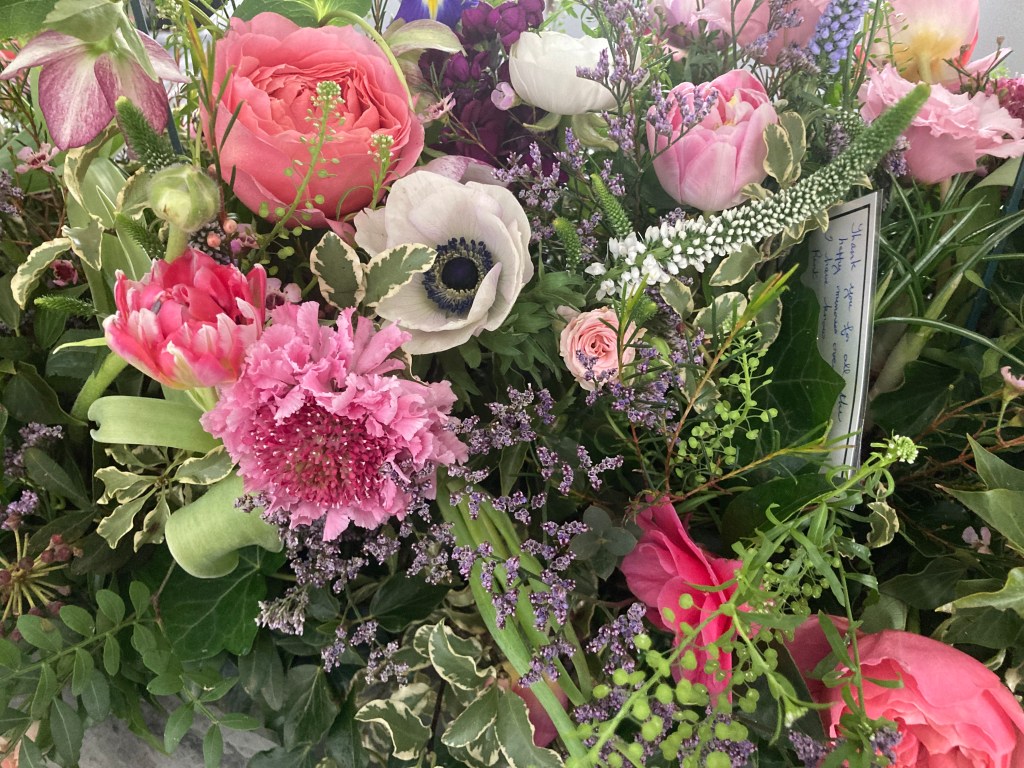
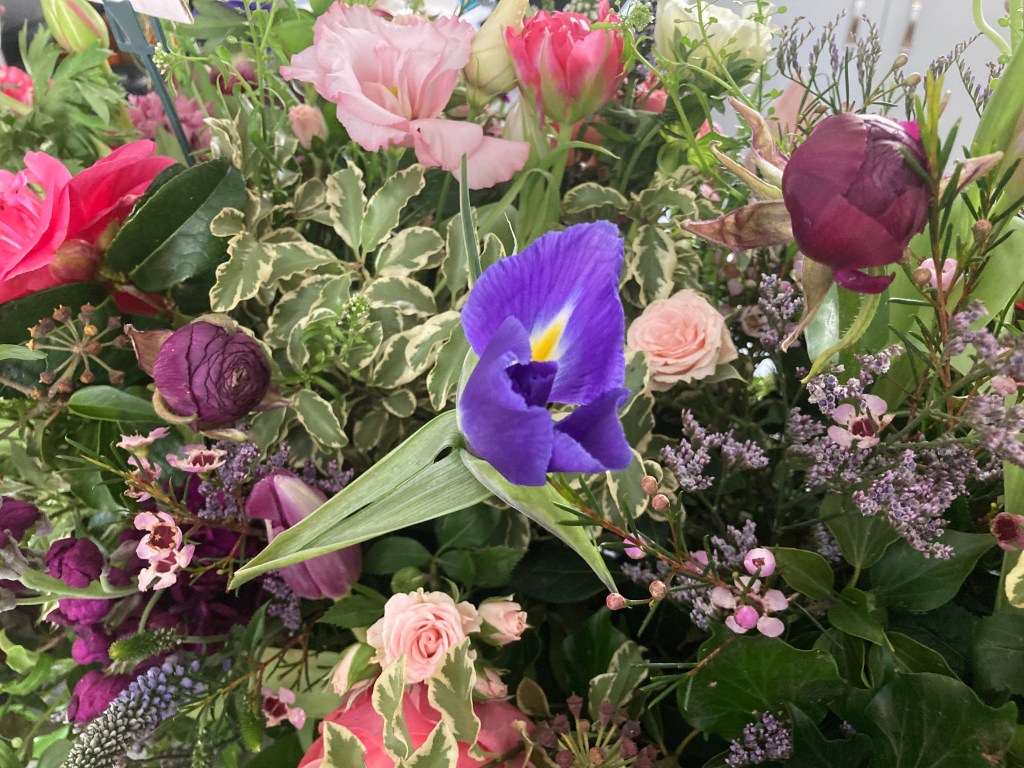
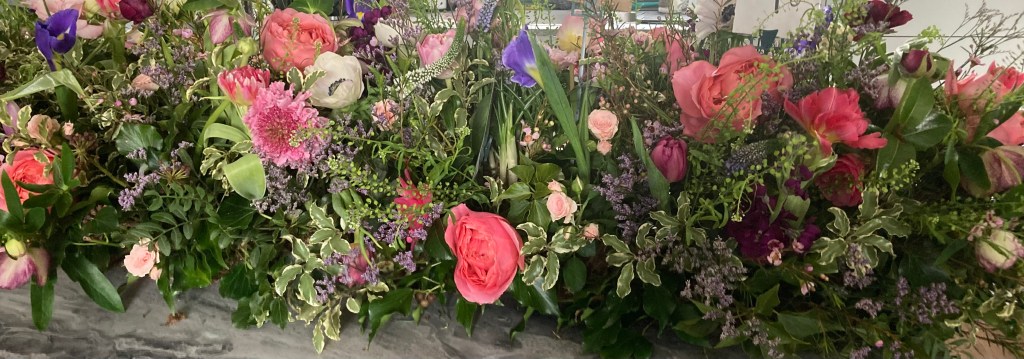
Mum used to help with the flowers at church. She used to tell me how there were no flowers during Lent, then the church would be lit up with daffodils and other spring flowers on Easter Sunday. With this in mind we decided on flowers on the coffin only. Local florist Polly Smith of Polly’s Petals, an old school friend of my daughter made the most beautiful arrangement.

We met her during the saddest time, during the week after Mum’s death and spent a lovely hour with Polly by the wood-burning stove in the cabin where she works. Polly’s style is very much inspired by nature. The spray she created resembles a spring meadow, including tulips, ranunculus, spray and tea roses, iris, lizianthus and anemones, in shades of pink, purple and white with complementary foliage. The peachy pink roses were like my Dad’s favourite peach rose in the garden.

The. arrangement was made in four sections, each to be taken home afterwards by female close family members. Polly sets the flowers in moss rather than florists foam, which is plastic based and does not break down. She also planted surprises among the moss, some white crocus bulbs, just starting to sprout, which can be taken out and planted in the garden later.

Polly was an absolute pleasure to deal with, so kind at all times. She took all our requests on board and made suggestions of her own. She even had sample flowers to show us when we visited to give us an idea of what is in season and what she’d most likely be using. The result was stunning.

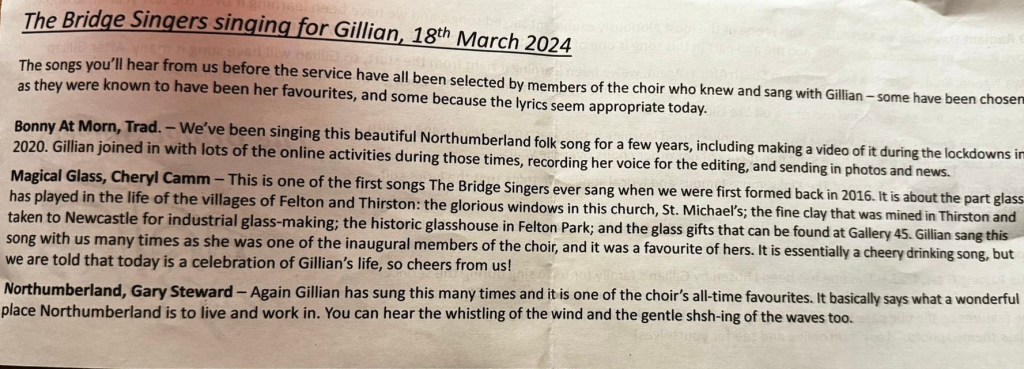
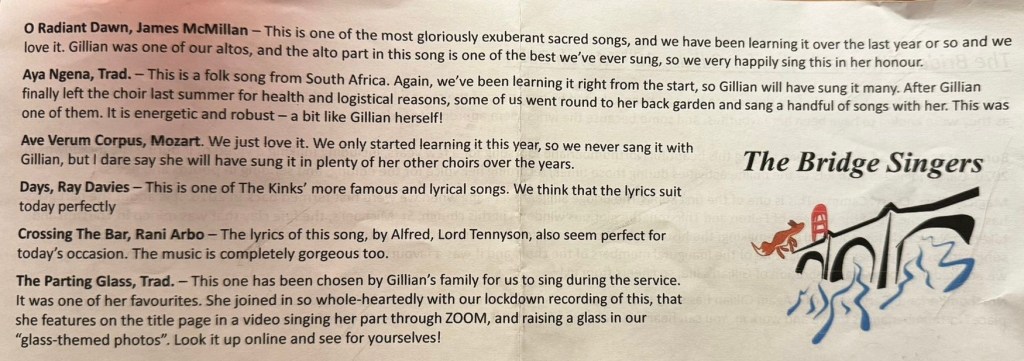
Music was important to my mum. She learnt to play the piano as a child and reached a high standard. She sang in choirs for many years, most recently The Bridge Singers, who played an important role in the service, their ranks swelled by the Swarland Community Choir. In the half hour before the service, as people were arriving, they sang a selection of songs, including some of Mum’s favourites. Notes of the song list and the reasons they were included were placed around the church.

The Choir also provided a lovely alternative to the more traditional organ music to accompany the congregational hymns. People were given the option of joining in or sitting to listen to the choir’s harmonies and contemplate the words. Their versions of “All Things Bright and Beautiful” and “How Great Thou Art” were beautiful. Their rendition of the very Scottish folk song, The Parting Glass, a favourite of Mum’s was very moving. I’m so grateful to the choirs and Musical Director Cheryl Camm for everything they did to make Mum’s service so special.

We have extended family and friends all over the world, including in India, Australia and the USA, as well as throughout the UK. Distance, health issues, work and other commitments made it impossible for quite a number of people to travel to the funeral. At the suggestion of one of my cousins, we arranged for the funeral to be live-streamed , with the option of watching later. Dejavu Video did a superb job – the videographer was unobtrusive and the video quality was excellent. I’ve had some great feedback from those who watched it. You can see it here.

As well as the eulogy I read, other personal touches were a favourite poem of Mum’s, Sea Fever by John Masefield read by my brother and the bible verses read by my daughter. I was so proud of them both for getting through it. Also, a lovely lady who is an ordained minister, and knew Mum said prayers.

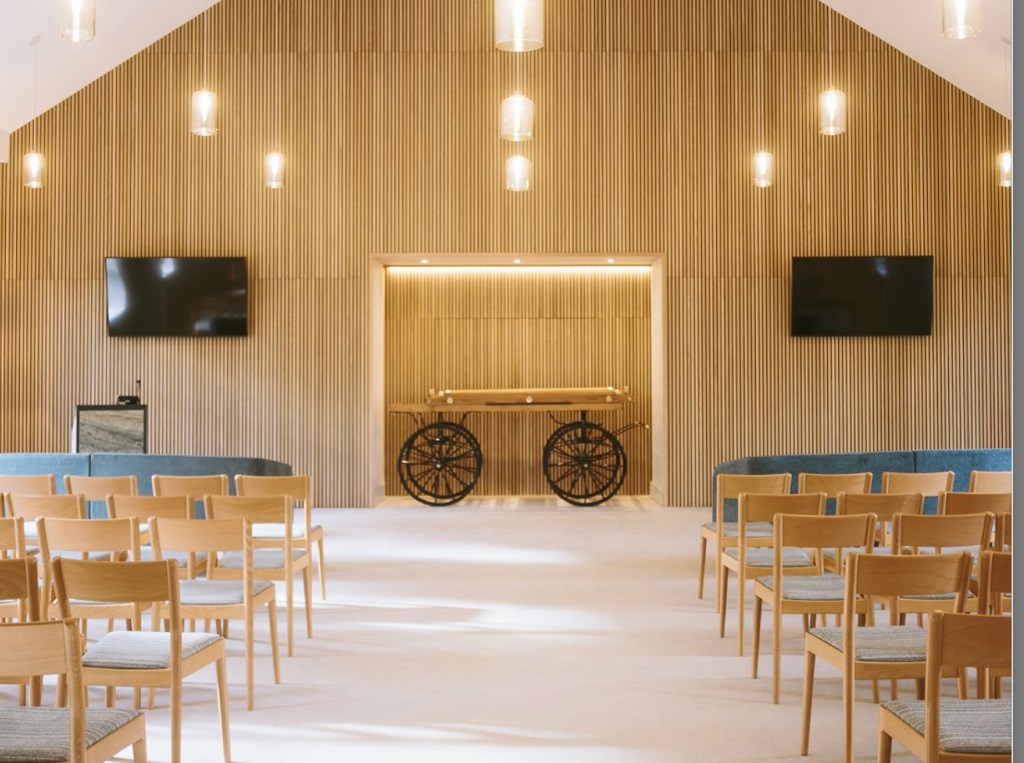
Over 80 people attended the church, after which immediate family went to a brief cremation ceremony at nearby Bockenfield Crematorium. This has been open for quite a short time: a much needed facility in this area. It is very well designed, simple and airy, with covered space outside and speakers in case the numbers overflow and a covered walkway for family to meet guestsafter the service, There are even comfortable sofas for close family at the front. The centrepiece is a beautiful antique wrought iron farm cart, that acts as a bier for the coffin.

Screenshot

A recording of one of Mum’s favourite piano pieces, Chopin’s Nocturne No.2 in E flat played as we went in, and Louis Armstrong’s “We Have All the Time in the World” played at the end, as it did at my Dad’s cremation.

Following that we joined the guests at The Northumberland Arms, Felton for refreshments. They had been a pleasure to deal with too and served a delicious hot and cold buffet.

It was an emotional, long day, but it went off without a hitch and it was lovely to share memories of Mum with family and friends, old and new. She would have loved it!

Posted in Uncategorized

Saying Goodbye to Mum (1)

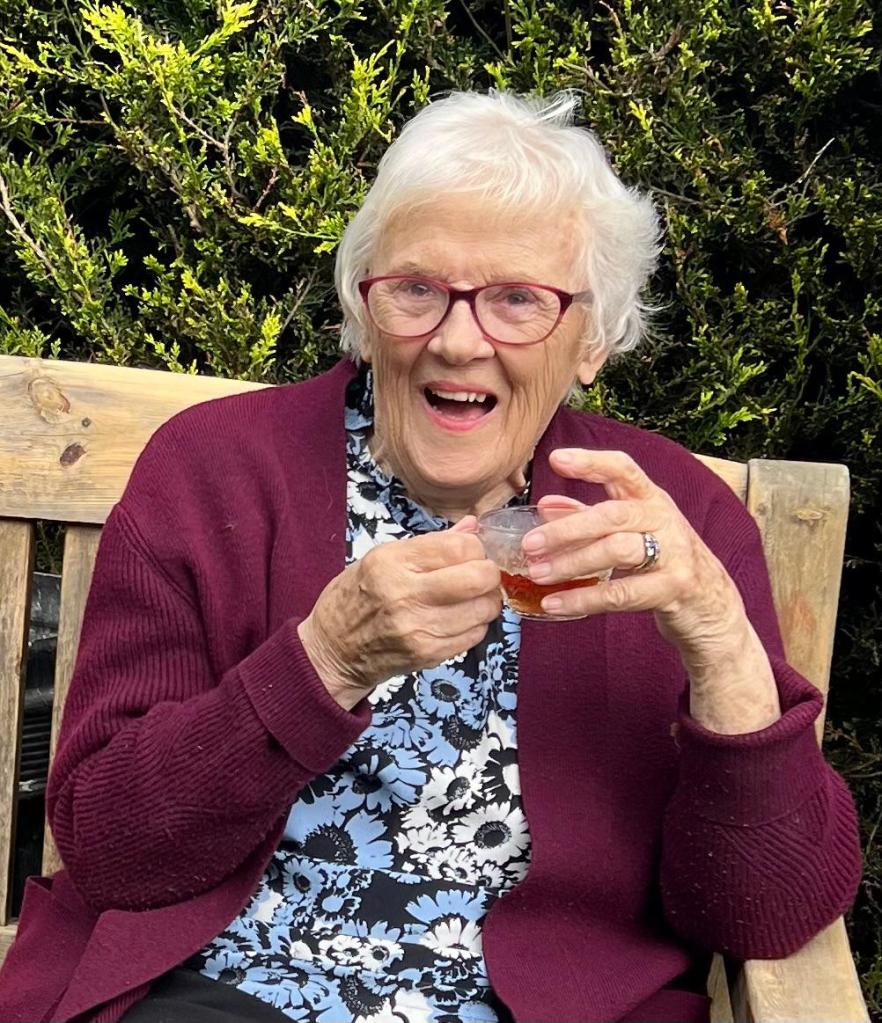
Today was the funeral of my lovely Mum, Gillian. I wrote and delivered this eulogy at the service we held for her today.

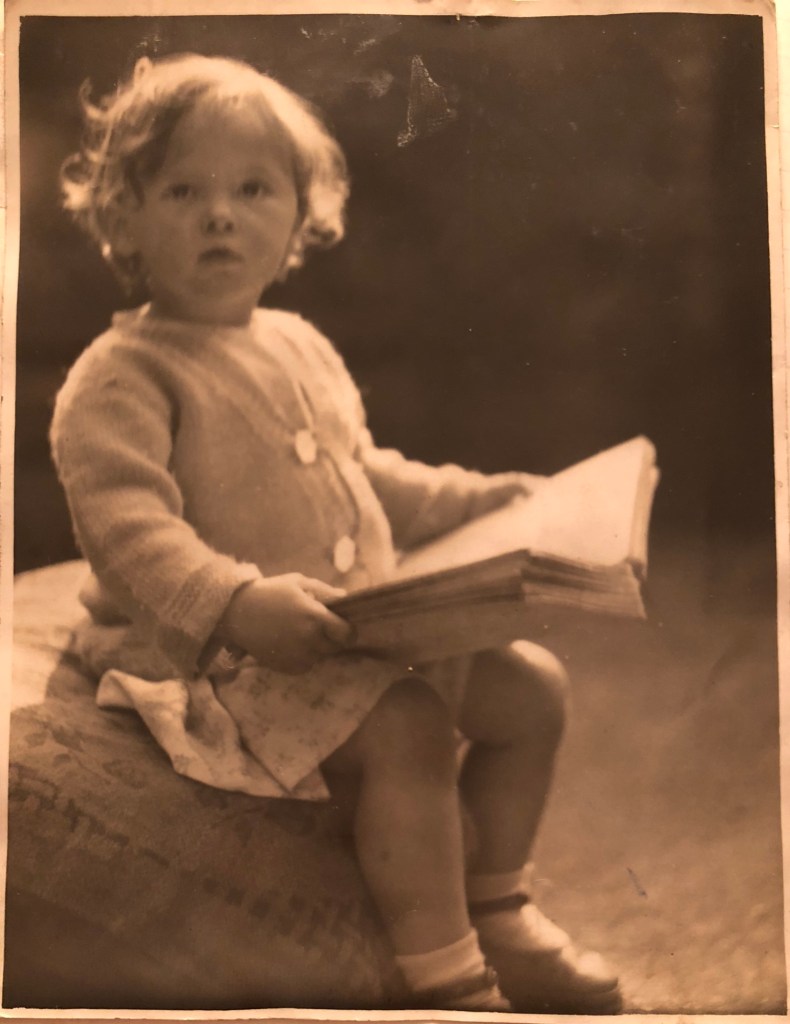
My Mum, Gillian was born in Newcastle on 15th February 1937, the first child of Ken and Wyn Holloway. I’m told that her form of the name (Gillian with a hard G) came from a character in a book that my grandmother had read. Mum was followed by her brothers: Peter in 1941 and Michael in 1946 . 

Some of Mum’s earliest memories are of WWII. Once, on hearing a news broadcast on the wireless, she asked her mother if there was any news on the radio when there was no war on. During an air raid she huddled under the stairs with her mother who was holding her baby brother Peter. My Granny prayed, “God save my babies”, over and over again – that always makes me want to cry. The children spent happier times when, accompanied by their mother and cousins, Pat and Michael Porter and Anita, they were evacuated to the village of Ingoe, where they stayed in a very spartan cottage – there was no running water, just a hand pump at the end of a very steep lane, but they loved the countryside.

After the war the family enjoyed holidays on the coast and fell in love with Newton-by-the- Sea. My grandfather rented and later bought a secluded former quarry, a beautiful sheltered spot, where a series of family caravans have been sited ever since. The children spent idyllic summers there and on the beach. 

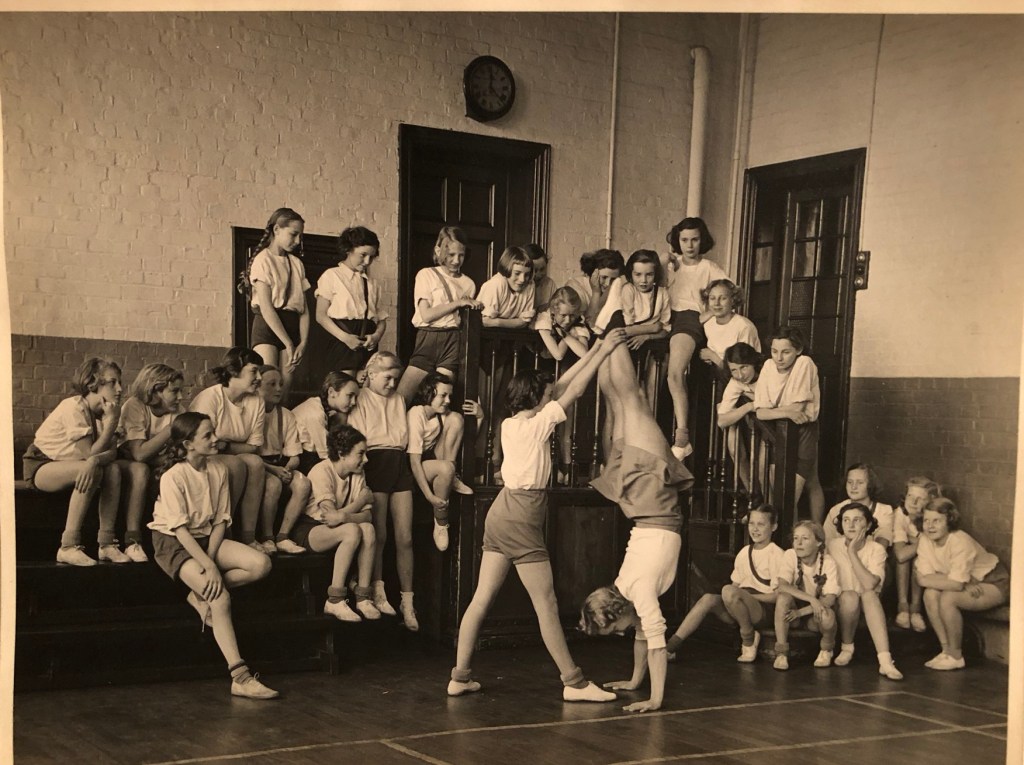
Mum attended Newcastle Church High School, where she enjoyed sport (apparently she once accidently knocked out the games mistress with a hockey stick). She was in the South North’land Tennis Club .She also learnt to play the piano to a high standard. It was while she was still a schoolgirl that Mum first noticed my dad.

The family would go along to watch my grandfather compete in motorcycle trials There was a handsome young competitor, a rising star in the sport named Arthur Brown. Mum was smitten!

Mum left school after O levels, doing well in most subjects, including Latin – her party piece was to recite Humpty Dumpty in Latin. Mum did fail her geography O level though, which my Dad teased her about a lot – when they were out in the car it’s amazing that they ever reached a destination because he’d never ask her to navigate and he (typical man) would never ask for directions.

After school Mum went to commercial college and trained as a secretary. Her first job was at Martins Bank, after that she worked at was to become Proctor and Gamble – Mum became secretary to the Marketing Director. and was there when they developed the jingle for “mild green Fairy Liquid” She actually knew the second verse to that.

By this time Mum and Dad were going out. My grandfather was not exactly supportive at first (nobody was good enough for his daughter) – sometimes Dad took Mum to the same pub that my grandparents visited, always picking secluded seats by the back door for a quick getaway if the bar staff tipped them off that her parents had come in the front.

Mum and Dad married in 1958 and set up home in South Shields, where Dad was born and worked. Mum continued to work at Proctor and Gamble until I came along in 1960. My brother Chris arrived 3 years later. My parents first home was in Leafield Crescent, and a few years later they moved to Harton Grove. We had lovely neighbours in both places. When we were very small there were coffee mornings with lots of other small children and their Mums, Nan would babysit on Thursday night and my parents would have a night out. I also have lovely memories Mum taking us to the beach at South Shields, summers spent at Newton by the Sea and family holidays in Scotland and sailing on the Norfolk Broads. 

On one sailing holiday the boat ran aground, Mum jumped ashore to push the boat off, but as she did so a gust of wind filled the sails and off went went leaving her behind. She was soon picked up by a motor cruiser which caught up alongside and Mum leapt gracefully from one boat to the other. It was so exciting

As we got older, Mum joined Dad working in the family motorcycle business, his father began, running the office and serving in the shop. She still managed to be home when we got back from school though. She looked after us and Dad and our pets (the guinea pigs, gerbils , hamsters, tortoise, fish) – the dog, Brett was all hers though.

Alongside all this she was also involved in the local church and, when my brother joined the scouts, Mum became heavily involved in a parents fundraising group, organising events like jumble sales and some rather raucous but very well supported cheese and wine parties …..and the scouts all the camping equipment they needed.

By this time Dad had joined the Rotary Club and Mum became a founder member of Harton Inner Wheel, resulting in more great friends. I’m told the conferences were particularly good fun, down to the great company of her fellow Inner Wheel ladies – she continued to meet them for lunch every month.

In the 1980’s Mum and Dad sold the business and both worked for the Motor Agents Association. Mum’s role was as a monitoring officer for a Youth Training Scheme. She checked up on trainees as they attended college and work placements, as mechanics, car salespeople and other roles in the industry, and soon became a familiar figure on garage forecourts and car showrooms across the area She told me that she’d feel so proud when years later, taking her car in for a service she meet a former trainee who’d done well following the scheme.

She became a mother in law for the first time when Kevin and I married in 1987. My only regret about our wedding is that we missed the after party. While we were travelling to our honeymoon destination, Harton Grove was partying hard. I’ve seen the photographs.

The following year Mum and Dad moved to Swarland. It was a carefully thought out choice, being close to the A1 for easy travel and near the coast, but just about out of reach of the sea fret. They loved it, totally embracing village life. They joined the golf club, Mum got Russ the labrador. She helped to run the Brownies (where she was known as Grey Owl), organised front of house for the drama group and joined the church here at Felton, helping with the flowers . She also rekindled her love of music singing in choirs, most recently the Bridge Singers. 

Mum was a devoted grandmother to Caitlin and Calum. Whenever we visited for a weekend and arrived late on a Friday night, Mum would insist on chasing me and Kevin out to the Pub, however tired we were “Because I know you don’t get out much just the two of you”. Then she’d relish getting the children ready for bed and reading them stories. When the children were older they would come on longer visits without us, which they absolutely loved. Mum would make their favourites: apple pie, green jelly. And there was the magic turtle – a tiny ornament that would mysteriously fill up with sweeties when you weren’t looking.

Importantly, Mum made wonderful friends in the village and had the best of neighbours. The kettle was always on and the gin and tonics were always available, they even had a gate between their garden and that of their neighbours Hazel and Trevor, which saved time when they shared refreshments in the garden. 

My brother Chris married Christine 2003. Ever the optimist, Mum had become convinced they would announce their engagement long before they actually did. In fact a bottle of champagne was put in and out of the fridge every time they visited over several months until it could be opened to celebrate properly

Mum looked after my father when he became ill. His death in 2002, not long after her own father’s death, hit Mum very hard, but she told me that if his death had to happen, at least it happened in Swarland, the place where they had been so happy and she was surrounded by so much love and support.

When we moved up here that Christmas it gave Mum the boost she needed .She looked after us too, and was delighted to be able to spend so much time with her beloved grandchildren. 

The following Christmas Mum threw the first of her legendary Swarland parties. I think initially she wanted to do it as a thank you for all the support everyone had given her, but it soon became an annual event, with food, drink (the Strictly Final usually) and lots of friends and their offspring. Someone once told me that Christmas wasn’t really Christmas until Gillian’s Party.

Mum loved to travel. Holidays with Dad included Hawaii, California and Crete. Later she went on some epic trips with her sister in law Pat, to India, China, Canada and Alaska, South Africa and more, experiencing the Taj Mahal, The Great Wall, dog sleds and and safari. When this started we began to refer to it as Gillian’s Gap Year, but the travel went on longer than that. Pat told me about when they went to Thailand for a wedding. The Buddhist monks arrived to officiate and sat cross legged on the floor. Mum, always wishing to repect customs and culture sat down cross legged too. Only then the translator said the English visitors didn’t have to and she wondered how she’d get back up.

She also had some great holidays with her dear friend Margaret. They visited a number of European cities and went ski-ing in La Tania in the French Alps with my brother, Chris. She was extremely proud that she finally got her pensioners free lift pass aged 75. She also travelled to the USA for her niece, Julia’s wedding and then again in 2016 to visit her brother Michael and his wife Donna. 

Mum’s health declined 6 years ago following an unusual mental illness. This came as a huge shock to all of us as Mum has always been the most grounded, level , calm person, and an absolute rock to so many. She recovered from this, though was frailer than before and then the symptoms resurfaced in 2022. Again she recovered but was frailer again. With the support of some wonderful carers she was able to continue to live in her own home in Swarland, the place she and Dad loved so much. 

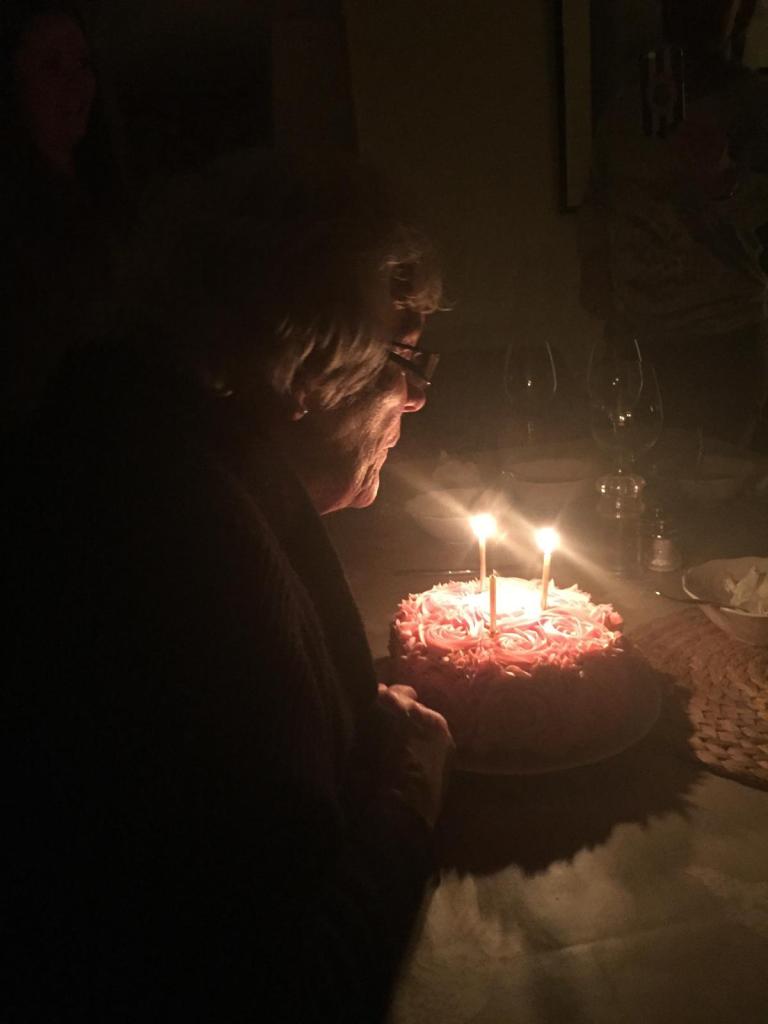
Mum had been really enjoying February. It was her turn to host our book club and we had a lovely evening. We drove to South Shields to have lunch with the Inner Wheel Ladies AND she celebrated her 87th birthday, with a family meal at the Cook and Barker. As usual, Mum ordered her favourite fish and chips, complained that it was far too big, before demolishing it, and dessert… and birthday cake! It was a wonderful evening.  She was looking forward to meeting up with her nieces Judy and Wendy and great nieces Lauren and Juliet the following month.

Mum passed away suddenly on 23rd February. We had seen her ealier in the day and she was in good spirits. It’s still sinking in that she’s gone. I keep thinking “oh I must tell Mum about that” – I bet I’m not the only one.

As I wrote this there seemed to be some common themes running through Mum’s long, well-lived life. They make me think we should all be more like her.

  • She loved her family more than anything
  • She cared, and continued to care for all of us, whenever we needed her,
  • always putting others before herself . She could always be depended on and was everyone’s rock
  • She valued friendship and kept in touch with friends that she’d made at every stage of her life
  • She had a great sense of adventure and a wicked sense of humour
  • She was one of the most positive people I have ever known, always seeing the best in people and finding something good in even the worst of situations.

And … she loved a good party.

Gillian Mary Brown 1937-2024

Posted in Uncategorized

Knit-a-Long Baby Blanket: Week 15 (Final Instalment)

After a bit of a delay, because Christmas and New Year have been hectic, here is the final part of the pattern – sorry if you’ve been waiting for it. My fault! Yvonne was on time as usual but I got caught up in other things and neglected the blog. Anyway, hope you had a lovely Festive Season and hoping that all of you have a fabulous 2024.

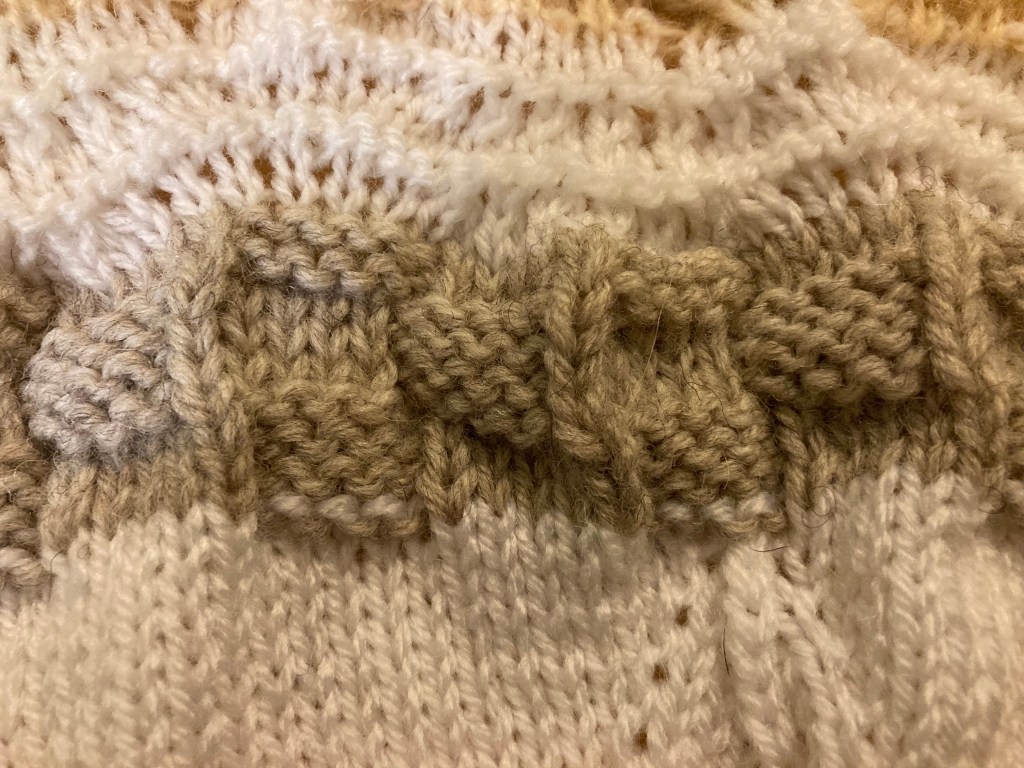
If you remember, the previous section was a checkerboard design of alternating plain and purl blocks of 3 stitches and 3 rows.

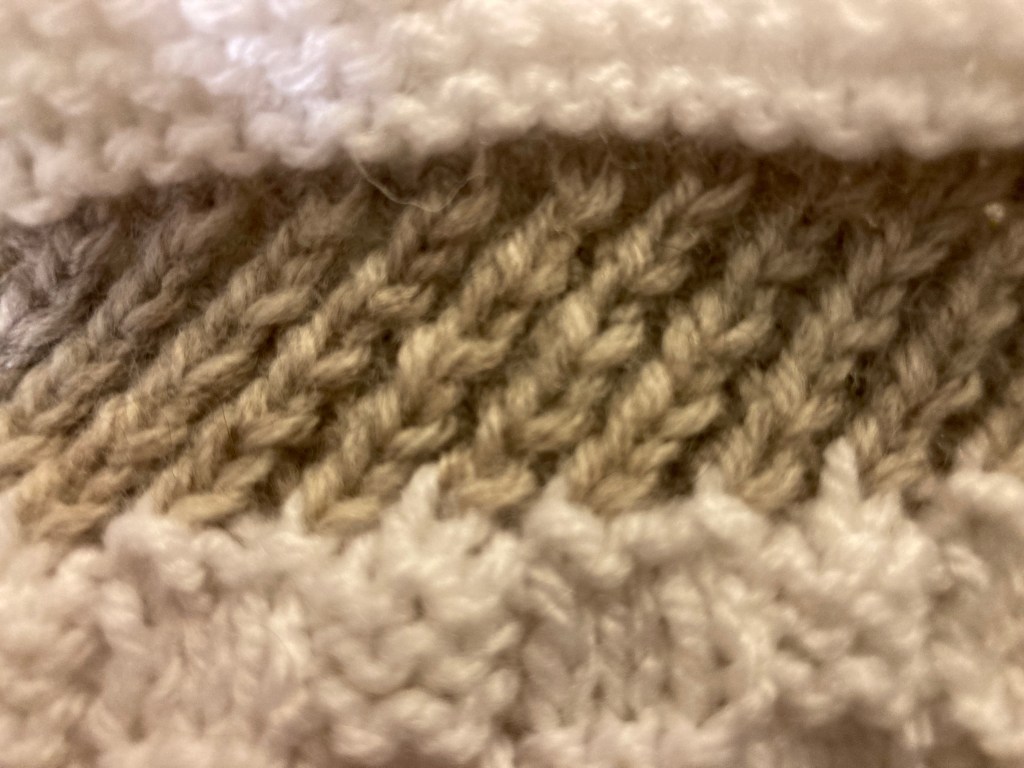
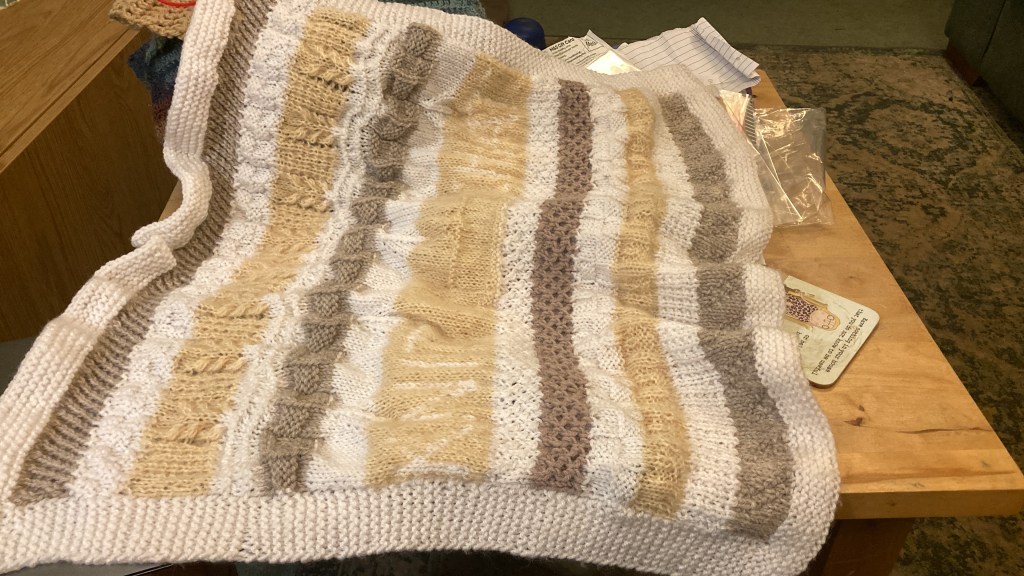
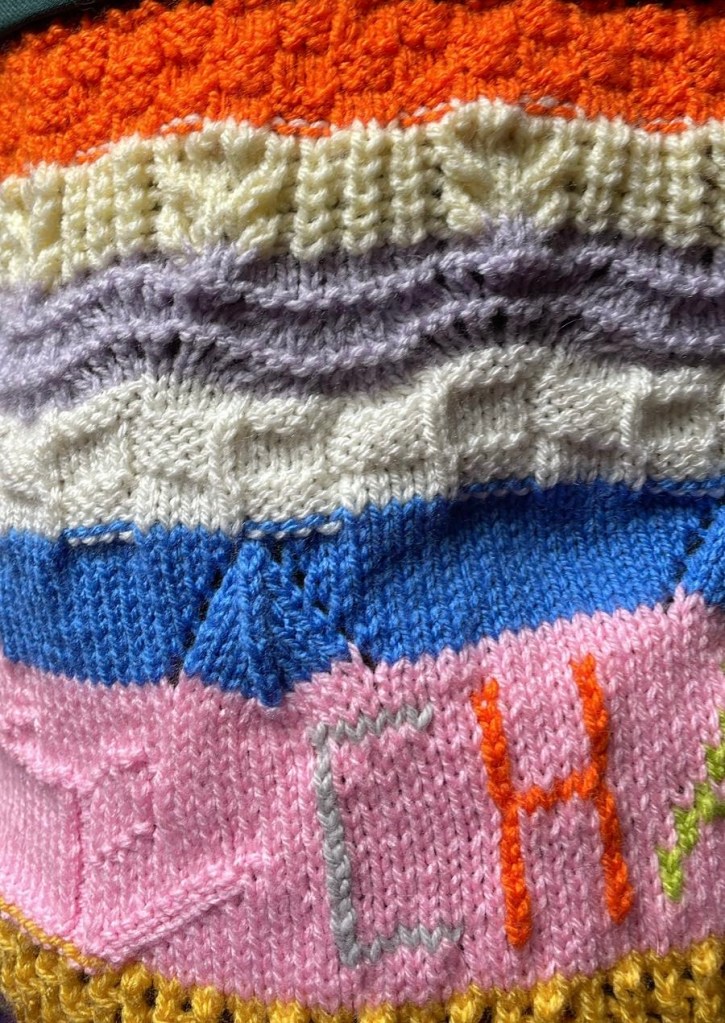
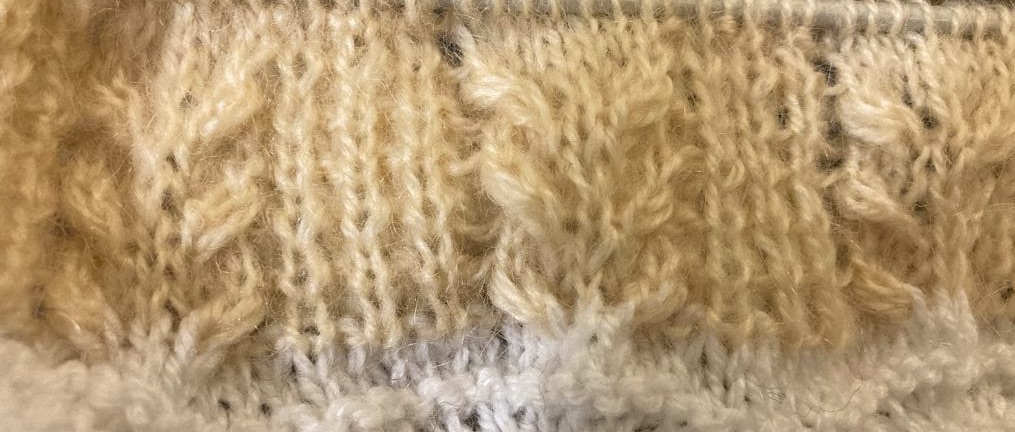
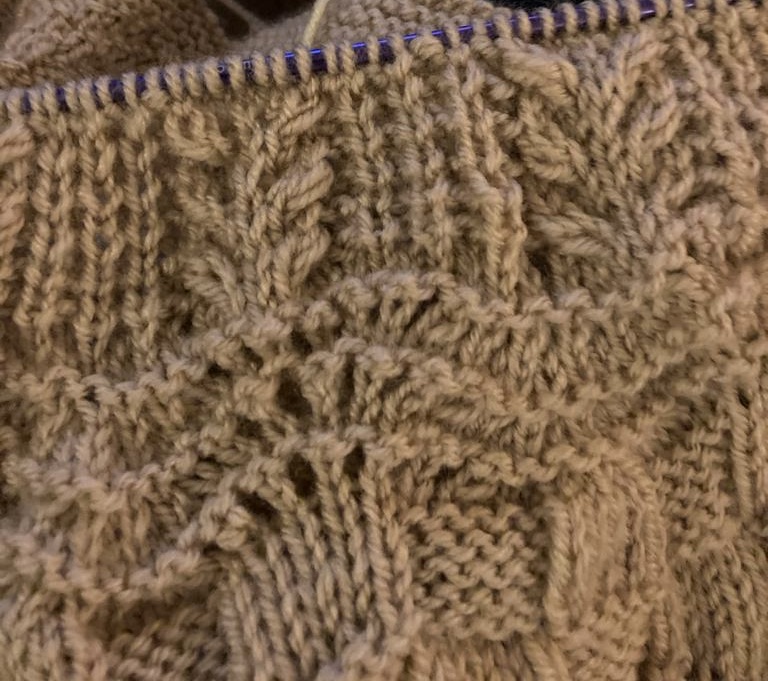
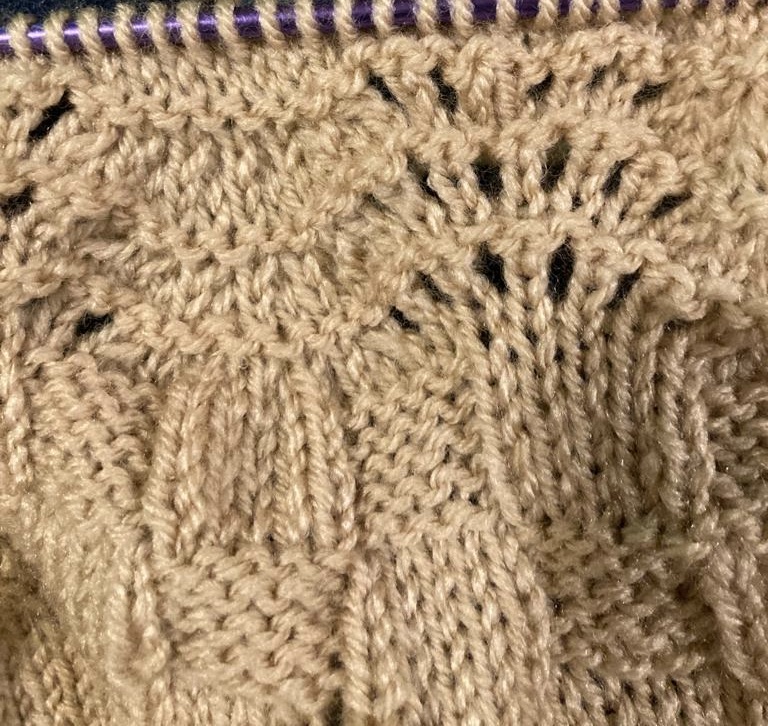
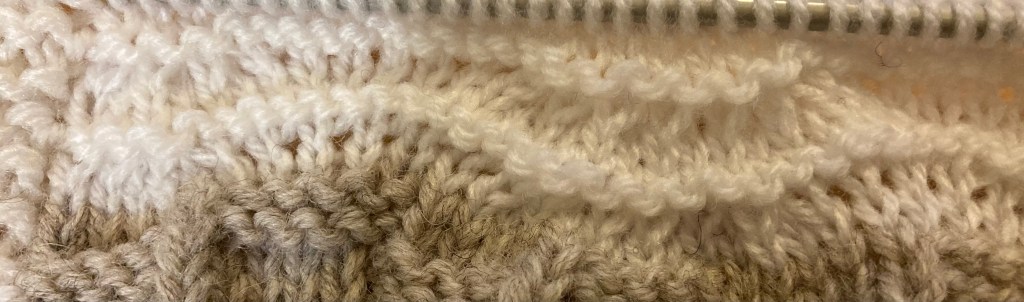
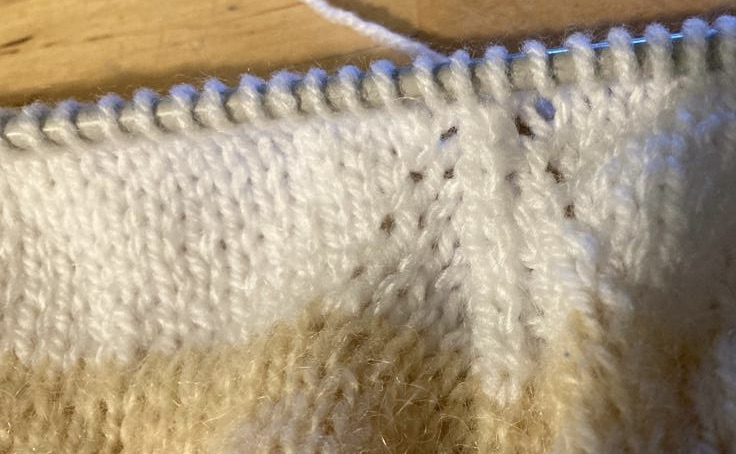
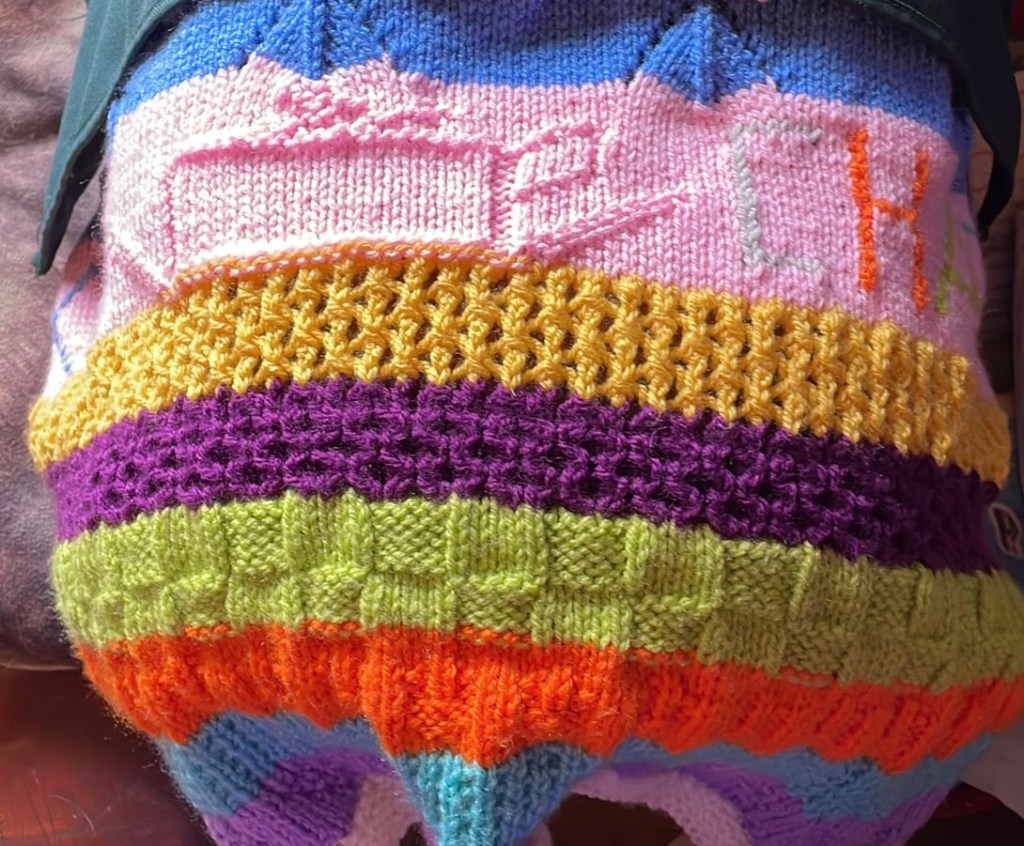
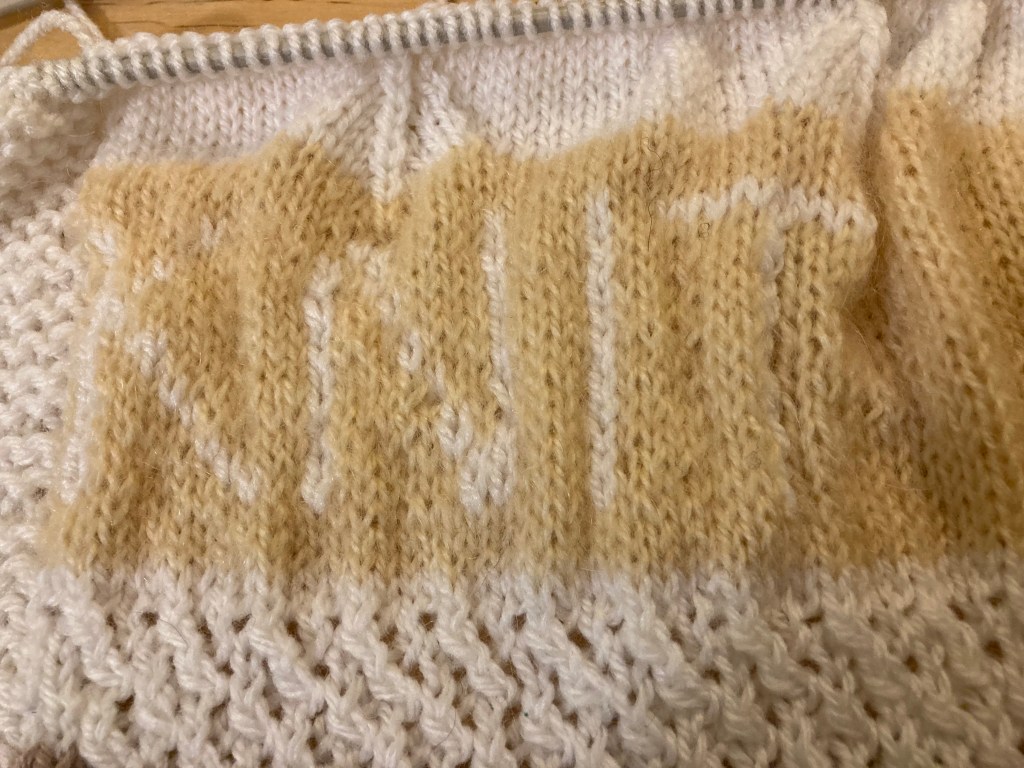
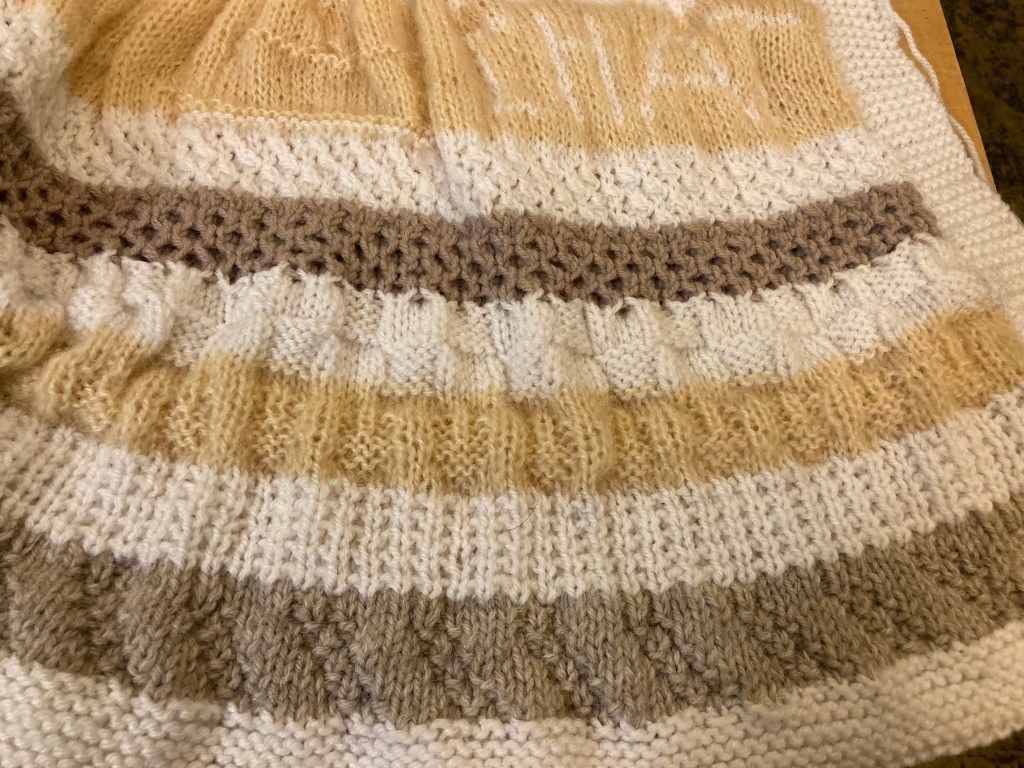
The final strip, before the garter stitch border looks rather like a diagonal rib.(see photo at top of post)

Yvonne writes,”I know you’ve all been waiting for the next instalment of our baby blanket and the final pattern which is pretty straightforward I think but we will see. So here we go…”

Week 15

Row 1. Remembering the edge sts, then K1, *K2tog but don’t slip the sts off and K into first st again and slip both off together, repeat to end of the row.
Row 2. And all wrong side rows P.
Row 3. K2tog, and K into first st again slipping both off together to last st K1.
Repeat rows 1 and 3 with P rows in between and then first two rows again until 10 rows have been completed.

When you have completed the pattern finish with your 10 rows of garter stitch to finish your blanket. Cast off, sew in ends and you’re all done.

Yvonne adds, “I have really enjoyed doing this blanket with you all and hope you have too and also learned something new along the way. Thanks guys for attempting to do this and I know it hasn’t been easy so well done to you all.”

I’d like to thank Yvonne on behalf of all of us for creating this project – we’ve all had a blast doing it and we love how they all turned out. It really took us out of comfort zones to try some challenging new stitches. Here are some of the results, from A, L and R respectively

It’s been very strange not to be knitting the blanket and comparing notes every week in our little knit and natter group.

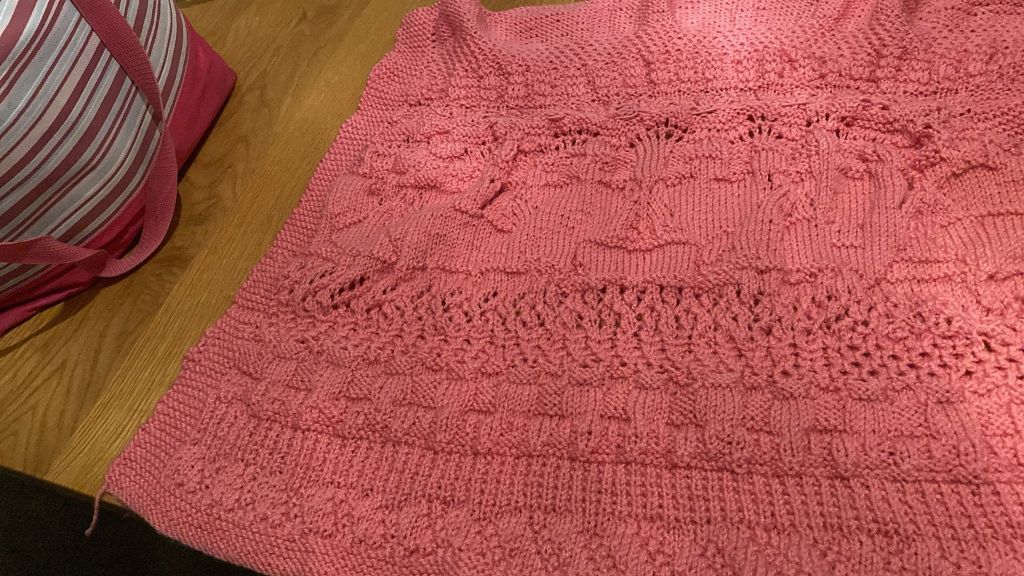
Here’s my finished blanket – I’m going to block it. A labour of love like this deserves the time it takes to finish it properly…and I got a blocking mat for Christmas!

Posted in Uncategorized

Knit-A-Long Baby Blanket: Week 14

Not long now and the blankets will be complete. it’s been fun watching them grow and trying out all the different patterns that Yvonne has sent us. Some have been more challenging than others and last week’s was no exception.

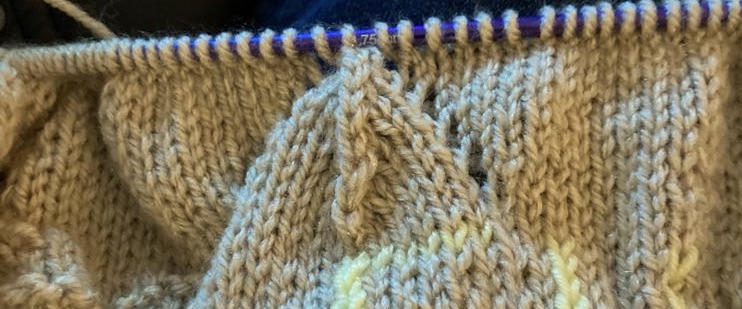
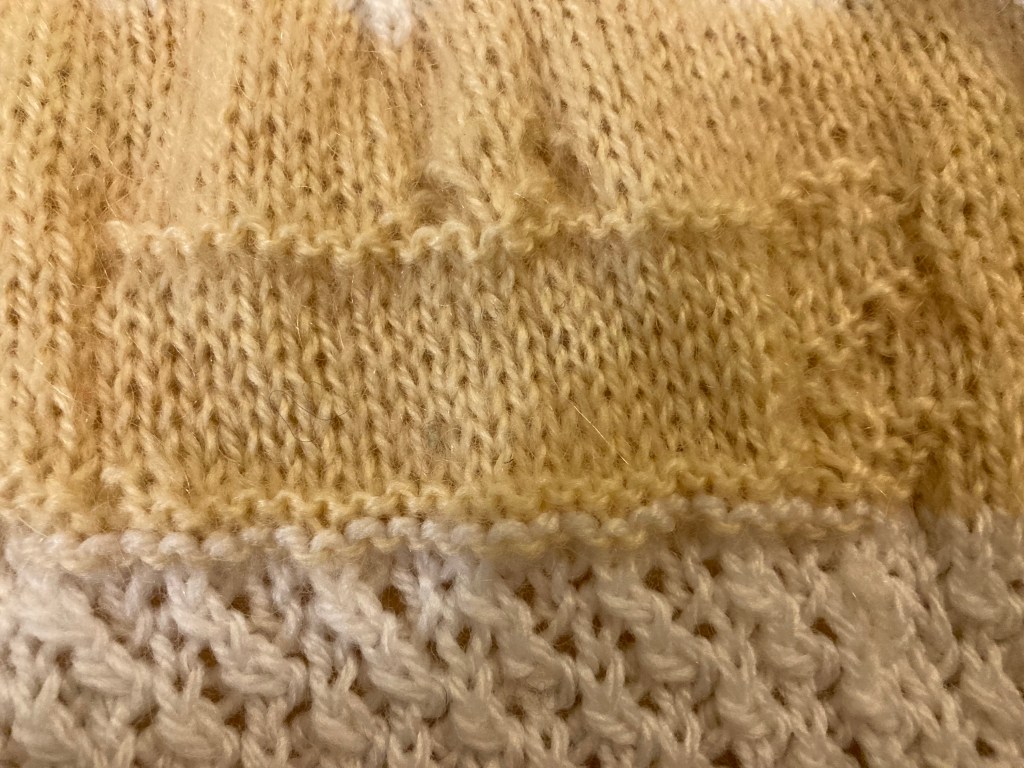
The pattern repeat was over 14 stitches (alternating panels of 7 stitches each, one of which used cable technique to make a gorgeous leaf design. Both panels had increases and decreases, so I used stitch markers between each group of 14 stitches to keep track of the pattern repeat. Here are some of our attempts at the Week 13 design. Once I got the hang of it I really enjoyed it and knitted a few more rows with a pale peachy yellow..

Avril’s fawn coloured blanket is looking great.

And now it’s time for the next one!

Yvonne writes,”Hi guys, I bet you’re all glad that unlucky 13 has been and gone so we will have an easy week this week. It’s a small basket weave so there should be no problems. 
So here we go.

Week 14

Row 1. K3, P3, repeat to last 5 sts K3,P2.
Row 2. K2, P3, (K3, P3,) to end.
Row 3. Repeat row 1.
Row 4. P2, K3, (P3, K3,) to end.
Row 5. P3, K3, repeat to last 5sts P3,K2.
Row 6. As row 4.
Row 7, 8, 9, as rows 1, 2, 3.
Row 10. As row 4.


Pretty easy so relax and enjoy and until next week. Happy knitting guys,

Yvonne

So that’s pretty straightforward as Yvonne says – a basketweave or checkerboard pattern of alternating plain and purl blocks of 3 stitches and 3 rows.

Not long to go now! Keep sending in the photos!

Posted in Uncategorized

Knit-A-Long Baby Blanket: Week 13

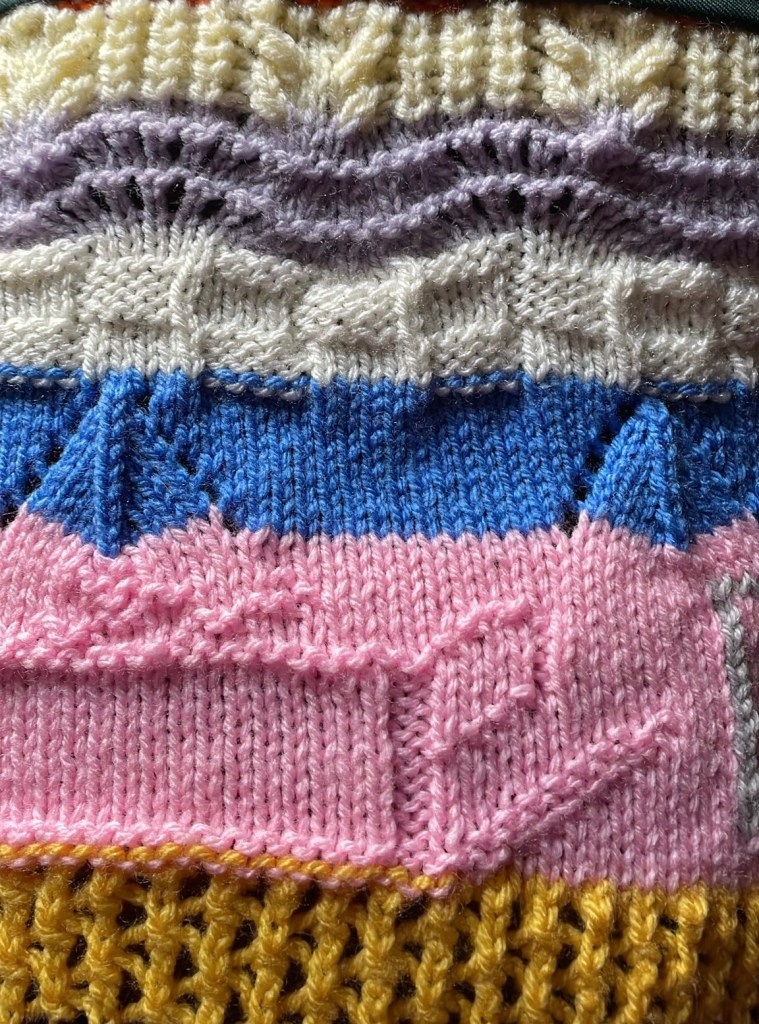
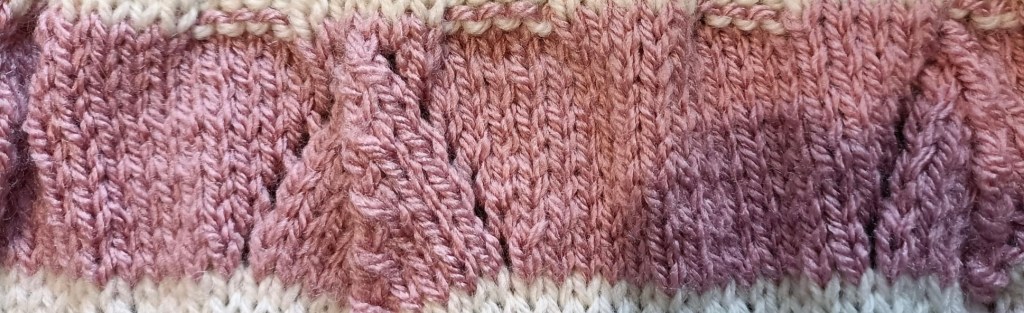
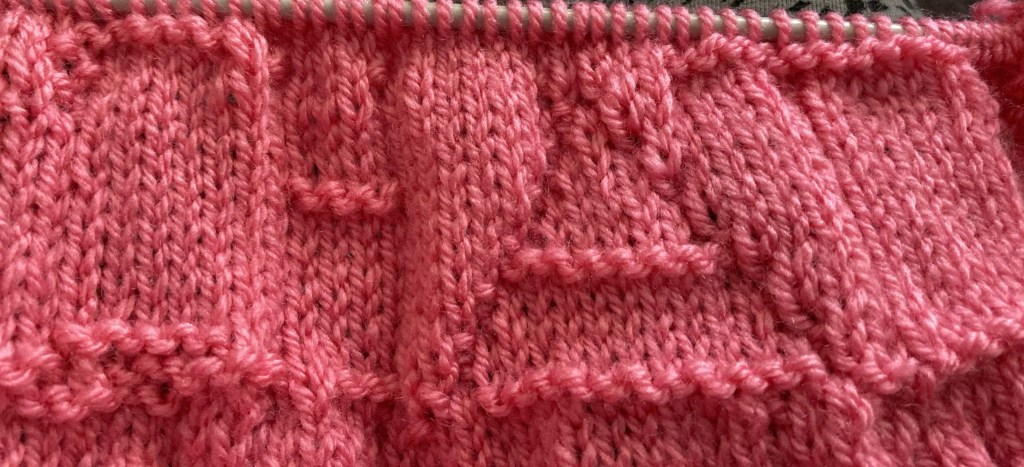
This week our KAL designer, Yvonne has given us a beautiful leaf design featuring cables, which you can see at the top of the picture above.

First of all lets look at how we got on with last week’s pattern (Yvonne chose a lavender shade for her prototype blanket

L’s was in pink

A loved hers so much she did extra rows

My colour scheme meant this section was in white on my version.

This week’s pattern looks quite complicated at first, but we’ve had a go and asked Yvonne lots of questions, so there are some extra hints which we hope will help.

Yvonne writes,”Hi guys I hope you all managed last week’s waves and may I suggest that the pattern is read carefully especially this week, as it’s a bit tricky again. I think it looks beautiful and is usually worked on larger scale and done like a basket weave pattern meaning the blocks are alternating but we are only doing 10 rows so no need to worry.”

“The pattern is sometimes called leaf stitch and consists of alternating panels of 7 stitches, one set of panels includes twists and in this version cable needles are used to achieve this. Within the four rows of the pattern each 7 stitch group increases then decreases back to 7.”

Week 13

Abbreviations for this week are:-
YO yarn over
SlP slip 1 st purlwise 
K3 tog  knit 3 together 
Tbl  through back of loop
K2tog knit 2 together 

Remember that you begin with a total 141 stitches (including the 8 stitch border at the edges) – so the pattern is worked over the 125 stitches between those garter stitch borders.

Row 1. K3, *(YO, S1P, K1) 3times, YO, S1P, K2, (K1,YO,K1  into next st, K1, (K1,YO,K1) into next st, K2). Repeat from* 8 times, then (YO, S1P, K1) 3 times, YO, S1P, K3.

Row 2. P3, (K2tog, P1) 3 times, K2tog, *P2, slip next 7 sts purlwise, carrying yarn across front (wrong side), P2, (K2tog, P1) 3 times, K2tog, repeat from* 8 times, to last 3 stitches, P3.  

Row 3. K3, *(YO, S1P, K1) 3 times, YO, S1P, Put next 2sts on cable needle leave at back of work K3 tog, K2 from cable needle, K1, put next 3 sts on cable needle leave at front of work, K2, K3tog tbl off cable needle, repeat from * 8 timesto last 10 stitches, (YO, S1P, K1)  3 times,YO, S1P,  K3.


Row 4. P3 , (K2tog, P1) 3 times, K2tog,  *P7, (K2tog, P1) 3 times, K2tog. Repeat from * 8 times to last  3csts P3.


These 4 rows form pattern so repeat 1-4 again.

 
Row 9. K3, *(YO, S1P, K1) rep 3 times YO, S1P, K7, rep from * 8 times, then (YO, S1P, K1) rep 3 times YO, S1P, to last 3 sts K3.


Row 10 as row 4.

That’s all there is to it 
Hope you manage this pattern ok so until next time happy knitting.
Yvonne

I’m enjoying this one very much. After a few issues with the last one I’m reading the pattern and counting very carefully

 A couple of hints that might help: – look out for the asterisks (*) and also, to keep track of the pattern, use stitch markers at * and after every 14 stitches than make up the pattern repeat

Meanwhile the blanket is growing!

Posted in Uncategorized

More Crochet Teaching On The Way

Last month I taught my first crochet workshop at Amble Pin Cushion. You can read more about it here. Initially I’d agreed to do this as a one-off and see how it went before I decided to do more. I ended up really enjoying the afternoon and the group taking part were absolutely lovely…..I’m now just about ready for my next workshops on Wednesday – this time I’m running one in the morning, and repeating it in the afternoon – there are still a few places left before the list closes tomorrow afternoon. You can watch the video I made about the course here

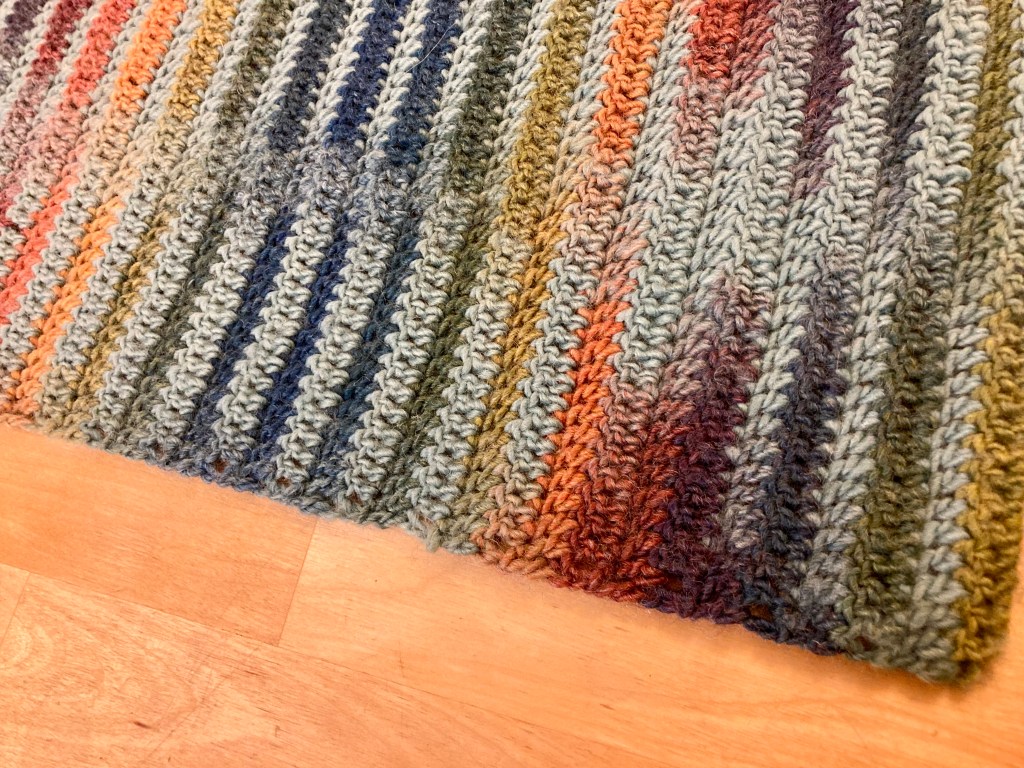
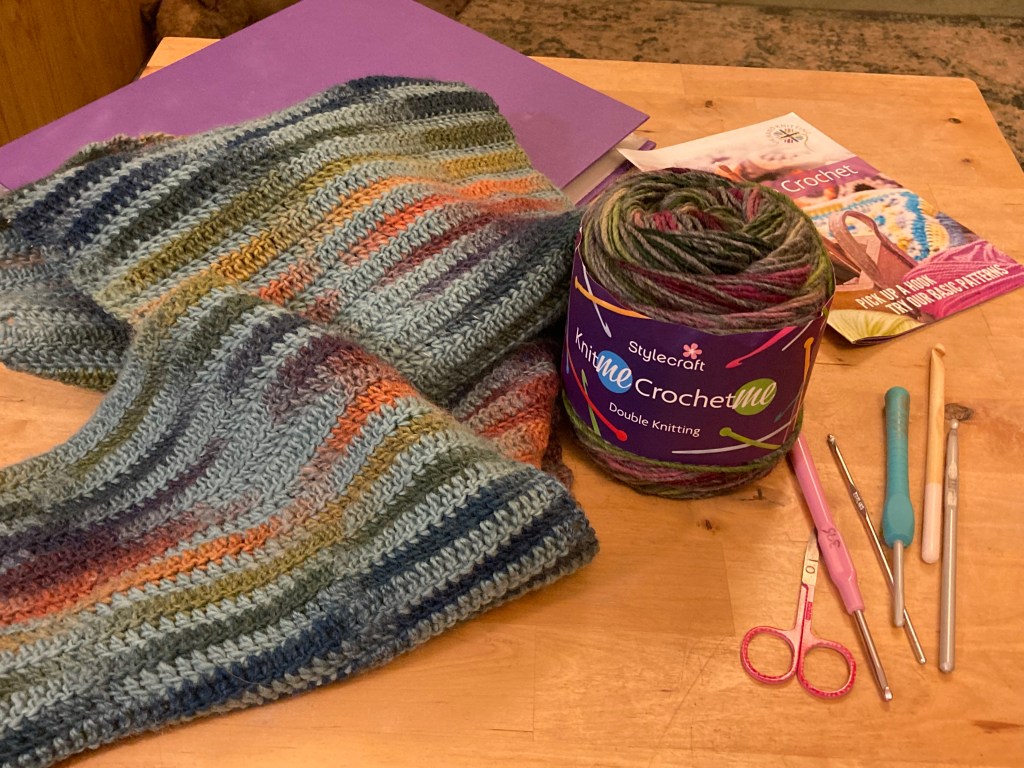
This time I’ll be teaching how to crochet either a scarf or a cowl, using a simple pattern of trebles. This course is suitable for beginners.

I chose this, crocheted in rows because I know this can be difficult when you first start with crochet, specifically where to place the first and last stitch of each row.

The treble stitch is great for quick-t0-crochet items: it grows quickly – it’s a great opportunity for beginners to perfect their treble stitches in this very simple pattern.

I strongly believe that simple doesn’t have to be dull, so I’m using a variegated yarn – the different colours in the yarn do all the work to make the design.

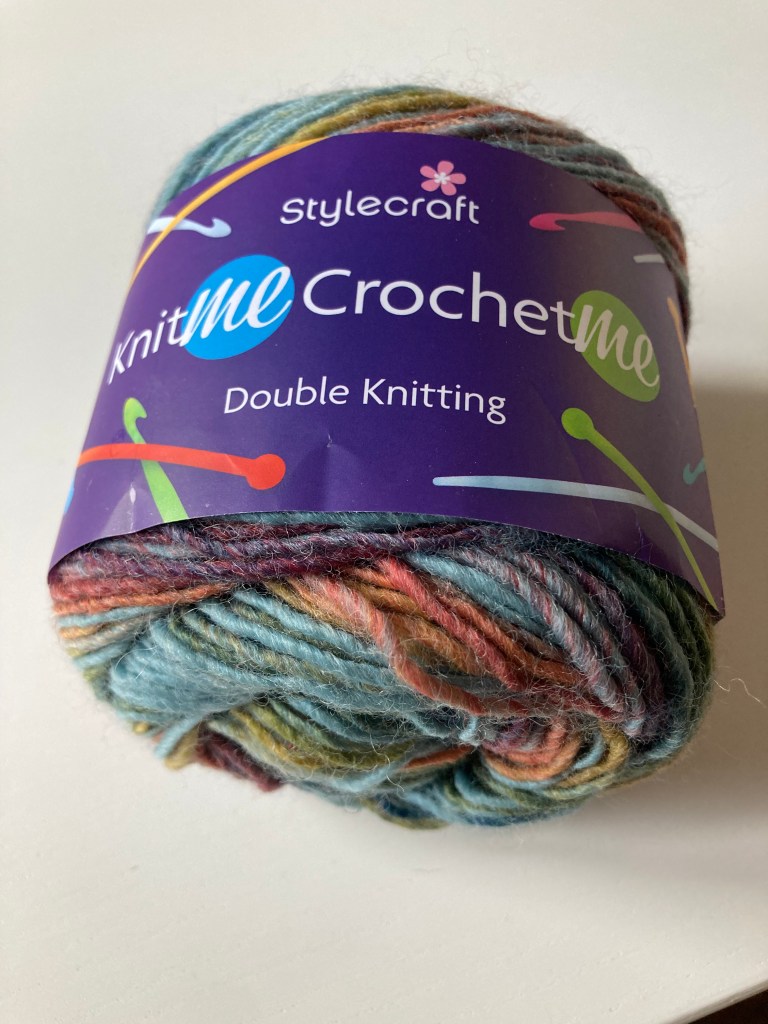
I used Stylecraft “Knit Me Crochet Me” in Nebula – a grey/blue main colour, alternating with lengths of rainbow colours. It’s an acrylic/wool blend double knitting yarn and feels very soft, without being too fluffy. Of course there are loads of different variegated yarns on the market and most would make great scarves (maybe not the harsher wools, which could be a bit scratchy to wear round your neck!). All will give a completely different result however, even using the same basic pattern of treble stitches, depending on the size of the colour repeats.

I like to give my students some handy hints to help them up their crochet game – this time I’m going to include the mysteries of the ball band – decoding the information on the back like dye lots, gauge and yardage, so there’ll be plenty to talk about as well as the practical crochet tuition.

With just a few more info packs to print out, I’m almost ready to go!

Posted in Uncategorized

Knit-a-Long Baby Blanket: Week 12

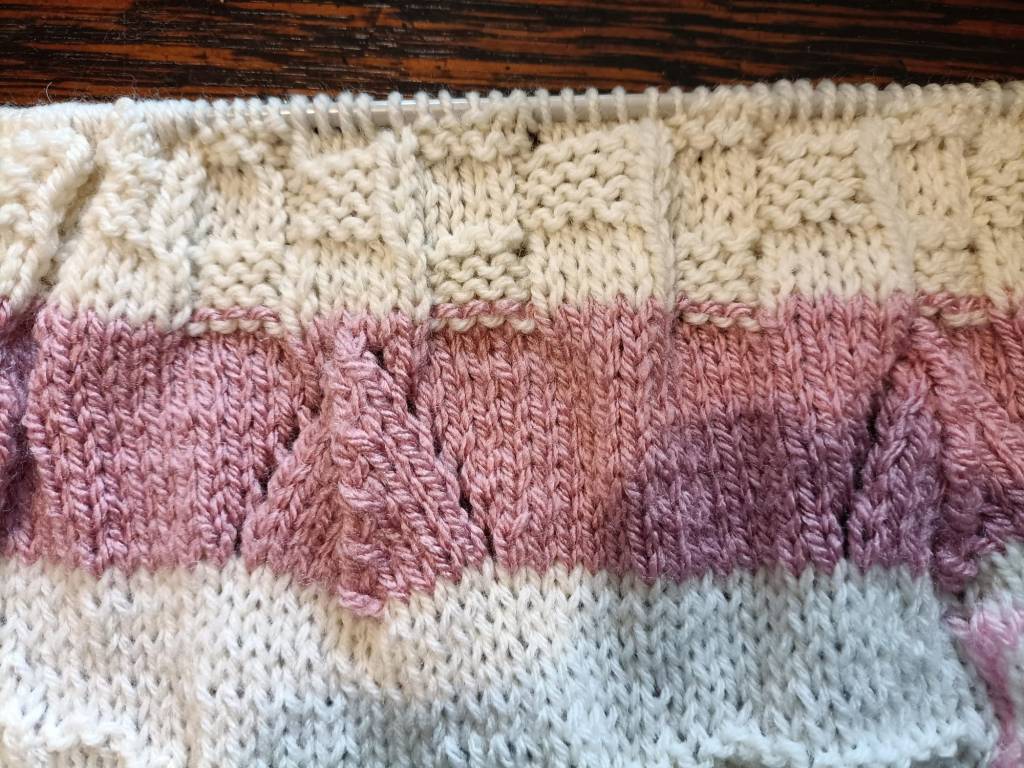
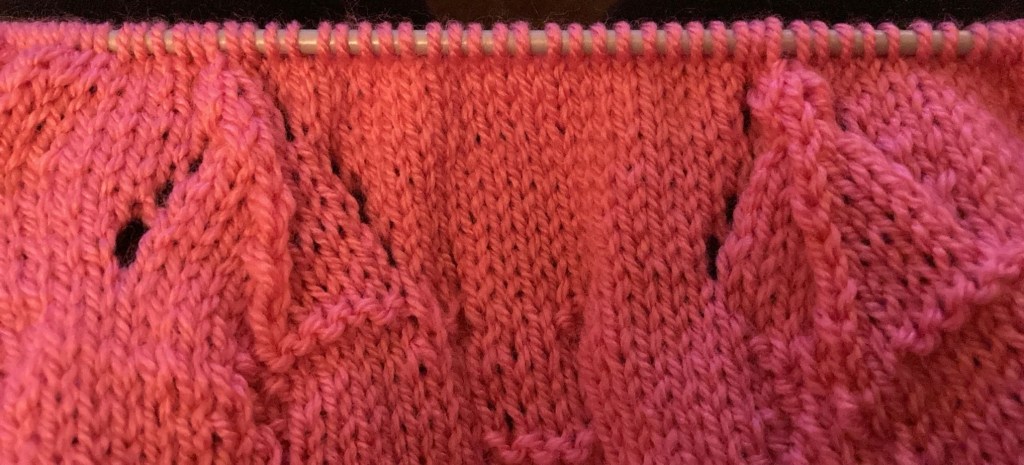
Before we look at the pattern Yvonne has set us for this week let’s look at how a couple of the blankets are getting on. This is R’s lovely shades of pink blanket -she added a cream accent this week.

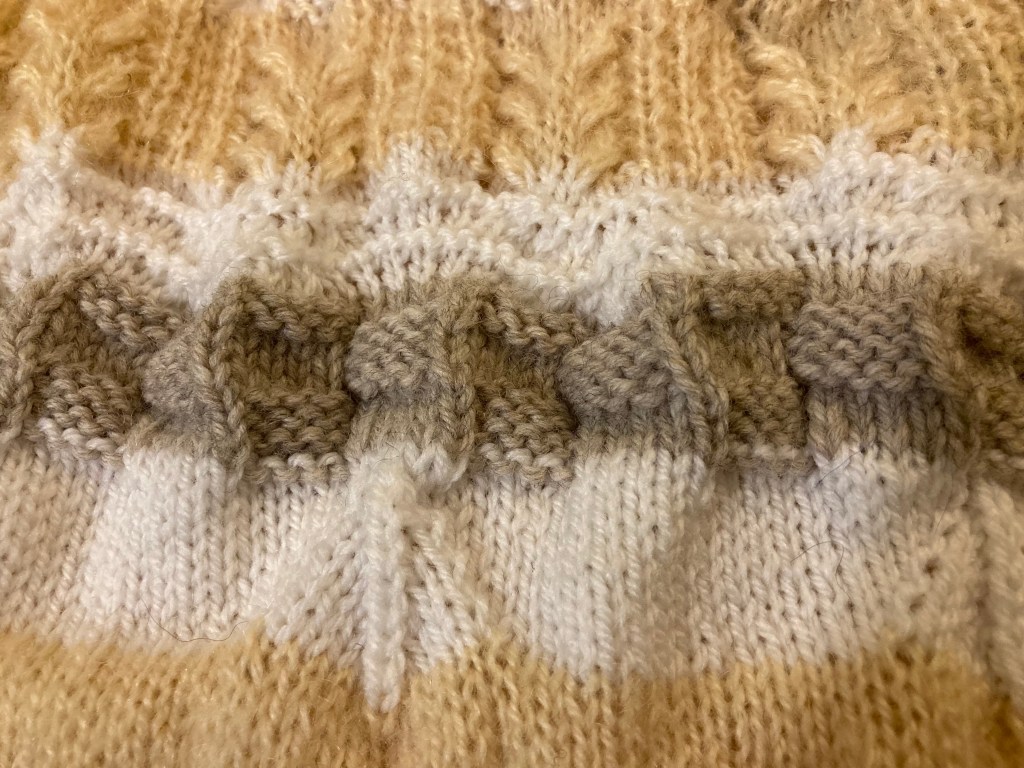
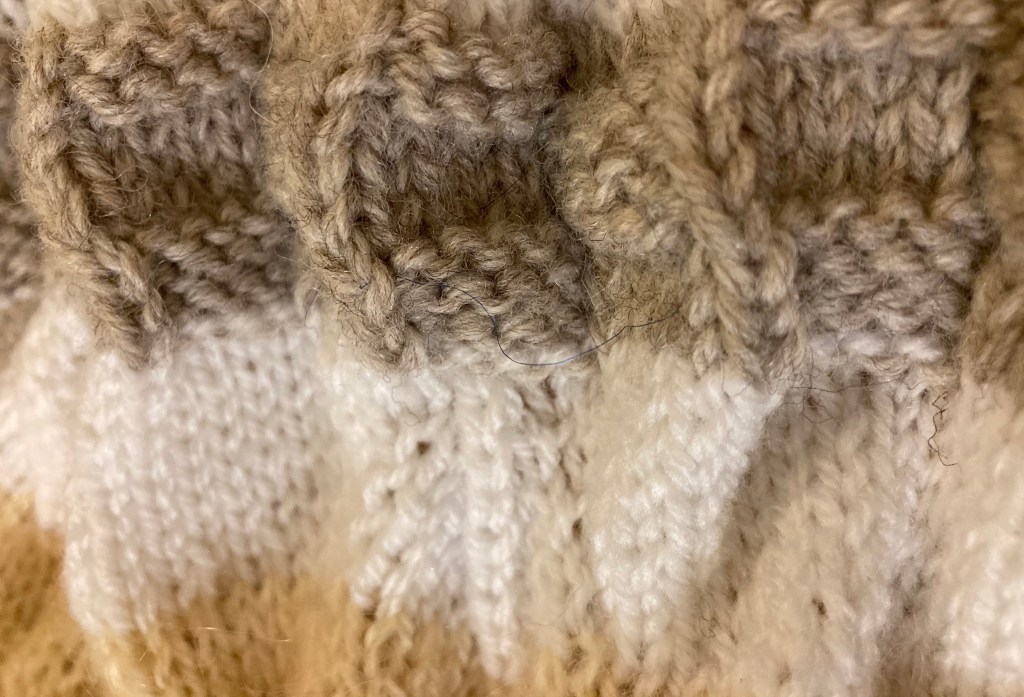
…and my blanket, which used fawn yarn for this one, here in close up

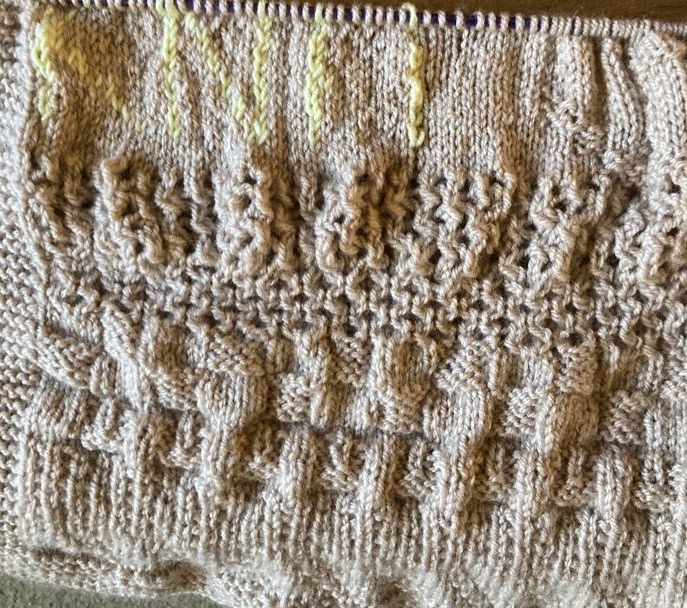
Yvonne had explained how this one, if knitted over a bigger area forms pleats like an accordion. You can see this just starting, even over the 10 rows we knitted,

And now for this week.

Yvonne writes, “Hi guys. Hope you’re all well and enjoying this beautiful blanket.”

” This week is another lacy one but it also resembles waves and I expect with the weather we have had these will be less choppy haha! – Not too difficult I hope. We have had the abbreviations before which are 
YO = yarn over the needle
K2tog = knit 2 together 

Here we go.”

Week 12

Row 1. K
Row 2. P
Row 3. *(k2tog) 3 times, (YO, k1) 6 times (k2tog) 3 times. Repeat from * to end
Row 4. K
Repeat rows 1-4 again then 1 & 2

That’s all there is to it and please remember your garter st border at each end.

Until next week, happy knitting.
Yvonne x

I’ve had a go and it helped to remember that over the course of the pattern you need to work equal numbers of k2 tog, (which decreases a stitch) and YO k1, which increases a stitch, I love these waves!

Keep sending in those photos!

Posted in Uncategorized

Knit-a-Long Baby Blanket: Week 11

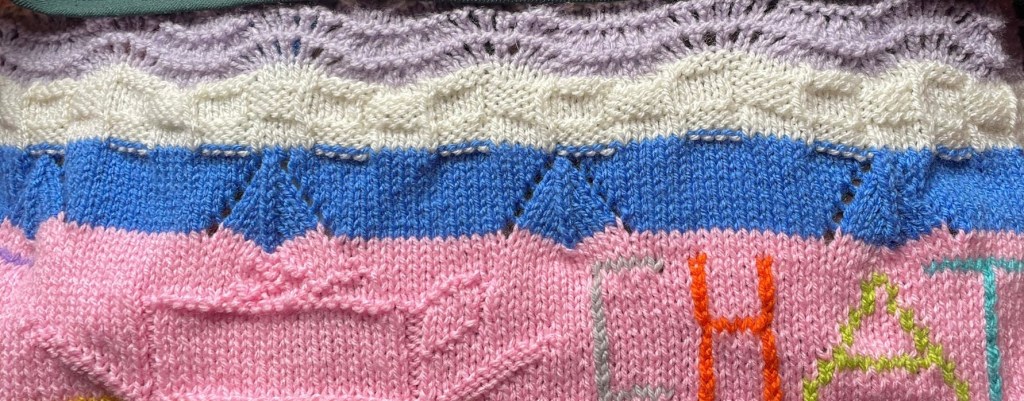
Before the next set of KAL instructions, here’s a round up of our efforts with the Week 10 arrowheads pattern. Yvonne’s prototype version is in blue below.
Next, we have L’s salmon pink….

…A’s fawn…

R’s pink….

…and a close up of my white stripe.

We were all relieved that this pattern was easier than the intarsia in the previous double pattern and pleased it turned out so well – it’s a really effective design.

This week, blanket designer, Yvonne, writes, “Well guys, it’s that time again, ready for the next part. Again, it’s all about the counting but setting up the pattern is easy enough. Just take care from row 5. There are no special abbreviations, nitting,just k and p.

So eyes down and here we go.

Week 11

Row 1. Remember your edges and then k5, p5, to end of row.
Row 2. P5, k5, to end of row.
Row 3 & 4 rep rows 1 & 2.
Row 5. K1, p5, k5, end with p4.
Row 6. K4, p5, k5, to last st p1.
Row 7 & 8 rep rows 5 & 6.
Row 9 & 10 rep rows 1 & 2.

This pattern, if done on a bigger scale, looks like a concertina but unfortunately 10 rows just starts it off.

Have fun and see you all next week.

Happy knitting 
Yvonne

Some of us have already completed this pattern, and R is first to send a photo of hers. It looks great!

How are you getting on with your blanket? Keep sending the photos.

Posted in Uncategorized

Knit-a-Long Baby Blanket: Week 10

After last week’s double helping of knitting pattern I did suggest that Yvonne had a week off so we could all catch up. She’s happy to carry on, so you’ll find her next pattern later on in this post.

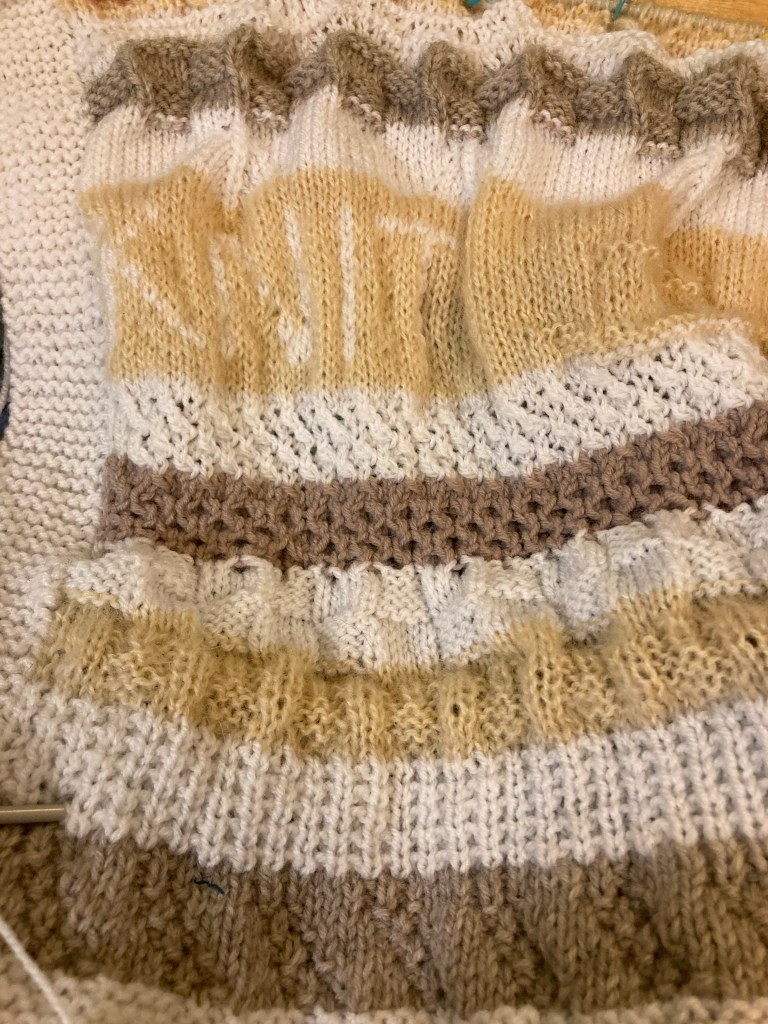
It’s been quite challenging to do the week 8-9 section. How did you find it? I think it was the combination of intarsia for the words KNIT and CHAT combined with a the central cup and saucer design in plain/purl that stumped us. There are a few things you might want to try that may help. You could use stitch markers to show the position of the 3 sections (KNIT, teacup and CHAT). I find it easier to work from a chart so I tried transferring the teacup design to graph paper – it didn’t look quite the same as Yvonne’s (my saucer is shallower) but I got through it.

Also, if you are getting in a tangle with separate balls of wool for the intarsia colour work you could use one yarn and use plain/purl to work all the designs. Here’s how some of the blankets are looking after the jumbo weeks 8-9 section.

L worked hers in one colour using plain/purl for the words.

R’s pink and white showed up well.

A’s and mine are in pastels so the colour contrast is more subtle.

And now for the next instalment. Yvonne writes, “Here we go – it’s that time of week again when you are all waiting for the next pattern. This one is a bit easier. Initting,t’s called vertical arrow panel and is a bit lacy.

Week 10

Abbreviations are:

Yf yarn forward or round needle 
Sl 2tog slip 2 stitches together off one needle to the other
P2sso pass the 2 slip stitches over

Remember 8 border sts at each end.
Row 1. K9, (Yf, k4, Sl 2tog, k1, p2sso, k4, Yf, k13), rep 4 times then Yf, k4, Sl 2tog, k1, p2sso, k4, Yf, k9
Row 2. And all even rows p.
Row 3. K10, (Yf, k3, Sl 2tog, k1, p2sso, k3, Yf, k15), rep 4 times then Yf, k3, Sl 2tog, k1, p2sso, k3, Yf, k10.
Row 5. K11, (Yf, k2, Sl 2tog, k1, p2sso, k2, Yf, k17), rep 4 times then Yf, k2, Sl 2tog, k1, p2sso, k2, Yf, k11.
Row 7. K12, (Yf, k1, Sl 2tog, k1, p2sso, k1, Yf, k19), rep 4 times then Yf, k1, Sl 2tog, k1, p2sso, k1, Yf, k12.
Row 9. K13, (Yf, Sl 2tog, k1, p2sso, Yf, k21) rep 4 times then Yf, sl 2tog, k1, p2sso, k13.
Row 10. P


That’s all there is to it. Happy knitting guys and until next week have fun.
Yvonne 

Isn’t Yvonne doing a great job designing this?